
R. S. DaBell coauthored validation of Fourier-transform microwave spectroscopy for trace gases. Comparisons of carrier conditions and a blind mixture test how reliably spectral measurements recover prepared concentrations.
The experiment distinguishes molecular identification from quantitative calibration: detecting a characteristic line does not by itself establish its concentration.[ref]
The Validation of Fourier-Transform Microwave Spectroscopy for Trace-Gas Analysis. Printed pages 25–27, Figures 2–3 and 6, Table II
Pamela M. Chu coauthored validation of Fourier-transform microwave spectroscopy for trace-gas analysis. The study compares an instrument response with known and blind gas mixtures.
A resolved rotational line can identify a molecule, but quantifying its abundance also requires a calibration model. Nozzle expansion and carrier-gas conditions can alter the relation between the prepared mixture and the measured signal.[ref]
The Validation of Fourier-Transform Microwave Spectroscopy for Trace-Gas Analysis. Printed pages 25–27: apparatus, calibration and blind mixture
Identity source: www.nist.gov/people/pamela-m-chu
Andrei Tokmakoff developed teaching treatments of molecular absorption lineshapes and rotational optical responses. His authored notes connect population differences and transition matrix elements with an experimentally observed spectrum.
A transition's energy determines where a line can occur, while its dipole or polarizability matrix element helps determine whether the line is observable. This separates the existence of energy levels from the strength of a spectroscopic signal.[ref]
Absorption lineshapes by Andrei Tokmakoff. Sections 6.1–6.2, population factors and optical matrix elements
Identity source: chemistry.uchicago.edu/faculty/andrei-tokmakoff

Portrait of Andrei Tokmakoff
. Photograph identified on the University of Chicago Department of Chemistry profile.William E. Moerner coauthored optical detection and spectroscopy of individual molecules in a solid. Resolving a single emitter separates its response from the average over many molecular environments.
The experiment connects spectral selectivity and optical sensitivity with molecular-level observation. A measured ensemble line can hide distinctions that become visible when individual molecules are observed.[ref]
Optical detection and spectroscopy of single molecules in a solid by W. E. Moerner and L. Kador. Primary single-molecule optical detection paper

Portrait of William E. Moerner
. Christopher P. Michel (Cmichel67), own photograph, 18 July 2024. Creative Commons Attribution-Share Alike 4.0 International., via Wikimedia Commons. Source.
Delmar S. Larsen authored or curated a physical-chemistry treatment of harmonic vibrations and infrared spectroscopy. Its dipole-change criterion explains why a vibrational mode can exist without producing an ordinary infrared absorption line.
Anharmonic corrections also permit overtones absent from the simplest harmonic, linear-dipole selection rule. These distinctions connect a model's assumptions with the features actually seen in a spectrum.[ref]
14: Harmonic Oscillators and IR Spectroscopy, UCD Chem 110A by Delmar S. Larsen. Lecture 14: infrared activity and overtone discussion
Tim Harrison co-prepared demonstrations that link visible chemical changes with equations and controls. In the zinc–copper-sulfate demonstration, a comparison with zinc sulfate helps test the interpretation of metal displacement.
The display is useful scientifically because the control and material balance connect an appearance change with a specific chemical transformation.[ref]
Chemical Demonstrations Booklet by Magdalena Wajrak and Tim Harrison. Demonstration 16, equipment, observations, and comparison
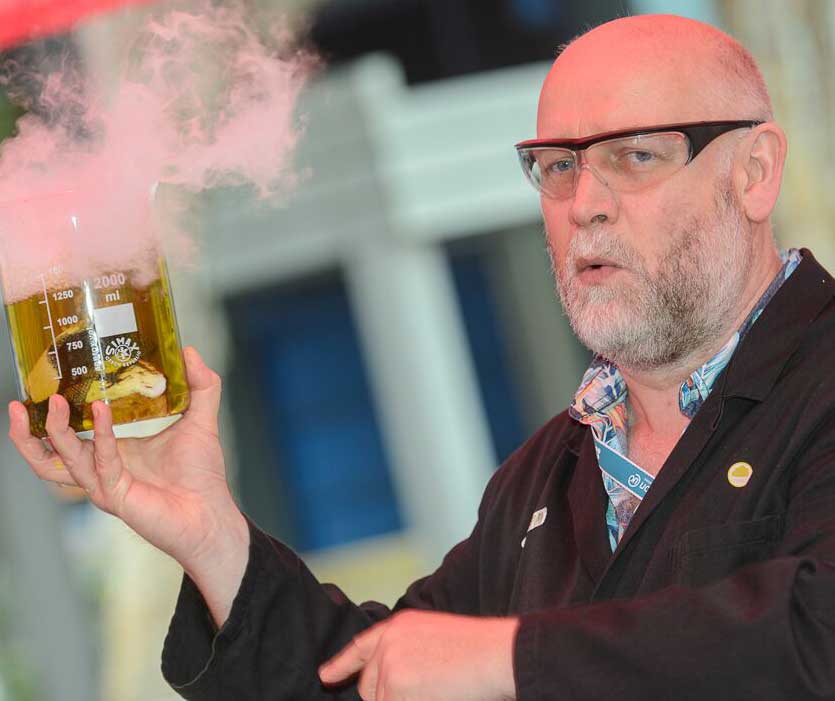
Magdalena Wajrak co-prepared chemical demonstrations connecting visible observations with balanced reaction chemistry. A zinc–copper-sulfate comparison distinguishes a reacting metal-salt pair from a zinc-sulfate control.
The control helps assign the colour and deposit changes to the proposed redox transformation. An observation becomes more informative when a comparison excludes a simpler explanation.[ref]
Chemical Demonstrations Booklet by Magdalena Wajrak and Tim Harrison. Demonstration 16, pages 32–33
Her institutional profile identifies her as a chemist whose research areas include electrochemistry and theoretical chemistry.
A chemist specializing in physical chemistry and precision thermometers.[ref]
https://cen.acs.org/articles/84/i20/Obituaries.html. Obituaries, 15 May 2006, George T. Furukawa entry: physical chemistry and precision thermometer calibration
His initials G. T. Furukawa appear on the 1997 study of triple-point cells.[ref]https://www.nist.gov/publications/effects-different-methods-preparation-ice-mantles-triple-point-water-cells-temporal. NIST publication record, Author(s): G T. Furukawa; Metrologia 34 (1997)
Researcher in seed physiology. With William E. Finch-Savage, Leubner-Metzger analyzed regulation of seed dormancy and germination, distinguishing a viable seed’s capacity to grow from its immediate response to favorable conditions.[ref]
Seed dormancy and the control of germination by William E. Finch-Savage and Gerhard Leubner-Metzger. Title, author list and reported study
Researcher in seed physiology. With Gerhard Leubner-Metzger, Finch-Savage analyzed seed dormancy and germination control, connecting environmental sensing with the physiological state that permits or prevents growth.[ref]
Seed dormancy and the control of germination by William E. Finch-Savage and Gerhard Leubner-Metzger. Title, author list and reported study
Researcher in seed physiology. Toole coauthored experiments on reversible light control of germination, making the timing of a developmental transition experimentally responsive to environmental signals.[ref]
A Reversible Photoreaction Controlling Seed Germination by Harry Alfred Borthwick and others. Title, author list and reported study
Researcher in seed physiology. Toole coauthored experiments on reversible photochemical control of germination, helping connect environmental light with the decision to initiate growth.[ref]
A Reversible Photoreaction Controlling Seed Germination by Harry Alfred Borthwick and others. Title, author list and reported study
Plant physiologist and coauthor of research on reversible light control of germination. The study connected light exposure with a physiological response that could be switched by a subsequent treatment.[ref]
A Reversible Photoreaction Controlling Seed Germination by Harry Alfred Borthwick and others. Title, author list and reported study
Plant physiologist who coauthored experiments on reversible light control of germination. Alternating light treatments made the physiological response reversible, connecting a plant developmental decision with a photochemical switch.[ref]
A Reversible Photoreaction Controlling Seed Germination by Harry Alfred Borthwick and others. Title, author list and reported study
Researcher in cell division. Sluder coauthored experiments showing how unattached kinetochores generate a signal delaying anaphase, connecting individual-chromosome status with cell-wide checkpoint control.[ref]
Researcher in mitosis. Khodjakov coauthored work on the inhibitory signal from unattached kinetochores, using cellular observations to connect chromosome attachment with control of anaphase.[ref]
Researcher in microscopy and mitosis. Cole coauthored experiments on signaling by unattached kinetochores, connecting observations of chromosome behavior with a mechanism that prevents premature anaphase.[ref]

Portrait of Richard W. Cole
. Portrait linked on the QUAREP profile of Richard Cole, which identifies his Wadsworth Center microscopy appointments.Researcher in mitosis. Rieder and collaborators investigated the inhibitory signal produced by unattached kinetochores, connecting chromosome attachment status with the checkpoint that delays anaphase.[ref]
Geneticist and coauthor of the study identifying the mouse Clock gene through mutagenesis and mapping. The work connected an experimentally altered behavioral rhythm with a specific genetic locus.[ref]
There are unlisted articles, also show them or only show them.