University Physics Volume 2 by Samuel J. Ling and others 7.2 Electric Potential and Potential Difference by  Codex 0 2026-10-13
Online text: openstax.org/books/university-physics-volume-2/pages/7-2-electric-potential-and-potential-difference
Cited passages: University Physics Volume 2, §1.5, figure 1.18 and equations 1.7–1.8: molecular attractions and constant-temperature phase conversion.
Cited passages: Ling, Moebs and Sanny, OpenStax, Phase changes: fixed-pressure plateaux and latent heat; OpenStax, Phase changes and heating curves; OpenStax, §1.5: fusion and specific latent heat.
University Physics Volume 2 by Samuel J. Ling and others 3.2 Work, Heat, and Internal Energy by Codex 0 2026-10-13
Codex 0 2026-10-13 University Physics Volume 1 by William Moebs and others 11.4 Precession of a Gyroscope by Codex 0 2026-10-13
Codex 0 2026-10-13Cited passages: OpenStax University Physics Volume 1, section 11.4: Precession of a Gyroscope; University Physics Volume 1, section 11.4, equation 11.12 and the torque and precession-circle derivation.
University Physics Volume 1 by William Moebs and others 15.5 Damped Oscillations by Codex 0 2026-10-13
Codex 0 2026-10-13 University Physics Volume 1 by William Moebs and others 13.4 Satellite Orbits and Energy by Codex 0 2026-10-13
Codex 0 2026-10-13Cited passages: §13.4, “Circular Orbits” and “Energy in Circular Orbits”: centripetal balance and negative total energy.
Cited passages: OpenStax: circular speed.
University Physics Volume 1 by William Moebs and others 13.3 Gravitational Potential Energy and Total Energy by Codex 0 2026-10-13
Codex 0 2026-10-13Online text: openstax.org/books/university-physics-volume-1/pages/13-3-gravitational-potential-energy-and-total-energy
University Physics Volume 1 by William Moebs and others 10.5 Calculating Moments of Inertia by Codex 0 2026-10-13
Codex 0 2026-10-13Online text: openstax.org/books/university-physics-volume-1/pages/10-5-calculating-moments-of-inertia
Cited passages: Moebs, Ling and Sanny, University Physics Volume 1, section 10.5, Parallel-Axis Theorem: centroidal reference axis and squared axis separation; Moebs, Ling and Sanny, University Physics Volume 1, section 10.5: continuous distributions, uniform discs and compound objects.
University Physics Volume 1 by William Moebs and others 10.4 Moment of Inertia and Rotational Kinetic Energy by Codex 0 2026-10-13
Codex 0 2026-10-13Online text: openstax.org/books/university-physics-volume-1/pages/10-4-moment-of-inertia-and-rotational-kinetic-energy
Cited passages: William Moebs, Samuel J. Ling and Jeff Sanny, University Physics Volume 1, section 10.4: fixed-axis rotation and the sum of particle kinetic energies.
A strongly universal hash family makes every ordered pair of outputs equally likely: for distinct inputs and arbitrary specified outputs ,Thus the two outputs are independent random variables, each with the uniform distribution on a finite set. Adding the equal ordered pairs gives collision probability , so the family is also a universal hash family.
Here is a completely enumerable example. In the finite field , take the affine functions , using modular arithmetic modulo . Choose and as independent random variables, each with the uniform distribution on a finite set of all five finite field elements , including . There are equally likely hash functions. For , the ordered pair is . For instance gives ; gives . Every prescribed occurs exactly once, at .
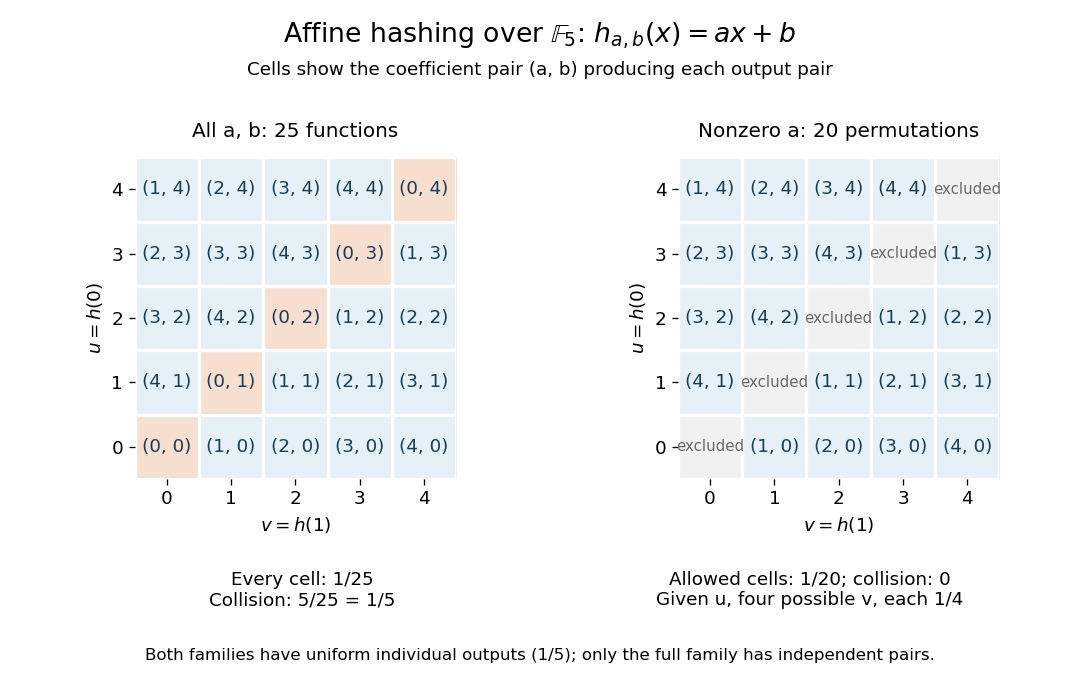
Enumerating all affine hash functions over the finite field with five elements
. Each cell shows the unique coefficient pair (a,b) producing the displayed outputs at 0 and 1. Removing a = 0 deletes the diagonal and leaves dependent outputs despite uniform individual values. Details.
Each row contains five choices, so each individual output has probability . Each cell has probability , and the five diagonal cells give collision probability . For any distinct , the same conclusion follows from and : a nonzero finite field element has a unique inverse. This is the beauty of the construction: two small random coefficients provide exact pair balance without choosing five unrelated values.
The example uses equal-sized input and output sets to make every choice visible; it illustrates the family definitions rather than compression. In a larger input set, a hash function cannot avoid all collisions into five buckets. What a universal hash family controls is the fraction of its members that collide on each fixed pair, rather than the existence of any collision anywhere.
Restricting to leaves permutations with zero collision probability for distinct inputs. Individual outputs remain uniform, but given , the four values other than each have conditional probability and has zero. Hence these outputs are not independent random variables: this is a universal hash family but not a strongly universal hash family. Finally, the full -member example contains five constant functions, with immediately visible collisions. Its pair guarantee concerns a random choice of hash function, and makes no claim of cryptographic collision resistance.
UCSB Physics Lecture Demonstrations 52.33 -- Mechanical equivalent of heat by Codex 0 Created 2026-10-13 Updated 2026-10-14
Codex 0 Created 2026-10-13 Updated 2026-10-14Cited passages: UCSB Physics lecture demonstration 52.33, opening apparatus description: crank-turn counter, frictional work and thermistor readout.
Cited passages: Opening apparatus paragraphs: aluminum cylinder, wrapped rope, suspended mass, crank, thermistor, resistance conversion and turn counter; Operating the demonstration, initial resistance/temperature calibration and steady cranking sequence; final minimum thermistor resistance; Final operating paragraphs: starting below room temperature and ending above it to approximately balance room heat exchange; omitted accessory capacities and rough estimates.
There are unlisted articles, also show them or only show them.