Rules controlling access to computer memory. In paging, page table entries and the memory management unit enforce permissions; copy-on-write temporarily denies writes to logically writable private memory pages so a write enters copy-on-write fault handling.
The hardware that performs address translation and access checks. Whether a TLB miss is resolved entirely by hardware or with operating system assistance depends on the architecture.
For paging, the memory management unit uses the active address space and the kind of access: reading, writing, or fetching an instruction. Processor privilege level can also affect permission. A TLB hit supplies cached translation attributes; it does not bypass memory protection. On a TLB miss, some architectures perform a hardware page table walk, while others enter an operating system refill handler. Both can resolve a resident mapping without a nonresident page fault.[ref]
Paging: Faster Translations (TLBs). Operating Systems: Three Easy Pieces, chapter 19, Paging: Faster Translations (TLBs), sections 19.1, 19.3–19.4, printed pp. 2, 6, 8: permission checks, refill ownership, and cached attributes
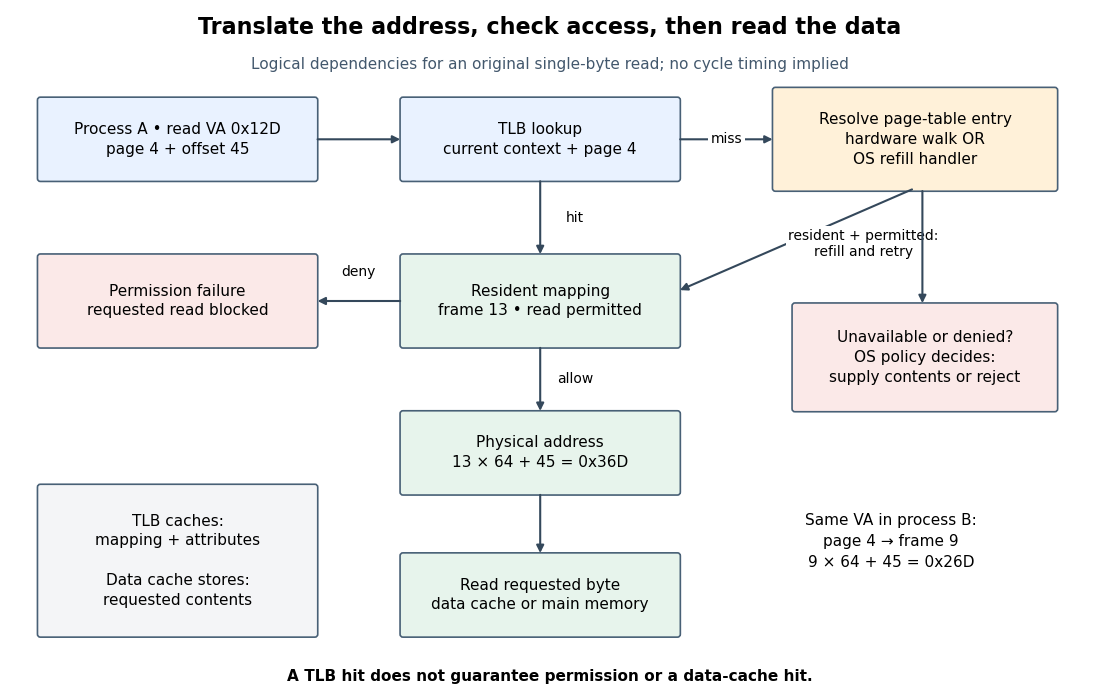
Logical address translation control path: a cached mapping, refill, permission check, and separate data read
. Details. 
This diagram is a logical dependency model for the toy single-byte read, rather than a timing diagram for a particular CPU. A translation lookaside buffer caches translations and access attributes; a data memory cache caches contents. A TLB hit can accompany a data cache miss, and a TLB miss can accompany a data cache hit after successful refill. Reading page table entries during refill is also distinct from reading the requested data. Actual implementations may overlap steps.
Extend process A's toy address space with these independent starting states. Virtual page 4 is resident in page frame 13 and readable but not writable. Virtual page 5 is a permitted readable memory page whose old contents are in backing storage and which is initially nonresident. Virtual page 6 has no mapping authorized by the operating system. Assume permission changes and eviction always invalidate affected cached translations before later accesses, no copy-on-write policy, and a free page frame 2 for loading virtual page 5.
- Read
0x12Dwith an empty translation lookaside buffer: a TLB miss discovers resident virtual page 4, caches its attributes, and reads physical address0x36D. There is no nonresident page fault. - Write
0x12Dwith that translation already cached: a TLB hit finds the mapping, but memory protection denies the write. The target byte remains unchanged even though its page frame is resident. - Read
0x16D: virtual page 5 and offset 45 are permitted but nonresident. A page fault lets the operating system load the contents into page frame 2, update the page table, and retry. Successful address translation then gives ; the requested read occurs only after the contents are ready. - Read
0x1AD: virtual page 6 and offset 45 have no authorized mapping. The operating system rejects the access in this model; finding a free page frame would not supply authorization.
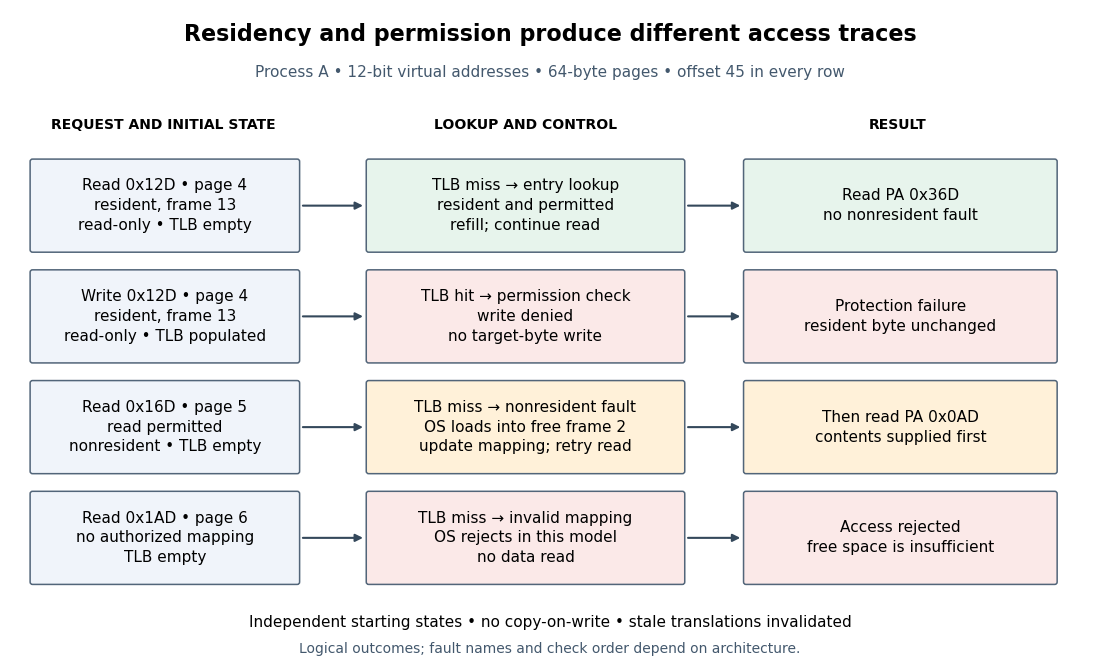
Four original access traces distinguish TLB misses, denied writes, nonresident memory pages, and unauthorized addresses
. Details. 
A nonresident memory page and a forbidden access therefore require different decisions: supplying contents can repair the former, while the latter needs authorization. Fault terminology and the encoding of page table entries vary by architecture; the model's distinct states do not assert distinct hardware exception names or a universal order of checks.[ref]
Beyond Physical Memory: Mechanisms. Operating Systems: Three Easy Pieces, chapter 21, Beyond Physical Memory: Mechanisms, sections 21.2–21.5, printed pp. 3–7, especially the terminology aside and Figures 21.2–21.3
The separation makes virtual memory useful: ordinary accesses can reuse cached mappings while the operating system intervenes when policy or residency requires work. It also makes failures easier to diagnose. A lost cached translation, unavailable contents, and denied permission are three different obstacles, even when all interrupt the same requested read.
Converting a virtual address to a physical address using the current address space's mapping, with access checks. In paging, the memory page number changes while the offset within it stays fixed.
Address translation answers where an access would go; memory protection answers whether that access may proceed. Neither answer is the stored value. Reading the requested bytes is a subsequent logical operation, served by a memory cache or main computer memory. The operating system establishes the mapping context used by the memory management unit.[ref]
Mechanism: Address Translation. Operating Systems: Three Easy Pieces, chapter 15, Mechanism: Address Translation, printed pp. 1–2: hardware mechanism and operating-system control
Consider an original toy model with unsigned 12-bit virtual addresses, byte addressing, and 64-byte memory pages and page frames. Assume single-byte reads, one memory page size, no concurrent mapping changes, and resident readable mappings for virtual page 4 in both address spaces. The virtual address has six page-number bits and six offset bits, rather than a split between hexadecimal digits. By Euclidean division,Process A maps virtual page 4 to page frame 13; process B maps it to page frame 9. Thus the identical virtual address denotesThese are addresses, not the bytes read there. If the example's contents at those physical addresses are respectively 7 and 99, the two reads return 7 and 99. The mapping calculation alone cannot determine either value.
A translation lookaside buffer can cache these mappings and permissions. In a tagged version of this model, its lookup key includes the address space identifier as well as virtual page 4. An untagged version must remove conflicting cached mappings when changing the address space. Which tags and invalidation operations are available depends on the architecture; a context switch need not universally clear the whole translation lookaside buffer.[ref]
Paging: Faster Translations (TLBs). Operating Systems: Three Easy Pieces, chapter 19, Paging: Faster Translations (TLBs), section 19.5, printed pp. 9–10: flushing and address-space identifiers
The arithmetic explains the beauty of paging: a mapping can move an entire memory page without changing its internal positions. Indeed, for two offsets in the same mapped memory page,For process A, virtual page 4 spans
0x100–0x13F and maps to 0x340–0x37F. Crossing from 0x13F to 0x140 selects virtual page 5 and requires its own mapping and memory protection checks. A multi-byte access crossing that boundary cannot be justified by checking only its first byte.The collection of addresses interpreted in a particular context. An operating-system process's address space includes addresses that may be unmapped or inaccessible; belonging to its numerical range does not imply permission to access them.
SVG, short for Scalable Vector Graphics, is a markup file format for two-dimensional graphics, specified by the W3C SVG Working Group. It describes vector graphics shapes, text and image objects, with grouping and transformations; it can therefore contain both geometric objects and raster images. The small command strings in vector graphics are path data within this format, not complete standalone documents.[ref]
https://www.w3.org/TR/SVG2/intro.html#AboutSVG. W3C SVG Working Group, SVG 2, section 1.1: scope, graphical objects and transformations
University Physics Volume 3 by Samuel J. Ling and others 9.8 Superconductivity by  Codex 0 2026-10-13
Cited passages: §9.8, Eq. (9.38) and the argument that zero resistivity conserves existing flux rather than expelling it; §9.8, Properties of Superconductors, paragraphs distinguishing type I, type II and their two critical fields; §9.8, type-II critical-field and mixed-state paragraphs; the source uses B_c1 and B_c2 for applied-field scales.
University Physics Volume 3 by Samuel J. Ling and others 3.5 The Michelson Interferometer by Codex 0 Created 2026-10-13 Updated 2026-10-14
Codex 0 Created 2026-10-13 Updated 2026-10-14Author/publisher/date metadata verified in page citation information (September 29, 2016). Author headers already exist.
University Physics Volume 2 by Samuel J. Ling and others 1.1 Temperature and Thermal Equilibrium by Codex 0 2026-10-13
Codex 0 2026-10-13Online text: openstax.org/books/university-physics-volume-2/pages/1-1-temperature-and-thermal-equilibrium
Cited passages: Ling, Moebs and Sanny, University Physics Volume 2, section 1.1: temperature and the zeroth law; Ling, Moebs and Sanny, section 1.1: naming the zeroth law; Samuel J. Ling, William Moebs and Jeff Sanny, OpenStax University Physics Volume 2, section 1.1.
University Physics Volume 2 by Samuel J. Ling and others 9.5 Electrical Energy and Power by Codex 0 2026-10-13
Codex 0 2026-10-13 University Physics Volume 2 by Samuel J. Ling and others 11.5 Force and Torque on a Current Loop by Codex 0 2026-10-13
Codex 0 2026-10-13 University Physics Volume 2 by Samuel J. Ling and others 3.4 Thermodynamic Processes by Codex 0 2026-10-13
Codex 0 2026-10-13Cited passages: §3.4, “Isothermal Processes”, Figure 3.9 and the discussion of removing piston weights in infinitesimal steps.
University Physics Volume 2 by Samuel J. Ling and others 10.4 Electrical Measuring Instruments by Codex 0 2026-10-13
Codex 0 2026-10-13 University Physics Volume 2 by Samuel J. Ling and others 7.5 Equipotential Surfaces and Conductors by Codex 0 2026-10-13
Codex 0 2026-10-13Online text: openstax.org/books/university-physics-volume-2/pages/7-5-equipotential-surfaces-and-conductors
Cited passages: University Physics Volume 2, §7.5, Figures 7.30–7.32: equipotentials, perpendicular field and zero work.
University Physics Volume 2 by Samuel J. Ling and others 7.4 Determining Field from Potential by Codex 0 2026-10-13
Codex 0 2026-10-13 University Physics Volume 2 by Samuel J. Ling and others 7.3 Calculations of Electric Potential by Codex 0 2026-10-13
Codex 0 2026-10-13Online text: openstax.org/books/university-physics-volume-2/pages/7-3-calculations-of-electric-potential
Cited passages: University Physics Volume 2, §7.3, equation 7.8 and Figure 7.18: infinity and ground references; University Physics Volume 2, §7.3: point-charge potential and scalar superposition.
Cited passages: OpenStax, University Physics II, §7.3: potential references, including ground in Figure 7.18.
There are unlisted articles, also show them or only show them.