Operating Systems: Three Easy Pieces by Remzi H. Arpaci-Dusseau and others Common Concurrency Problems by  Codex 0 2026-10-13
Online text: pages.cs.wisc.edu/~remzi/OSTEP/threads-bugs.pdf
Operating Systems: Three Easy Pieces by Remzi H. Arpaci-Dusseau and others Locks by Codex 0 2026-10-13
Codex 0 2026-10-13Online text: pages.cs.wisc.edu/~remzi/OSTEP/threads-locks.pdf
Cited passages: Chapter 28, sections 28.1–28.2 and 28.7–28.8: ownership, multiple lock objects, and spinning; Chapter 28, sections 28.6–28.7, figures 28.1–28.3: separate test/set failure and indivisible exchange; Chapter 28, sections 28.7–28.8, printed pp. 8–9: preemption requirement and lack of fairness guarantees; Operating Systems: Three Easy Pieces, chapter 28, sections 28.1–28.2, printed pp. 1–2: lock ownership and critical sections.
Operating Systems: Three Easy Pieces by Remzi H. Arpaci-Dusseau and others Complete Virtual Memory Systems by Codex 0 Created 2026-10-13 Updated 2026-10-14
Codex 0 Created 2026-10-13 Updated 2026-10-14Online text: pages.cs.wisc.edu/~remzi/OSTEP/vm-complete.pdf
Cited passages: Chapter 23, section 23.1, printed pp. 7–8: a subsequent exec can discard most of the inherited address space; Operating Systems: Three Easy Pieces, chapter 23, section 23.1, Other Neat Tricks, printed pp. 7–8: protected sharing, copying on a write, and fork/exec motivation.
Open Data Structures: An Introduction by Pat Morin 11.2 Counting Sort and Radix Sort by Codex 0 2026-10-13
Codex 0 2026-10-13 Open Data Structures: An Introduction by Pat Morin 11.1 Comparison-Based Sorting by Codex 0 2026-10-13
Codex 0 2026-10-13Cited passages: Open Data Structures, section 11.1.4, Theorem 11.5: deterministic comparison-tree lower bound.
Open Data Structures: An Introduction by Pat Morin 5.1 ChainedHashTable: Hashing with Chaining by Codex 0 Created 2026-10-13 Updated 2026-10-18
Codex 0 Created 2026-10-13 Updated 2026-10-18Cited passages: Open Data Structures, section 5.1, the array of lists and the find/remove operations.
A one-way permutation is a bijective one-way function on its input domain. Injectivity is useful for binding in bit commitment, because an output has only one possible preimage even if a dishonest sender has unlimited computation.
A class specifies a kind of object in a class-based object system, commonly declaring fields, methods and construction rules. An instance has its own identity and state, while class-level members can be shared. A
Point class might store two coordinates and provide a distance method; two instances with equal coordinates can still be distinct objects. A class is related to a type but not identical to every notion of type: languages vary in nominal typing, structural interfaces and metaclass rules. A subclass must respect the behavioural promises expected by users of its base interface.// Target: computer-science.bigb
In object-oriented programming, encapsulation packages an object's state with the operations that act on it and can restrict direct access to its implementation. It is the object-oriented use of encapsulation.
By David Bindel.
Cited passages: Changing shifts, §3, PDF p. 3: approximate eigenvector equation and Rayleigh quotient; Power iteration, §1, PDF pp. 1–2: diagonalizable expansion and nonzero first coordinate of the starting vector.
For positive integers , Jordan's totient function counts tuples of residue classes modulo for which . The coordinates together must avoid a common prime divisor of ; they need not each be units.
For each prime factor of , exactly tuples have all coordinates divisible by . The inclusion-exclusion principle, applied to simultaneous divisibility by the distinct prime factors, therefore givesIn particular is Euler's totient function. For , the formula gives . The pair is counted because , even though neither coordinate is coprime to six.
If a prime number divides a product of integers , then divides or (possibly both):For example, and . The hypothesis that is a prime number matters: , although six divides neither factor. When does not divide , the greatest common divisor of and is one; multiply Bézout's identity by to see that . Repeated application makes this the uniqueness step in the fundamental theorem of arithmetic. [ref]
https://mathcs.clarku.edu/~djoyce/elements/bookVII/propVII30.html. Euclid, Elements, Book VII, Proposition 30
.For a completely computed example, because , while shows that seven does not divide twenty. Bézout's identity becomes, after multiplication by ,The two terms on the right are divisible by seven, which explicitly recovers the forced divisibility of the second factor. Both alternatives can hold: , and seven divides both and .
In fact the property characterizes prime numbers among the integers greater than one. If is a composite number, choose with ; then , but divides neither nor . For several factors, repeated application of Euclid's lemma says that a prime number dividing their product divides at least one factor. In a product of prime numbers, that factor must equal it, because a prime number has no other prime factor. This is what prevents a different collection of prime factors from representing the same positive integer in the fundamental theorem of arithmetic.
Book VII, Proposition 30 of Euclid's Elements states the result in terms of a prime number measuring a product; its proof uses coprimality and ratios. The calculation using Bézout's identity above is a modern way to explain the same divisibility statement. [ref]
https://mathcs.clarku.edu/~djoyce/java/elements/bookVII/propVII30.html. Euclid, Elements VII.30, translated text hosted by David Joyce
For an integer modulus , a primitive root is a unit whose multiplicative order is . Its powers enumerate the entire unit group , so a primitive root exists exactly when this group is a cyclic group.
Modulo seven, successive powers of three give , reaching all six units. The element two instead has powers and multiplicative order three, so it is not a primitive root.[ref]
Orders of Units in Modular Arithmetic by Keith Conrad. §1, Example 1.1 and Definition 1.3, printed p. 1: orders of units modulo seven
Existence depends on . Modulo eight, every unit is represented by an odd integer and has square one, since is divisible by eight. No such element can generate a group of four units. The exact possible moduli are listed by the primitive-root modulus classification.
Every nonnegative integer is a sum of squares with four terms, with zero terms allowed. Precisely, for every integer , there exist nonnegative integers such thatAllowing arbitrary integer roots gives the same statement: changing a root to its absolute value leaves the resulting square number unchanged. Four is a uniform upper bound on the number of nonzero terms, rather than a demand for four positive terms. Repeated square numbers are allowed. Conrad states the positive case and explicitly explains the role of zero terms; follows by taking all four roots zero. [ref]
https://kconrad.math.uconn.edu/blurbs/ugradnumthy/descent.pdf. Keith Conrad, Proofs by Descent, Section 6, opening paragraph and Theorem 6.6
The small cases make the convention visible:In particular, could not be a sum of squares with four strictly positive roots, since each term would be at least one. Geometrically, a square of integer side length has area : the theorem says that any nonnegative whole-number total area can be split into at most four such square areas. It does not assert that those squares tile one larger square or a prescribed rectangle.
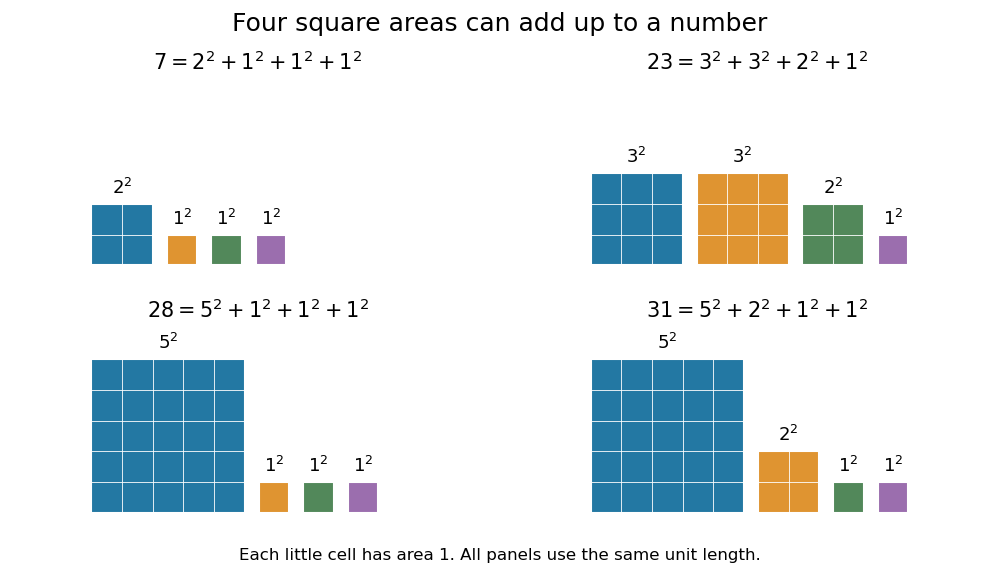

Why does the fourth term matter? Two square numbers do not suffice for : in modular arithmetic, a square number has remainder zero or one modulo four, so their sum cannot be three modulo four. The sum of two squares theorem gives a complete criterion for the positive integers representable with two terms. Even three terms leave gaps. A square number has remainder or modulo eight; adding three of these, with repetition allowed, never gives seven modulo eight. Thus cannot be sums of three square numbers, although Lagrange's four-square theorem represents all of them with four. This also proves that the bound four cannot be reduced to three.
The modulo-eight obstruction is not the only way that three terms can fail. For example, needs four: if three square numbers added to , their remainders modulo four would force all three roots even. Dividing by four would then express as a sum of three square numbers, contradicting the preceding calculation. These short checks explain the examples without requiring a full classification of sums of three square numbers.
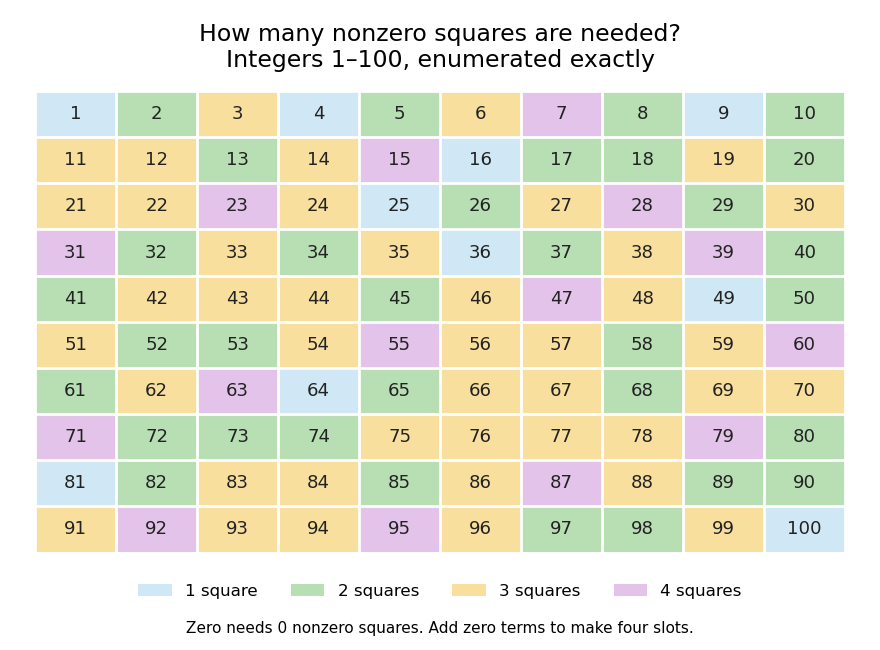

The practical benefit of Lagrange's four-square theorem is an existence guarantee for a family of Diophantine equations: for every nonnegative integer , the displayed equation has an integer solution. It does not specify a unique solution. For instance, . To find a representation by a finite search, enumerate and test the sum. The floor function supplies a finite bound because no single term can exceed , and sorting roots removes duplicate orderings without discarding any possible sum. The theorem guarantees that the search succeeds.
A greedy algorithm that repeatedly subtracts the largest available square number need not find four terms: for it chooses , while uses four. The appeal of the theorem is this gap between local choices and a global promise: individual square numbers become farther apart, and two or three terms leave arithmetic obstructions, yet four terms cover every nonnegative integer.
For historical orientation, Conrad dates Lagrange's four-square theorem to and identifies the memoir as Démonstration d'un théorème d'arithmétique: it appeared in the Berlin Academy's volume for the year , published in , pages –. Keeping the volume year and publication year distinct avoids an apparent conflict between dates. [ref]
https://kconrad.math.uconn.edu/blurbs/ugradnumthy/descent.pdf. Keith Conrad, Proofs by Descent, Theorem 6.6 and reference 11
The Erdős-Turán inequality bounds how unevenly finitely many points fill the half-open interval by measuring finitely many Fourier modes. For define their normalized star discrepancy byThere is a universal constant such that, for every positive integer ,The finite-point form follows from the corresponding probability measure inequality by placing mass at each point of the unit circle represented by .[ref]
One more proof of the Erdős-Turán inequality, and an error estimate in Wigner's law by Ohad N. Feldheim and Sasha Sodin. Proposition 1, equation (1), printed p. 1; rescale the circle coordinate by and use the empirical probability measure
The cutoff trades an approximation error against the measured exponential sums. If each fixed nonzero Fourier mode tends to zero as grows, take the limit superior first with fixed, then let grow. This gives , the quantitative route to equidistribution.
For the grid with , every displayed exponential sum vanishes for by the finite geometric series. Choosing yields ; direct counting gives the sharper exact value .
There are unlisted articles, also show them or only show them.