For incident light with linear polarization, an ideal linear polarizer transmitswhere is light intensity and is the angle between the incident electric field's line of oscillation and the polarizer's pass axis. The input and output are compared in the same medium. The classical explanation is an orthogonal projection: for a unit vector along the pass axis,The dot product reduces the transmitted wave amplitude by . For a plane electromagnetic wave in the same medium, light intensity is proportional to squared electric field wave amplitude, giving Malus's law. For example, transmits one quarter of the incident light intensity, although the transmitted wave amplitude is one half. [ref].
Start with light already in linear polarization along the horizontal axis and let its light intensity be . Two ideal absorbing linear polarizers with pass axes and give . Insert a polarizer between them: the first leaves unchanged, the middle transmits with linear polarization along , and the last transmits with linear polarization along . Each angle in Malus's law is relative to the preceding output, so the final step uses :
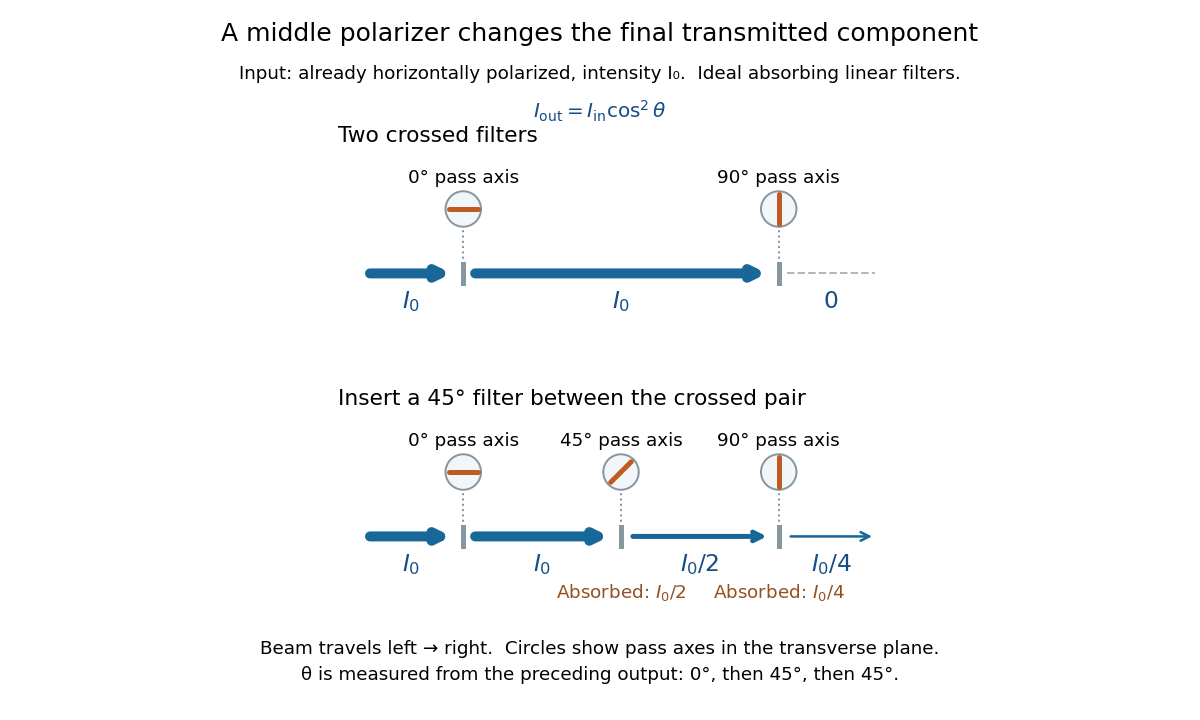
Two crossed polarizers transmit zero; inserting a middle polarizer transmits for initially horizontal linear polarization
. Pass axes are measured from horizontal. Each blue segment represents transmitted light intensity, and each inset shows the pass axis in the transverse plane. The two successive changes each halve light intensity by Malus's law. Details.
For these ideal absorbing polarizers, the rejected electric field component transfers energy to the filter. In the three-filter arrangement the middle absorbs the fraction , and the last absorbs , leaving transmitted. Conservation of energy holds at each step. Inserting the middle polarizer changes the linear polarization arriving at the last one; it does not create light. The effect illustrates why successive orthogonal projections cannot generally be replaced by a single comparison of the first and last axes.
The initially horizontal assumption matters. For unpolarized light of light intensity , the first ideal linear polarizer transmits : averaging over uniformly distributed incident orientations gives . The same sequence then transmits . This extra first-stage factor does not apply to the already horizontally polarized input in the figure.
For an elliptically polarized wave, the tip of its transverse vector traces an ellipse at a fixed point during each wave period. For polarization of an electromagnetic wave, this is the electric field vector. With the real components in polarization of waves, assume and . Eliminating time givesA short derivation uses and the cosine addition formula to obtain ; squaring and using the sine and cosine identity gives the displayed equation. Outside phase quadrature, the mixed term gives a tilted ellipse; are component wave amplitudes and need not be its semi-major and semi-minor axes.
In phase quadrature, , the mixed term vanishes. For , the ellipse is , its semi-major and semi-minor axes have lengths and , and its electric field magnitude varies between and . At with , the electric field is and has magnitude . Equal wave amplitudes instead give circular polarization, a special case of elliptical polarization with constant magnitude. As approaches or , the ellipse collapses to a line segment and gives linear polarization; this limit is degenerate rather than a nondegenerate ellipse.
Changing from to reverses traversal of the same ellipse. In the displayed plot, moves from toward negative as time increases. A label such as right- or left-handed circular polarization additionally requires a stated viewing direction and naming convention: viewing along propagation and viewing against propagation reverse the apparent rotation. [ref]
https://www.feynmanlectures.caltech.edu/I_33.html#Ch33-S1. Feynman Lectures, I §33–1: polarization conventions
.The ellipse records both the relative wave amplitudes and the phase difference of two transverse oscillations. This separates a change of polarization of waves from a change of overall wave amplitude: multiplying both components by the same positive factor enlarges the ellipse while preserving its shape and orientation.
A rotating ideal linear polarizer can probe this geometry. For the ellipse in phase quadrature, orthogonal projection onto a pass axis at angle gives , in . Averaging its square over a wave period gives , while the incoming squared electric field magnitude averages to . Thus the transmitted fraction of light intensity is : it is at , at and at . There is no single incident line of linear polarization to insert into Malus's law; projecting the electric field and averaging its square is the appropriate generalization. This measurement cannot distinguish from , because reversing the traversal leaves all these squared averages unchanged.
Point-Set Topology by Romyar Sharifi Chapter 3: Connected and compact spaces by  Codex 0 2026-10-13
Online text: www.math.ucla.edu/~sharifi/notes/topology-ch03.html
Cited passages: Romyar Sharifi, Point-Set Topology, Corollary 3.1.10, Proposition 3.1.11, Definition 3.1.12 and Remark 3.1.16: maximal connected subsets and equivalence classes; Romyar Sharifi, Point-Set Topology, Definition 3.1.1 and Example 3.1.3: connectedness and discrete spaces; Romyar Sharifi, Point-Set Topology, Lemma 3.1.13 and Example 3.1.14: closed components and a component which is not open.
Diploid biological cells have two sets of chromosomes. In the ordinary one-locus inheritance model, a diploid genotype therefore contains two allele copies at each genetic locus.
Two homologous chromosomes of a given type are distinct inherited members of the two sets; the two sister chromatids of one replicated chromosome are its copied members. In the stipulated example, a diploid G2 phase cell nucleus has six replicated chromosomes, not twelve sets or twelve independently counted chromosomes.
A haploid cell nucleus has one complete set of chromosomes. For the stipulated example, both products after meiosis I and products after meiosis II are haploid; their Nuclear DNA contents differ because the former retain associated sister chromatids. Haploid therefore does not mean “unreplicated”.[ref]
The Process of Meiosis. Biology 2e by Mary Ann Clark and others; §11.1, Telophase I and Cytokinesis, final two paragraphs; Meiosis II, opening paragraph
Physics Demonstrations: A Sourcebook for Teachers of Physics (1996 online manuscript) by Julien Clinton Sprott Bicycle Wheel Gyroscope (section 1.3) by Codex 0 2026-10-13
Codex 0 2026-10-13Online text: sprott.physics.wisc.edu/demobook/CHAPTER1.HTM
Physics 2212 laboratory manual by Eric Murray Physics 2212, Lab 5: Electric Potential and Field by Codex 0 2026-10-13
Codex 0 2026-10-13Online text: introphys.gatech.edu/lab/2212/lab5/labmanual.html
Cited passages: Eric Murray, Physics 2212, Lab 5, Experiment 2: evaluate the field fit and its uncertainty; Eric Murray, Physics 2212, Lab 5, Experiment 2: quantitative field determination; Eric Murray, Physics 2212, Lab 5: Electric Potential and Field, Fall 2006; Features, Preliminaries and Experiment 1.
Physically Based Rendering: From Theory to Implementation (4th edition) by Matt Pharr and others 7.3 Bounding Volume Hierarchies by Codex 0 2026-10-13
Codex 0 2026-10-13 Physically Based Rendering: From Theory to Implementation (4th edition) by Matt Pharr and others 3.7 Bounding Boxes by Codex 0 2026-10-13
Codex 0 2026-10-13Cited passages: §3.7, Intersect() and Overlaps(): coordinate-wise intersection and inclusive comparisons; §3.7, two-point representation and Figure 3.9.
A clade comprises an ancestor and all its descendants. Membership is about common descent, not a taxonomic rank or a degree of cellular complexity. In a two-domain system, the nuclear lineage of eukaryotes nests within archaea; a group containing only the prokaryotic members excludes descendants and is therefore not that complete clade. See OpenStax Biology 2e, 20.2: clades and shared ancestry.
In a chloroplast, light-dependent reactions take place at thylakoid membranes. Chlorophyll captures light; electron transfer helps establish an electrochemical gradient across the thylakoid membrane, enabling formation of ATP. The oxygenic photosynthesis pathway also forms NADPH and releases molecular oxygen from water. ATP and NADPH become available in the chloroplast stroma for the Calvin cycle. See Alberts et al.: chloroplast light reactions.
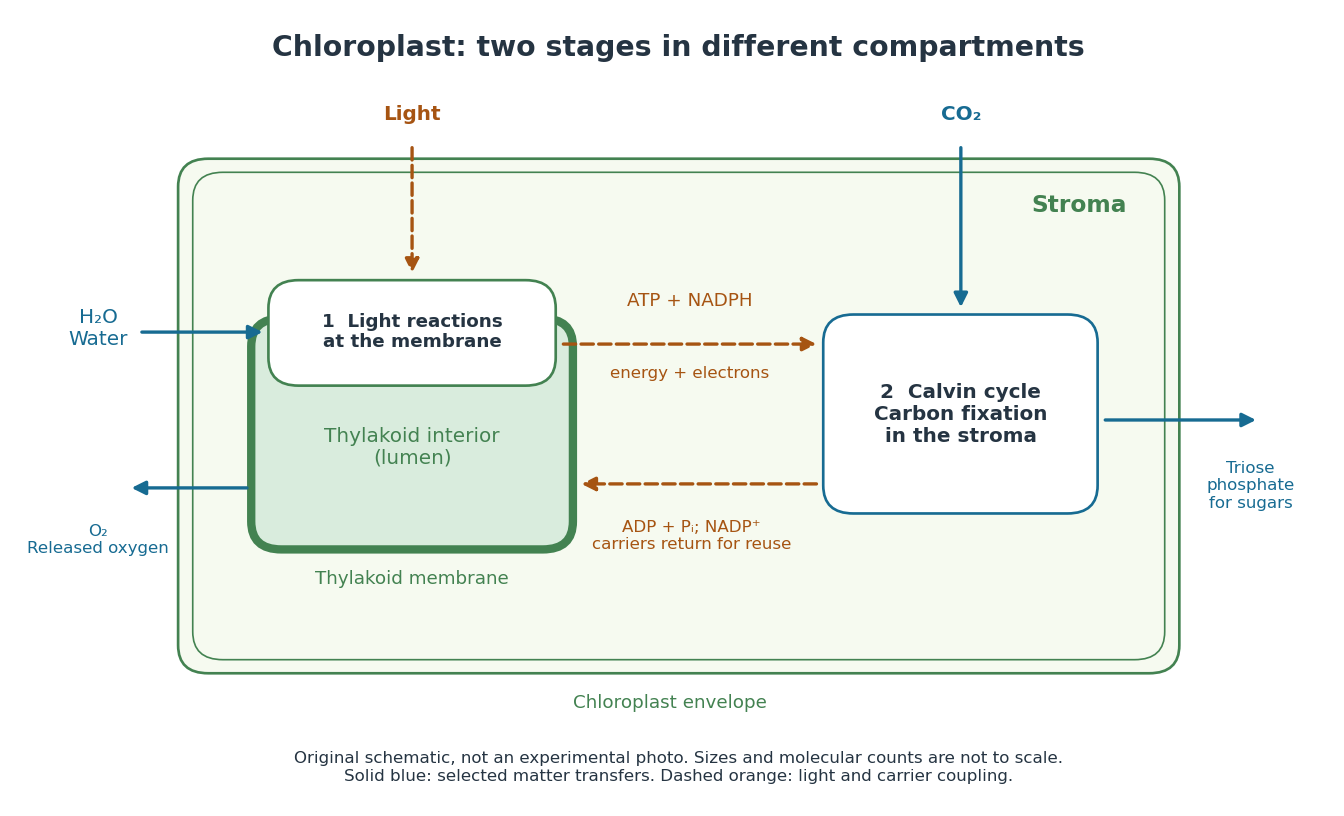

Anoxygenic photosynthesis captures light without producing molecular oxygen. It occurs in some bacteria and uses electron sources other than water. Whether carbon fixation accompanies this light capture depends on the organism and conditions; photosynthesis does not imply one universal carbon-assimilation pathway. See Alberts et al.: chloroplasts and photosynthetic bacteria.
Oxygenic photosynthesis uses water as an electron source and releases molecular oxygen. Plants, algae and cyanobacteria provide examples. The defining distinction from anoxygenic photosynthesis is molecular oxygen release, not merely capture of light.
Photofragment-ion imaging detects fragment velocities by ionizing neutral products and mapping their motion onto a position-sensitive detector using an electric field. In a velocity-mapping implementation, the image radius measures transverse speed under fixed lens settings. Selecting an arrival-time slice helps extract the central plane of the three-dimensional distribution. Species identification and electronic quantum state selection are essential for turning a radius into a particular dissociation threshold.
Inorganic phosphate, abbreviated , denotes the free phosphate pool in biochemical chemical equations, including ATP hydrolysis. Its constituent chemical species depend on pH and protonation; does not specify a single electric charge or proton count. See the IUBMB recommendations on biochemical reactant pools.
There are unlisted articles, also show them or only show them.