
For calculations of identity by descent, an outbred pedigree has unrelated, noninbred founders in a pedigree, and no additional ancestral relationships beyond those explicitly specified. Founder gene copies are treated as distinct ancestral copies even if they have identity by state.
// Target: biology.bigb
Current clamp prescribes injected electric current while recording membrane potential. A constant command does not force membrane potential to remain constant: a neuron can produce action potentials or synaptic potentials while that command is unchanged. At zero commanded electric current, the amplifier still measures membrane potential; intrinsic ionic electric currents continue. The name concerns current supplied by the instrument, not the cancellation of all currents in the biological cell.
In whole-cell recording, the measured pipette voltage during a current pulse includes the patch-clamp series resistance drop. A modern authored methods article explicitly describes current-pulse protocols and this distortion.[ref]
Multiple Two-Photon Targeted Whole-Cell Patch-Clamp Recordings From Monosynaptically Connected Neurons in vivo by Jean-Sébastien Jouhanneau and others. Intracellular Current Injection; Step 5: Whole-Cell Configuration
Check the access contribution with small pulses and distinguish the immediate pipette-voltage jump from the slower membrane capacitance response. A zero-input interval measures a baseline, not proof that the instrument has no voltage offset. The passive example below explains these distinctions without asserting any new physiological measurements.Whole-cell recording establishes intracellular electrical access by rupturing the membrane under a sealed patch pipette while retaining the gigaohm seal. Under adequate voltage clamp, the measured electric current combines contributions from accessible ion channels, membrane capacitance and seal leak current. Current clamp instead follows membrane potential while supplying a chosen electric current. Whole-cell recording is useful for linking a biological cell's total electrical response to its ion channels, but neither mode automatically controls distant dendrites or preserves the original cytosol.
In the 1981 methods demonstration, a bovine chromaffin biological cell was tested before and after patch rupture. Small voltage clamp steps produced a much larger capacitive transient after break-in. Integrating it gave for a cell; its decay indicated patch-clamp series resistance below . Depolarizing commands then revealed ionic electric currents. Separate current clamp recordings showed spontaneous action potentials. The comparison established access to the cell interior, rather than a claim that every pipette command equals membrane potential. Slower transients sometimes indicated incomplete rupture, and these small-cell results do not establish spatial control of a branched neuron.[ref]
Improved patch-clamp techniques for high-resolution current recording from cells and cell-free membrane patches by O. P. Hamill and others. pp. 98–99, Figure 15 and following voltage-clamp and current-clamp discussion
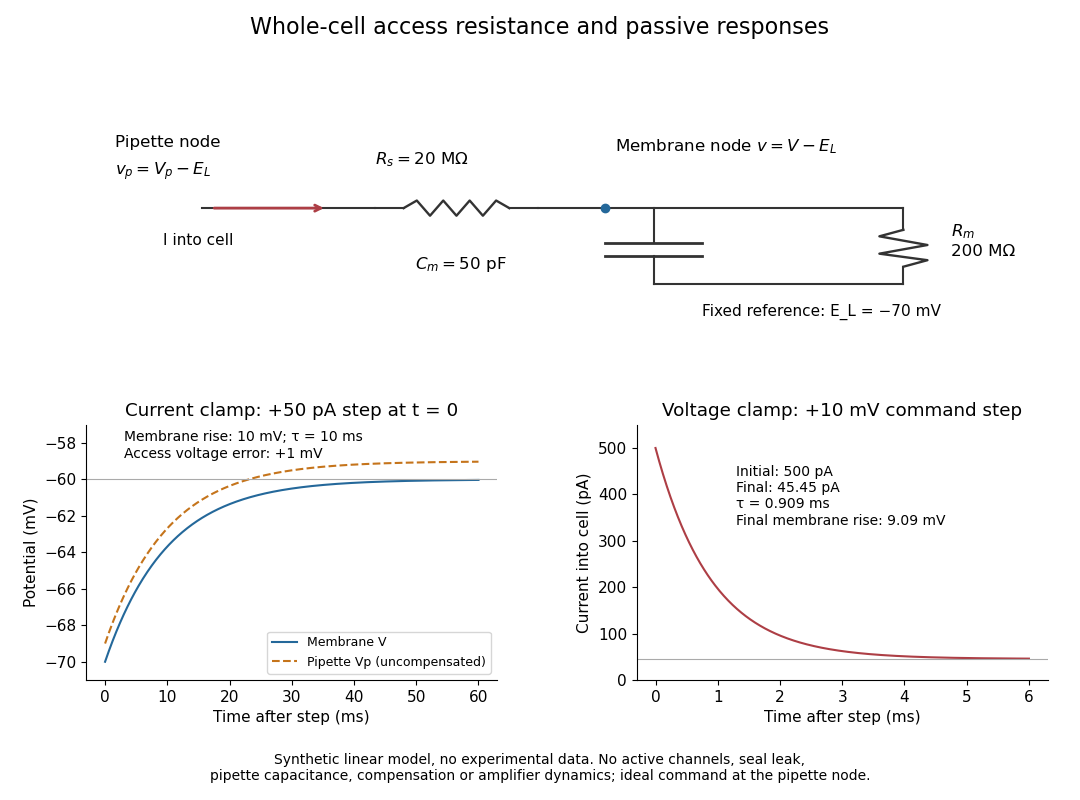
Synthetic whole-cell recording: patch-clamp series resistance and passive responses
. An original equivalent electrical circuit uses , and . The current clamp step and voltage clamp step are separate synthetic experiments. The passive model omits active ion channels, seal leak current, pipette capacitance and amplifier dynamics. Curves are calculations, not experimental measurements. Details.
An outside-out patch is an excised membrane patch whose extracellular side faces the bath. It can form on withdrawal after whole-cell recording, with the intracellular face exposed to pipette solution. The orientation determines which side a bath-applied substance reaches.
An inside-out patch is an excised membrane patch whose cytosol side faces the bath. Bath changes can therefore test effects on the intracellular face of an ion channel, with the extracellular face exposed to pipette solution.
Single-channel recording resolves individual ion channel opening events as changes in electric current. The distinction is resolution, not an absolute rule about configuration: rare, sufficiently large events can also be resolved during whole-cell recording. Simultaneously open identical ion channels can give successive current levels; indistinguishable amplitudes alone do not prove a unique channel identity.
In cell-attached recording, the membrane under the patch pipette remains intact and the cytosol is retained. If bath voltage is zero, cell-interior voltage is and pipette voltage is , the patch's inside-minus-outside membrane potential is . Commanding alone does not determine that difference when is unknown or changing. This is especially relevant to single-channel current-voltage relations.
A gigaohm seal is the high electrical resistance contact between the glass rim and cell membrane, also called a gigaseal. It suppresses a bypass route around the membrane patch; it does not make the membrane patch itself impermeable. The 1981 methods used pulled, coated and heat-polished pipettes, a chlorided silver electrode and a pressure connection. Clean glass and suction supported tight seals; coating reduced pipette-to-bath capacitance and recording noise, rather than being required for sealing.[ref]
A patch pipette is the tapered glass, solution-filled probe used in patch clamp. Its electrode connects the solution to an amplifier, with another electrode referencing the bath. The open-tip electrical resistance differs from the much larger gigaohm seal electrical resistance. After break-in, a narrow or partly obstructed tip contributes to patch-clamp series resistance.
There are unlisted articles, also show them or only show them.