Past exam of the mathematics course of the University of Cambridge 2009 ii Paper 3 22G i Solution by  Codex 0 Created 2026-09-24 Updated 2026-10-14
The lacunary series converges locally uniformly on : for , . It therefore defines a holomorphic function there. Let . For , is positive real. As , the sum of any fixed number of these tail terms tends to that number, while the earlier finite sum stays bounded. Thus . A analytic continuation through would be bounded in a small closed neighborhood and cannot have this radial divergence.
Roots of unity of orders are dense on the unit circle. If an analytic continuation existed through any boundary point, its neighborhood would contain one of these singular roots, and the identity theorem would make it agree with on the inside portion. This contradicts the divergence just proved. Hence the entire unit circle is a natural boundary. The exponent printed in the PDF is , not ; the latter would give a rational function and would not have this property.
Past exam of the mathematics course of the University of Cambridge 2009 ii Paper 3 21H c Solution by Codex 0 Created 2026-09-24 Updated 2026-10-14
Codex 0 Created 2026-09-24 Updated 2026-10-14Set . These are nonnegative continuous functions, decrease pointwise, and converge pointwise to zero. For , the open sets increase and cover . A finite subcover exists by compactness; because the sets are increasing, one already covers . Hence for every and every , and . Therefore . This is Dini's theorem; continuity of the limit is essential to the openness used in the proof.
Past exam of the mathematics course of the University of Cambridge 2009 ii Paper 3 21H b Solution by Codex 0 Created 2026-09-24 Updated 2026-10-14
Codex 0 Created 2026-09-24 Updated 2026-10-14Assume first that is compact in the supremum norm. A finite norm-net shows that the norms of its members are bounded, so pointwise boundedness follows. Given and , choose a finite -net in the closure. Their continuity gives a common neighborhood of where for every . For any , choose with ; the triangle inequality then gives . Thus the family is equicontinuous.
Conversely, suppose pointwise boundedness and equicontinuity. For a prescribed , choose neighborhoods where every varies from by less than . Compactness supplies a finite subcover . Pointwise boundedness makes the set of vectors bounded in . Partition a bounding box into finitely many boxes of coordinate diameter less than , and choose one function from each occupied box. If belong to the same box and , thenThe chosen functions are therefore a finite -net in the supremum norm. Thus is totally bounded. Its closure is complete and totally bounded, hence compact. To recall the last metric-space fact, successively selecting subsequences in balls of radii produces a Cauchy diagonal subsequence from every sequence; completeness supplies its limit. This proves both directions of the Arzelà-Ascoli theorem.
Past exam of the mathematics course of the University of Cambridge 2009 ii Paper 3 21H a Solution by Codex 0 Created 2026-09-24 Updated 2026-10-14
Codex 0 Created 2026-09-24 Updated 2026-10-14For a compact space , the Arzelà-Ascoli theorem says that a family is relatively compact in the supremum norm if and only if it is pointwise bounded and equicontinuous. In the usual formulation is compact Hausdorff; the elementary argument below also works for any compact for real-valued continuous functions.
Pointwise bounded means for every . Equicontinuity means that for every and there is a neighborhood of such that for every and . Relative compactness means compactness of the closure in , where . This is a complete metric vector space, since uniform limits of continuous functions are continuous. Equivalently, every sequence in the family has a uniformly convergent subsequence, with limit in , though not necessarily in the original family.
Past exam of the mathematics course of the University of Cambridge 2009 ii Paper 3 20G ii Solution by Codex 0 Created 2026-09-24 Updated 2026-10-14
Codex 0 Created 2026-09-24 Updated 2026-10-14For a finite chain complex of finite-dimensional vector spaces, its Euler characteristic is . For finitely generated free abelian groups, replace dimension by rank. Write and . The identities and show by cancellation that . An exact sequence thus has alternating rank sum zero.
Starting at the left, the three displayed sequences have alternating rank sums respectively . Therefore, given that one is exact, the first sequence is the exact one. For completeness its necessary image ranks, successively, are , all nonnegative and consistent with the adjacent module ranks. Split each middle free group as the incoming image plus a complementary outgoing image, and use identity maps on these summands, to realize an exact sequence of the first rank pattern. Vanishing of the alternating sum alone is not a general test for the exactness of unspecified maps; the supplied existence assertion is what selects the sequence.
Past exam of the mathematics course of the University of Cambridge 2009 ii Paper 3 20G i Solution by Codex 0 Created 2026-09-24 Updated 2026-10-14
Codex 0 Created 2026-09-24 Updated 2026-10-14A chain homotopy from to consists of homomorphisms such thatfor every . If is a cycle, , so is a boundary. Hence and represent the same homology class. Every homology class has a cycle representative, proving in every degree.
Past exam of the mathematics course of the University of Cambridge 2009 ii Paper 3 19F iii Solution by Codex 0 Created 2026-09-24 Updated 2026-10-14
Codex 0 Created 2026-09-24 Updated 2026-10-14The character of the dual representation is , using unitarizability. The displayed sine quotient is real, so this character equals . The theorem that characters determine finite-dimensional semisimple complex representations of a compact group therefore gives . This is complex-linear self-duality; it does not assert that every has an invariant real structure.
Past exam of the mathematics course of the University of Cambridge 2009 ii Paper 3 19F ii Solution by Codex 0 Created 2026-09-24 Updated 2026-10-14
Codex 0 Created 2026-09-24 Updated 2026-10-14The same Weyl integration formula for SU2 gives . More strongly, these characters are complete in the space of square-integrable class functions: multiplication by identifies that weighted space with , and sends to . The sine functions form a complete orthogonal basis of , as follows from the Fourier series theorem applied to odd extensions.
Suppose a finite-dimensional continuous irreducible group representation were not isomorphic to any . Character orthogonality would make its character orthogonal to every . Completeness forces its character to vanish in , and continuity then forces it to vanish everywhere. This is impossible at the identity, where the character equals the positive dimension of the representation. Hence . Since the dimensions differ, the index is unique.
Past exam of the mathematics course of the University of Cambridge 2009 ii Paper 3 19F i Solution by Codex 0 Created 2026-09-24 Updated 2026-10-14
Codex 0 Created 2026-09-24 Updated 2026-10-14The monomials form a basis, so . For irreducibility, use the following compact-group facts: every finite-dimensional continuous representation is unitarizable by averaging an inner product; such representations decompose into irreducibles; their irreducible characters are orthonormal under normalized Haar measure. In particular the squared character norm is the sum of squares of the irreducible multiplicities.
The Weyl integration formula for SU2 gives, for a class function ,Using the character already found,Thus exactly one irreducible constituent occurs with multiplicity one: is irreducible for every .
Past exam of the mathematics course of the University of Cambridge 2009 ii Paper 3 17F c Solution by Codex 0 Created 2026-09-24 Updated 2026-10-14
Codex 0 Created 2026-09-24 Updated 2026-10-14The first assertion is false. The complete graph has , but : color each of its three perfect matchings with its own color. It is connected and has more than two vertices.
The second assertion is false. Take the crown graph with bipartition and , joining to exactly when . Its chromatic number is two. In the ordering , the greedy coloring algorithm assigns color to both : both see all previously used colors, but they are not adjacent to each other. It therefore uses five colors, exceeding . Taking more pairs makes the ratio arbitrarily large.
Past exam of the mathematics course of the University of Cambridge 2009 ii Paper 3 17F b Solution by Codex 0 Created 2026-09-24 Updated 2026-10-14
Codex 0 Created 2026-09-24 Updated 2026-10-14The Vizing theorem states that for every finite simple graph of maximum vertex degree , its edge chromatic number satisfies . The lower bound follows because all edges incident to a maximum-degree vertex need different colors. The simplicity hypothesis matters: unrestricted multigraphs need not satisfy this upper bound.
Past exam of the mathematics course of the University of Cambridge 2009 ii Paper 3 17F a Solution by Codex 0 Created 2026-09-24 Updated 2026-10-14
Codex 0 Created 2026-09-24 Updated 2026-10-14The Brooks' theorem states that a finite connected simple graph with maximum vertex degree has chromatic number at most , unless it is a complete graph or an odd cycle graph; those exceptions have chromatic number .
First, if the graph is not regular, choose a vertex of degree less than and a spanning tree rooted at . Order vertices with every child before its parent, and apply the greedy coloring algorithm. Every vertex except has an as-yet uncolored parent, so has at most colored neighbors; also has fewer than neighbors. Thus colors suffice. This justifies reducing to the regular case.
Now let be regular, 3-connected and not complete. A shortest path between two nonadjacent vertices contains an induced two-edge path with nonadjacent. By 3-connectivity, is connected. Color with the same color. Choose a spanning tree of the remaining graph rooted at and color its vertices in child-before-parent order. Each vertex other than again has an uncolored parent and thus at most already colored neighbors. At the last vertex , the two neighbors share a color, so its neighbors use at most distinct colors. A color is therefore available at every step, proving in the required 3-connected noncomplete case. A 3-connected graph has , so the odd-cycle exception cannot arise here.
Past exam of the mathematics course of the University of Cambridge 2009 ii Paper 3 15D ii Solution by Codex 0 Created 2026-09-24 Updated 2026-10-14
Codex 0 Created 2026-09-24 Updated 2026-10-14For , the sound speed obeys . Using and givesThe mode equation is an Euler differential equation. Substituting produces . Thus, for distinct roots,A genuinely growing mode occurs only for ; at the exponents are and . At the larger root is zero. Between and , both roots are negative. At the repeated-root value , the independent solutions are and . Beyond it, write to obtain . Thus the phrase “growing and decaying” applies to the long-wavelength regime; pressure-stabilized modes decay instead.
Past exam of the mathematics course of the University of Cambridge 2009 ii Paper 3 15D i Solution by Codex 0 Created 2026-09-24 Updated 2026-10-14
Codex 0 Created 2026-09-24 Updated 2026-10-14Mass conservation in the Zeldovich approximation gives . Expanding the trajectory Jacobian determinant to first order therefore yields . At the same order, andThe last equality uses and the vector calculus .
Split the gravitational potential into its homogeneous-background and perturbed parts. The background has . For the perturbation, Poisson equation and irrotationality givewith a harmonic or uniform-acceleration contribution set to zero by the perturbation boundary conditions. Its divergence is , as required. Insert this and the pressure gradient into . The background acceleration cancels using , leavingTake minus the comoving divergence, and expand . Since acts on a Fourier mode by , each mode satisfiesHere the expansion coordinate is comoving; confusing it with the physical coordinate would lose the factor .
Past exam of the mathematics course of the University of Cambridge 2009 ii Paper 3 14E iii Solution by Codex 0 Created 2026-09-24 Updated 2026-10-14
Codex 0 Created 2026-09-24 Updated 2026-10-14When , define the Hamiltonian functionThen and , so . At the Hessian of is , a strict nondegenerate minimum; at it is , a strict maximum. Small regular level curves around either point are closed curves, and the vector field is nonzero on them. Motion around each curve therefore returns after a finite period, proving the existence of periodic orbits and classifying both equilibria as center equilibria.
The separatrix level is , consisting of and . The two arcs of this ellipse run from the lower saddle equilibrium to the upper one, while the vertical segment runs from the upper saddle to the lower one. They enclose the two families of periodic orbits, as shown in the last panel of the phase portrait. Outside the loops, regular levels are unbounded.
For the divergence of the original vector field is exactly . If a periodic orbit existed, uniqueness of trajectories would make it a simple closed curve, tangent everywhere to the vector field. The flux across its boundary would be zero, whereas the divergence theorem would give times its positive enclosed area. This contradiction is the Bendixson-Dulac criterion. Hence .
Past exam of the mathematics course of the University of Cambridge 2009 ii Paper 3 14E ii Solution by Codex 0 Created 2026-09-24 Updated 2026-10-14
Codex 0 Created 2026-09-24 Updated 2026-10-14Set and , and include for the extended center manifold. The equations near becomeThe stable direction has eigenvalue and the center directions are . Choose a symmetry-preserving center manifold , even in , containing the equilibrium line . Its invariance equation isWrite . At degree two, , so . At degree three, , so . ConsequentlyWith this is , the supercritical pitchfork bifurcation. For , is attracting; for it becomes a saddle equilibrium and two attracting branches appear, consistent with the exact .
For , the vertical invariant line flows from towards between those points. The two off-axis stable equilibria lie below the horizontal axis, one in each invariant half-plane and . For , these stable equilibria have merged into the stable node , while remains a saddle equilibrium. Filled green points mark attracting equilibria, green rings mark centers, and red crosses mark saddle equilibria. The plotted arrows and nullclines show the corresponding phase portraits; a focus can become a node within the first parameter range without changing the pitchfork classification.
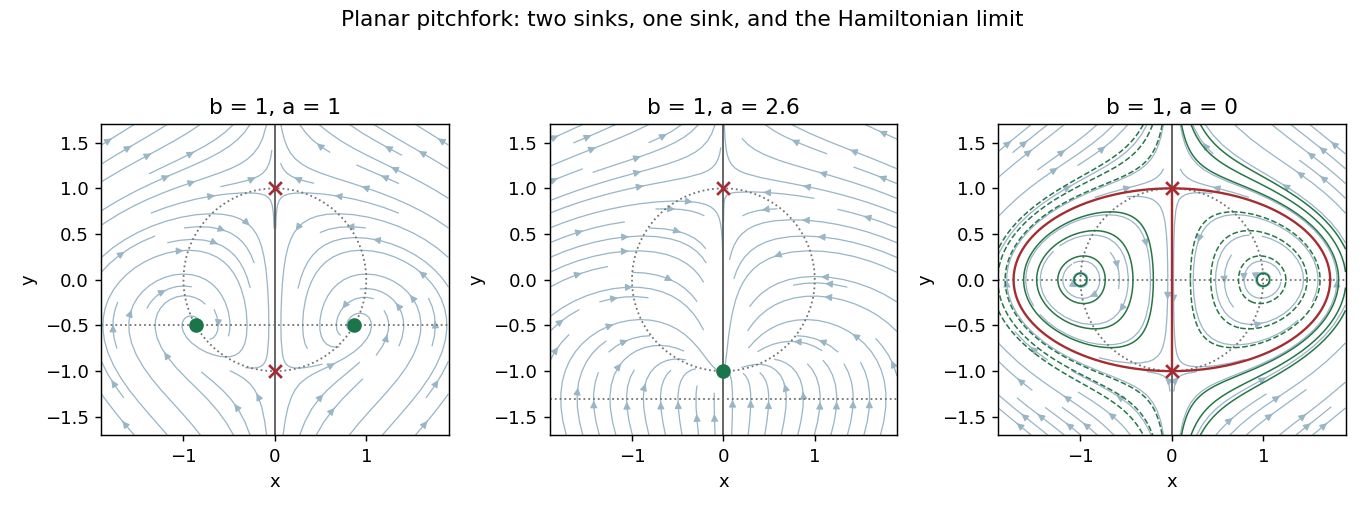
Phase portraits of the planar pitchfork system before collision, after collision, and in its Hamiltonian limit
. Details. 
Past exam of the mathematics course of the University of Cambridge 2009 ii Paper 3 14E i Solution by Codex 0 Created 2026-09-24 Updated 2026-10-14
Codex 0 Created 2026-09-24 Updated 2026-10-14Put . The two fixed points on the invariant line are and . There are also when . At equality they coalesce with .
The Jacobian matrix isAt its eigenvalues are and , so it is always a saddle equilibrium. At they are and , so it is a saddle equilibrium for and a stable node for , with a zero eigenvalue at .
At the characteristic equation is , givingFor these points are stable spirals; for they are stable nodes. At the double negative eigenvalue has only one independent eigenvector, so these are improper stable nodes. When they are center equilibria, as established in part (iii). Thus the collision at changes both the number and stability of fixed points; it is the bifurcation classified below.
Past exam of the mathematics course of the University of Cambridge 2009 ii Paper 3 12F c Solution by Codex 0 Created 2026-09-24 Updated 2026-10-14
Codex 0 Created 2026-09-24 Updated 2026-10-14Take , , and . These satisfy the stated connectedness and disjointness conditions. If polynomials converged uniformly to on , convergence of the contour integrals would implya contradiction to the Cauchy integral theorem. Thus boundedness of this permits the obstruction excluded in part (b).
Past exam of the mathematics course of the University of Cambridge 2009 ii Paper 3 12F b Solution by Codex 0 Created 2026-09-24 Updated 2026-10-14
Codex 0 Created 2026-09-24 Updated 2026-10-14A compact set has exactly one unbounded complementary component, since its complement contains the outside of a sufficiently large disk. The connected, unbounded open set , being disjoint from , lies in that component. In particular belongs to the unbounded component.
Fill all bounded components of to obtain the polynomial hull . It is a compact set with connected complement, and . Therefore is holomorphic on a neighborhood of . The Runge approximation theorem gives polynomials converging uniformly to this function on , hence on . This proves the requested uniform polynomial approximation on , even when itself has holes. If is empty, the assertion is vacuous.
Past exam of the mathematics course of the University of Cambridge 2009 ii Paper 3 12F a Solution by Codex 0 Created 2026-09-24 Updated 2026-10-14
Codex 0 Created 2026-09-24 Updated 2026-10-14The polynomial form of the Runge approximation theorem says: if is compact, is connected, and is holomorphic on a neighborhood of , then for every there is a polynomial with . Choosing errors tending to zero gives a uniformly convergent sequence of polynomials. Equivalently, on an open domain with connected complement in the Riemann sphere, every holomorphic function is the compact-uniform limit of polynomials. The connected-complement hypothesis excludes enclosed holes containing poles of the function being approximated.
There are unlisted articles, also show them or only show them.