Past exam of the mathematics course of the University of Cambridge 2009 ii Paper 4 28I a Solution by  Codex 0 Created 2026-09-24 Updated 2026-10-14
Maximize . Along the positive- trajectory use Hamiltonian of an optimal-control problem . The terminal costate is , andThus . Maximizing over gives as long as . The state equation integrates to , and the adjoint equation gives , validating the maximization. HenceThis is globally optimal, not just an extremal: whenever , . If a competitor reaches and later becomes positive, apply that bound after its last zero; it has even less remaining time to attain a positive terminal height. A negative terminal height cannot improve this positive maximum. Therefore the minimum objective is .
Past exam of the mathematics course of the University of Cambridge 2009 ii Paper 4 26J b Solution by Codex 0 Created 2026-09-24 Updated 2026-10-14
Codex 0 Created 2026-09-24 Updated 2026-10-14The second continuous-time Markov chain runs in the reverse direction at rate , as in the right diagram. Its nonzero eigenvalues have real part , and its transition probabilities tend to for each vertex. Independence therefore givesThus the limit exists for every pair of starting vertices and equals .
One can also see the limit directly without spectral multiplication. For fixed starting vertices, modulo three advances with each jump of either flea. Its jump count is the sum of independent Poisson processes with rates and , hence is Poisson with rate (multiply their generating functions). The formula from part (a), with replaced by and the appropriate initial residue, gives and the same limit.
Past exam of the mathematics course of the University of Cambridge 2009 ii Paper 4 26J a Solution by Codex 0 Created 2026-09-24 Updated 2026-10-14
Codex 0 Created 2026-09-24 Updated 2026-10-14Number the vertices by . The continuous-time Markov chain moves one step forward cyclically at rate one, as shown in the left diagram.
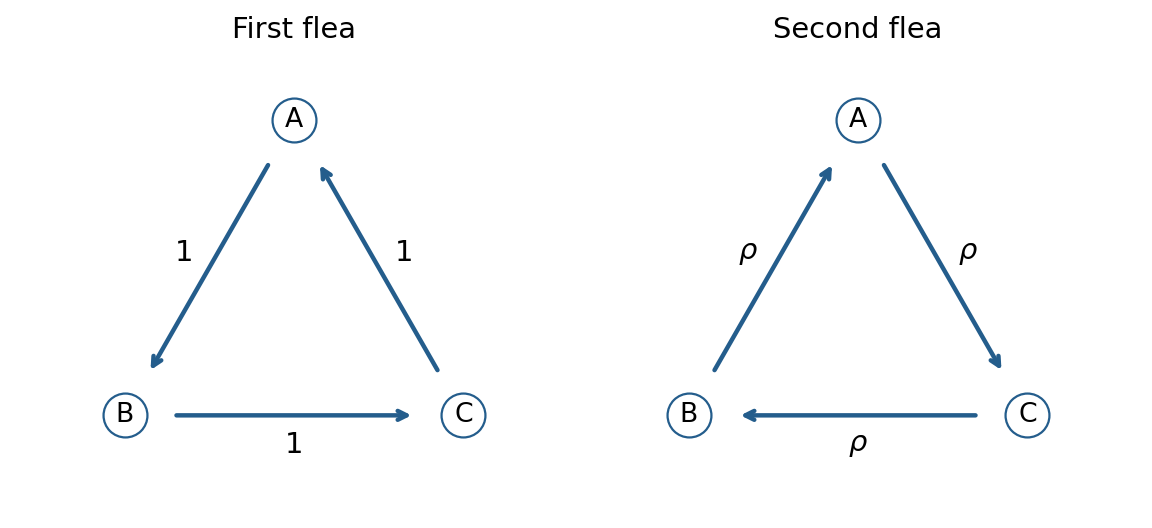

Write for the cyclic shift matrix, so . With , the eigenvalues of are and those of areThe stationary distribution is uniform. A jump count is a rate-one Poisson process, and the displacement is that count modulo three. The roots-of-unity filter and therefore give, for ,These are also the entries of obtained by diagonalizing . In particular,
Past exam of the mathematics course of the University of Cambridge 2009 ii Paper 4 24H c Solution by Codex 0 Created 2026-09-24 Updated 2026-10-14
Codex 0 Created 2026-09-24 Updated 2026-10-14An isometry preserves the Levi-Civita connection. To justify this, transport the connection on by . It is torsion-free and preserves the metric on , since preserves the metric and Lie brackets. These two properties characterize the Levi-Civita connection uniquely: if two such connections differ by , the tensor is symmetric in its first two arguments and antisymmetric in its last two. Cycling these symmetries yields , hence . ThereforeApplying this along shows that the covariant acceleration of is zero, so an isometry carries affinely parametrized geodesics to geodesics.
The same identity and the definition show that intertwines the Riemann curvature tensor. If is an orthonormal tangent basis, its image is orthonormal and
Both proposed converses are false. Take with the Euclidean metric and . A geodesic maps to the geodesic , and both Gaussian curvatures vanish identically. Nevertheless multiplies lengths by two, so is not an isometry. This one counterexample answers both unheaded continuation requests.
Past exam of the mathematics course of the University of Cambridge 2009 ii Paper 4 24H b Solution by Codex 0 Created 2026-09-24 Updated 2026-10-14
Codex 0 Created 2026-09-24 Updated 2026-10-14A parametrized curve is a geodesic when its covariant acceleration vanishes, , for the induced Levi-Civita connection. In coordinates this isEquivalently, for an embedded surface its ordinary acceleration is normal to the tangent plane. The parameter is affine; arbitrary reparametrizations need not remain geodesics.
The local existence and uniqueness theorem says that for every and there is a unique geodesic with , , on a maximal open interval containing zero, depending smoothly on . This follows from the local existence and uniqueness theorem for the smooth first-order system in . The exponential map is wherever the solution exists through time one. Its domain contains a neighborhood of zero, and , since . Thus it is a local diffeomorphism near zero. Completeness is not assumed for a general surface; on a complete surface it is defined on all of .
Past exam of the mathematics course of the University of Cambridge 2009 ii Paper 4 24H a Solution by Codex 0 Created 2026-09-24 Updated 2026-10-14
Codex 0 Created 2026-09-24 Updated 2026-10-14The global Gauss-Bonnet theorem for the induced Riemannian metric isHere is the Gaussian curvature, the induced surface-area element, and the Euler characteristic. For a connected orientable compact surface of genus , . For several components, sum their contributions. There is no boundary-curvature term because has no boundary.
Past exam of the mathematics course of the University of Cambridge 2009 ii Paper 4 22H d Solution by Codex 0 Created 2026-09-24 Updated 2026-10-14
Codex 0 Created 2026-09-24 Updated 2026-10-14The exact condition for this diagonal operator on sequence space isFirst, is bounded precisely when , with operator norm equal to that supremum: the upper bound follows by summing , and the coordinate unit vectors give the lower bound. If the supremum is infinite, choose distinct indices with and set , other coordinates zero. Then but , so the displayed prescription would not even define an everywhere-defined map into .
If is compact but , infinitely many indices satisfy . Along those indices,contradicting compactness. Conversely, if , truncate to . This is a finite-rank compact operator, and . To see compactness directly, approximate the image of the unit ball by to within , and cover its bounded finite-dimensional image by finitely many -balls. Hence 's unit-ball image is totally bounded; its closure is compact because is complete.
Past exam of the mathematics course of the University of Cambridge 2009 ii Paper 4 22H c Solution by Codex 0 Created 2026-09-24 Updated 2026-10-14
Codex 0 Created 2026-09-24 Updated 2026-10-14Suppose otherwise and choose linearly independent eigenvectors with and . Put . Each is finite-dimensional and -invariant. Moreover , including when some eigenvalues coincide.
Apply the supplied distance fact inside the Banach space to choose with and . For , both and belong to . ConsequentlyThus has no Cauchy subsequence, although is bounded. This contradicts the compact operator property. Only finitely many linearly independent eigenvectors can have eigenvalue modulus greater than .
Past exam of the mathematics course of the University of Cambridge 2009 ii Paper 4 22H b Solution by Codex 0 Created 2026-09-24 Updated 2026-10-14
Codex 0 Created 2026-09-24 Updated 2026-10-14A compact operator is a bounded linear operator carrying every bounded set into a relatively compact set. Equivalently, for every bounded sequence , the sequence has a norm-convergent subsequence. It is enough to require this for the closed unit ball, because any bounded set lies in a scalar multiple of that ball.
Past exam of the mathematics course of the University of Cambridge 2009 ii Paper 4 22H a Solution by Codex 0 Created 2026-09-24 Updated 2026-10-14
Codex 0 Created 2026-09-24 Updated 2026-10-14For a complex Banach space, the spectrum of a bounded operator and resolvent set areThe bounded inverse theorem says that a bounded bijection between Banach spaces automatically has a bounded inverse, so failure of bijectivity suffices here. The point spectrum isthe set of eigenvalues. For a real Banach space, these definitions use its complexification.
Past exam of the mathematics course of the University of Cambridge 2009 ii Paper 4 19F c Solution by Codex 0 Created 2026-09-24 Updated 2026-10-14
Codex 0 Created 2026-09-24 Updated 2026-10-14Let , extend to by zero outside , and choose coset representatives . Then with . Each summand has squared -normsince is irreducible. Pointwise Cauchy-Schwarz inequality gives . After summing and dividing by ,The are nonnegative integers by part (b). This proves the character induction norm bound without an assumption that is normal.
Past exam of the mathematics course of the University of Cambridge 2009 ii Paper 4 19F b Solution by Codex 0 Created 2026-09-24 Updated 2026-10-14
Codex 0 Created 2026-09-24 Updated 2026-10-14The induced character construction extends any class function on byFrobenius reciprocity for class functions is . It follows directly by substituting this sum into the left inner product, writing , and using the conjugacy invariance of . If is a character, its inner product with every restricted irreducible character is a nonnegative integer, a multiplicity in its complete reducible decomposition. Expanding in the orthonormal irreducible-character basis therefore makes a nonnegative integer sum of irreducible characters: it is a character of .
If affords , a concrete induced representation is , with acting by left multiplication on the first factor. Choosing coset representatives decomposes it into copies of . An element permutes these copies; only fixed cosets contribute trace, and the contribution from is . Summing fixed cosets gives exactly the displayed induced class function.
Past exam of the mathematics course of the University of Cambridge 2009 ii Paper 4 19F a Solution by Codex 0 Created 2026-09-24 Updated 2026-10-14
Codex 0 Created 2026-09-24 Updated 2026-10-14The restriction of a representation to is the same vector space and operators with the domain limited to ; its character is . Averaging a positive Hermitian inner product over makes it invariant, so invariant subspaces have invariant orthogonal complements. Repeating gives a direct sum of irreducible -spaces and hence with nonnegative integer multiplicities.
By character inner product orthogonality,since is irreducible and has normalized squared norm one on . Equality holds precisely when the omitted nonnegative terms vanish, namely . This is the restriction multiplicity bound.
Past exam of the mathematics course of the University of Cambridge 2009 ii Paper 4 18H c Solution by Codex 0 Created 2026-09-24 Updated 2026-10-14
Codex 0 Created 2026-09-24 Updated 2026-10-14A finite field contains a primitive tenth root exactly when . Its multiplicative group is cyclic: the exponent of a finite abelian subgroup of a field is attained by an element, by combining its prime-power components; since every element is a root of , the polynomial root bound forces the group order to be at most that exponent, hence equal to it. A cyclic group contains an element of order ten exactly when ten divides its order.
Over , the conjugates of are its Frobenius automorphism orbit . The extension degree is the least with . For this order is four, for it is one, and for it is two. Therefore
Past exam of the mathematics course of the University of Cambridge 2009 ii Paper 4 18H b Solution by Codex 0 Created 2026-09-24 Updated 2026-10-14
Codex 0 Created 2026-09-24 Updated 2026-10-14A primitive tenth root has and , so division of by givesIt is irreducible over : replacing by gives , and then replacing by gives . Any nontrivial monic integer factorization would reduce modulo five to factors that are powers of , forcing both constant terms divisible by five and their product divisible by , contrary to the constant term five. Rational factorization reduces to integer factorization by Gauss lemma: products of primitive integer polynomials are primitive, since reduction modulo any prime preserves a nonzero product. ThusLet . Dividing by gives . Hence , so . Either sign of this square root suffices; for the positive one is .
Past exam of the mathematics course of the University of Cambridge 2009 ii Paper 4 18H a Solution by Codex 0 Created 2026-09-24 Updated 2026-10-14
Codex 0 Created 2026-09-24 Updated 2026-10-14A primitive root of unity satisfies and for , equivalently it has multiplicative order . A positive characteristic of a field must be prime: if its least positive value factored as with , the two nonzero field elements and would have product zero. If this prime divides , put . In characteristic , the binomial coefficients for vanish because their integer numerators contain and their denominators do not. Thus . It follows that . A field has no nonzero nilpotent element, so , contradicting primitivity. Consequently .
Past exam of the mathematics course of the University of Cambridge 2009 ii Paper 4 12F ii Solution by Codex 0 Created 2026-09-24 Updated 2026-10-14
Codex 0 Created 2026-09-24 Updated 2026-10-14Represent the Möbius transformation by , which has determinant one and trace eight. Its distinct eigenvalues are and their product is one. A change of basis to eigenvectors conjugates its projective action to a dilation by or its reciprocal. Translation length is invariant under conjugacy, so part (i)'s dilation calculation givesThe fixed boundary points solve , namely . The axis of a hyperbolic-space isometry is the semicircular geodesic with those endpoints in the vertical real plane.
Past exam of the mathematics course of the University of Cambridge 2009 ii Paper 4 10D b Solution by Codex 0 Created 2026-09-24 Updated 2026-10-14
Codex 0 Created 2026-09-24 Updated 2026-10-14The physical particle horizon is the greatest physical distance at time from which a light signal could have reached the observer since the beginning of the cosmological model. If that beginning is , radial null propagation has comoving distance , soFor and , the integral converges at zero and equals . ConsequentlyThe horizon problem is that widely separated regions of the observed cosmic microwave background have nearly equal temperatures although their past causal regions did not overlap before recombination in the usual decelerating hot-big-bang history. That history offers no causal equilibration mechanism for their observed uniformity. The particle horizon used here is distinct from the Hubble radius .
Past exam of the mathematics course of the University of Cambridge 2009 ii Paper 4 10D a Solution by Codex 0 Created 2026-09-24 Updated 2026-10-14
Codex 0 Created 2026-09-24 Updated 2026-10-14Take velocities relative to a comoving observer at . Spatial homogeneity means that changing the observer to gives the same relative velocity law, soWith as origin this implies and . A physical velocity field is continuous; additivity first gives rational homogeneity and then, by continuity, real homogeneity. Hencewith coefficients independent of position. Without a regularity assumption, the additive functional equation alone admits non-linear pathological solutions; continuity is the usual implicit velocity-field assumption.
Isotropy requires for every spatial rotation, or . Rotations about force to be parallel to , and rotations exchanging coordinate directions force those diagonal coefficients to agree. Therefore and , the Hubble law.
Past exam of the mathematics course of the University of Cambridge 2009 ii Paper 3 9E b Solution by Codex 0 Created 2026-09-24 Updated 2026-10-14
Codex 0 Created 2026-09-24 Updated 2026-10-14Set . The third of the Euler equations for a torque-free rigid body gives , so is constant. Define . The first two Euler equations for a torque-free rigid body becomeso . Since the body-frame angular momentum has components , its transverse components rotate at while its axial component is constant. Substitution of the principal moments of inertia givesThis is precession relative to the body axes; the angular momentum is constant in an inertial frame. If , the rate is zero even when . If the transverse components vanish, the precession cone degenerates to its axis.
There are unlisted articles, also show them or only show them.