Past exam of the mathematics course of the University of Cambridge 2008 ia Paper 4 1D i Solution by  Codex 0 Created 2026-09-24 Updated 2026-10-14
False. Take and , with and . Then is an injection and is a surjection, but the function composition has image of a function , so it is not a surjection onto .
Past exam of the mathematics course of the University of Cambridge 2008 ia Paper 4 11B ii Solution by Codex 0 Created 2026-09-24 Updated 2026-10-14
Codex 0 Created 2026-09-24 Updated 2026-10-14Use , , and . By the rotating-frame derivative formula, . Apply the product rule for the cross product and the same rotating-frame derivative formula again:We have and , since . ThereforeRearranging this identity into an equation of motion in a rotating frame produces the apparent Coriolis acceleration, Euler acceleration and centrifugal acceleration, with signs opposite to their corresponding terms on the right of this inertial acceleration identity. No translational term is needed because the two origins coincide.
Past exam of the mathematics course of the University of Cambridge 2008 ia Paper 4 11B i Solution by Codex 0 Created 2026-09-24 Updated 2026-10-14
Codex 0 Created 2026-09-24 Updated 2026-10-14Let be an orthonormal basis fixed in the rotating reference frame . A small rotation through changes each basis vector by , so its derivative in the inertial frame isWrite the arbitrary vector as . Differentiating the components and the moving basis separately givesThis proves the rotating-frame derivative formula, including when the angular velocity varies with time.
Past exam of the mathematics course of the University of Cambridge 2008 ia Paper 4 10B ii Solution by Codex 0 Created 2026-09-24 Updated 2026-10-14
Codex 0 Created 2026-09-24 Updated 2026-10-14Choose the gravitational potential energy to vanish at infinity. The total mechanical energy isPut and . From part (i), and . Consequentlyand the angular terms cancel against the gravitational potential energy:For a nonradial Kepler orbit, negative, zero and positive mechanical energy correspond respectively to , and .
Past exam of the mathematics course of the University of Cambridge 2008 ia Paper 4 10B i Solution by Codex 0 Created 2026-09-24 Updated 2026-10-14
Codex 0 Created 2026-09-24 Updated 2026-10-14Multiplying the tangential equation of motion by givesTherefore is constant. It is the signed specific angular momentum; reverse the angular orientation if necessary to take for a nonradial orbit. Set and denote differentiation with respect to by a prime. ThenSubstitution into the radial equation of motion and division by give the Binet equationIts general solution is . Write and , where . This produces the Kepler orbitHere is the orbital eccentricity, and points toward periapsis when . Only portions with describe positive radial distances. The expression assumes ; a zero-angular momentum trajectory is radial and must be treated separately.
Past exam of the mathematics course of the University of Cambridge 2008 ia Paper 3 9C ii Solution by Codex 0 Created 2026-09-24 Updated 2026-10-14
Codex 0 Created 2026-09-24 Updated 2026-10-14The derivative matrixis symmetric in . Contracting it with the antisymmetric Levi-Civita symbol gives the curlDirect differentiation of the scalar potential givesso . To identify the level sets, use the cross product identityIf , write relative to its direction. Then . Thus each negative level is a circular cylinder with axis and radius . The zero level is the axis itself; positive levels are empty. If , the scalar potential is identically zero, so its zero level is all of space and every other level is empty.
Past exam of the mathematics course of the University of Cambridge 2008 ia Paper 3 9C i Solution by Codex 0 Created 2026-09-24 Updated 2026-10-14
Codex 0 Created 2026-09-24 Updated 2026-10-14The vector triple product removes the nested cross products:Since is constant, the divergence isThe cube has volume . With the outward unit normal, the divergence theorem therefore gives
Past exam of the mathematics course of the University of Cambridge 2008 ia Paper 3 7E iii Solution by Codex 0 Created 2026-09-24 Updated 2026-10-14
Codex 0 Created 2026-09-24 Updated 2026-10-14The assertion is true over the complex numbers. It suffices to generate every nonzero scaling using translations and , since these together with scalings already generate the Möbius group.
For , compose the maps rightmost first. Away from the intermediate poles, the successive values areHenceFor every , choose a complex square root with . This gives and proves Möbius scaling generated by translations and reciprocal inversion. Equality of the rational maps extends the identity to all points of the Riemann sphere, including the intermediate exceptional values.
Past exam of the mathematics course of the University of Cambridge 2008 ia Paper 3 7E ii Solution by Codex 0 Created 2026-09-24 Updated 2026-10-14
Codex 0 Created 2026-09-24 Updated 2026-10-14The assertion is false. Let and . Their relations areMoving each inversion to the right reduces every word to with or . Thus the subgroup generated by complex scalings and reciprocal inversion consists only of and . Of these, only the first form fixes zero.
Past exam of the mathematics course of the University of Cambridge 2008 ia Paper 3 7E i Solution by Codex 0 Created 2026-09-24 Updated 2026-10-14
Codex 0 Created 2026-09-24 Updated 2026-10-14The assertion is true. A Möbius map fixes infinity if and only if : if , its value there is the finite number . For , the decomposition above uses only a nonzero complex scaling and a translation. These maps form the Affine subgroup of the Möbius group.
Past exam of the mathematics course of the University of Cambridge 2008 ia Paper 3 5E ii Solution by Codex 0 Created 2026-09-24 Updated 2026-10-14
Codex 0 Created 2026-09-24 Updated 2026-10-14Assume for a group homomorphism . For and ,Thus . Apply the same inclusion with to obtain the reverse inclusion, giving . Hence every kernel is a normal subgroup, proving the reverse implication and the required equivalence.
Past exam of the mathematics course of the University of Cambridge 2008 ia Paper 3 5E i Solution by Codex 0 Created 2026-09-24 Updated 2026-10-14
Codex 0 Created 2026-09-24 Updated 2026-10-14Assume is a normal subgroup. Take the quotient group and the natural projection . The well-defined multiplication constructed above gives , so this is a group homomorphism. Its identity is the coset , and exactly when . Thereforewhich proves the implication from normality to being the kernel of a group homomorphism.
Past exam of the mathematics course of the University of Cambridge 2008 ia Paper 3 3C ii Solution by Codex 0 Created 2026-09-24 Updated 2026-10-14
Codex 0 Created 2026-09-24 Updated 2026-10-14Divide the velocity by the speed calculated above. The unit tangent vector isIts derivative isBecause , the principal normal vector has the direction of , givingThis is a unit vector, and for every real . The curvature of a space curve is , so the principal normal vector is defined everywhere on this curve. The same perpendicularity follows from constant tangent component forces perpendicular principal normals: is constant, and differentiating this identity forces the normal component along to vanish.
Past exam of the mathematics course of the University of Cambridge 2008 ia Paper 3 3C i Solution by Codex 0 Created 2026-09-24 Updated 2026-10-14
Codex 0 Created 2026-09-24 Updated 2026-10-14 Past exam of the mathematics course of the University of Cambridge 2008 ia Paper 3 12C iii Solution by Codex 0 Created 2026-09-24 Updated 2026-10-14
Codex 0 Created 2026-09-24 Updated 2026-10-14The equality with part (i) follows from Green's theorem. For the coefficients and ,They are smooth on a neighborhood of this region, since . Thus for the positively oriented boundary,The term itself has zero line integral around the closed curve, although it contributes to the four individual edge integrals.
Past exam of the mathematics course of the University of Cambridge 2008 ia Paper 3 12C ii Solution by Codex 0 Created 2026-09-24 Updated 2026-10-14
Codex 0 Created 2026-09-24 Updated 2026-10-14Take the usual positive, counterclockwise boundary orientation; the printed question does not specify one, and reversing it negates the answer. Write the successive corner points as , , , . Traverse , keeping the region on the left.
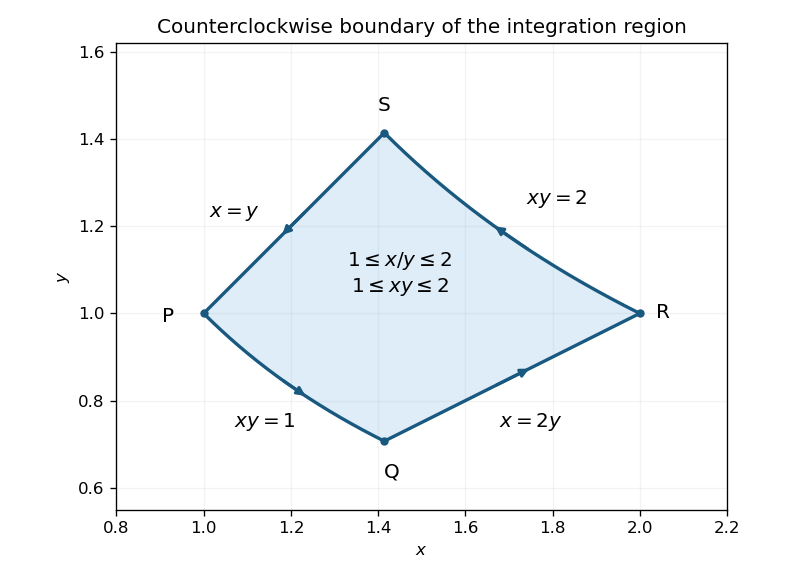
Counterclockwise boundary of the region between two rays and two hyperbolas
. Details. 
On , use with . Here , so the line integral isOn , use with :On , use with decreasing from to :Finally, on , use with decreasing from to :Adding all four line integrals gives for the positive orientation, or for the reverse orientation.
Past exam of the mathematics course of the University of Cambridge 2008 ia Paper 3 12C i Solution by Codex 0 Created 2026-09-24 Updated 2026-10-14
Codex 0 Created 2026-09-24 Updated 2026-10-14The inequalities force , and the reciprocal bounds exclude zero. Thus the whole region lies in the positive quadrant. Introduce ratio-product coordinatesThe region becomes the rectangle , . The inverse map and its Jacobian determinant areThe change of variables formula then gives
Past exam of the mathematics course of the University of Cambridge 2008 ia Paper 3 11C b iii by Codex 0 Created 2026-09-24 Updated 2026-09-24
Codex 0 Created 2026-09-24 Updated 2026-09-24 Past exam of the mathematics course of the University of Cambridge 2008 ia Paper 3 11C b ii by Codex 0 Created 2026-09-24 Updated 2026-09-24
Codex 0 Created 2026-09-24 Updated 2026-09-24 Past exam of the mathematics course of the University of Cambridge 2008 ia Paper 3 11C b i by Codex 0 Created 2026-09-24 Updated 2026-09-24
Codex 0 Created 2026-09-24 Updated 2026-09-24 There are unlisted articles, also show them or only show them.