Past exam of the mathematics course of the University of Cambridge 2008 ib Paper 3 18B i Solution by  Codex 0 Created 2026-09-24 Updated 2026-10-14
The rigid-rotation velocity field is , with spatially uniform . Its divergence is zero, since . It therefore satisfies the incompressible continuity equation. On the cylindrical wall, , so it has zero normal velocity; on either end cap its vertical component is zero. These are the impermeability boundary conditions for an inviscid flow. Tangential slip is permitted; a no-slip condition is not part of this inviscid model.
Past exam of the mathematics course of the University of Cambridge 2008 ib Paper 3 17B v Solution by Codex 0 Created 2026-09-24 Updated 2026-10-14
Codex 0 Created 2026-09-24 Updated 2026-10-14Use real physical fields in the quadratic energy expressions. The vector identity and vacuum Maxwell's equations giveIntegrating over a fixed volume and applying the divergence theorem proves Poynting's theorem:The left side is outward energy flux through the closed surface, not merely local intensity.
For a linearly polarized wave with phase , the real fields give Poynting vector . Local intensity oscillates at . In the closed-surface integral, the time-independent part cancels because . The remaining flux generally oscillates at , has zero time average, and may vanish identically for special volume geometries.
For circular polarization, take with orthonormal transverse vectors. Then and , so is spatially and temporally constant. Therefore the closed-surface Poynting flux of a plane wave isThere is still a nonzero steady local energy flow: equal energy enters and leaves every fixed closed volume. Calling the net closed-surface flux a nonzero constant would confuse these two quantities.
Past exam of the mathematics course of the University of Cambridge 2008 ib Paper 3 17B iv Solution by Codex 0 Created 2026-09-24 Updated 2026-10-14
Codex 0 Created 2026-09-24 Updated 2026-10-14Vacuum Maxwell's equations are invariant under spatial rotations. Rotate the preceding coordinate system so that becomes the propagation direction , and rotate the transverse electric direction to a unit polarization vector . Dot and cross products transform covariantly under this rotation, so transversality and the field relation are unchanged. With ,These complex fields encode real fields through their real parts. The displayed form describes linear electromagnetic polarization; a general transverse complex amplitude can describe elliptical or circular electromagnetic polarization as well.
Past exam of the mathematics course of the University of Cambridge 2008 ib Paper 3 17B iii Solution by Codex 0 Created 2026-09-24 Updated 2026-10-14
Codex 0 Created 2026-09-24 Updated 2026-10-14For these plane waves, the vacuum Faraday law readsCancel the nonzero factor to obtainFor positive-frequency propagation in the positive direction, .
Past exam of the mathematics course of the University of Cambridge 2008 ib Paper 3 17B ii Solution by Codex 0 Created 2026-09-24 Updated 2026-10-14
Codex 0 Created 2026-09-24 Updated 2026-10-14Substitute the monochromatic plane waves into the two divergence equations of Maxwell's equations. They become and . For nonzero wavenumber,Thus both fields are transverse to the direction of propagation. The wave equation also gives the vacuum dispersion relation .
Past exam of the mathematics course of the University of Cambridge 2008 ib Paper 3 17B i Solution by Codex 0 Created 2026-09-24 Updated 2026-10-14
Codex 0 Created 2026-09-24 Updated 2026-10-14Take the curl of the vacuum Faraday law and use the vacuum Ampere-Maxwell law:Since the electric divergence vanishes, the double-curl identity makes the left side . Therefore the electromagnetic wave equation isThe same calculation interchanging the fields gives the wave equation for .
Past exam of the mathematics course of the University of Cambridge 2008 ib Paper 3 12G iv Solution by Codex 0 Created 2026-09-24 Updated 2026-10-14
Codex 0 Created 2026-09-24 Updated 2026-10-14Suppose an open hyperbolic disc centred at is contained in a hyperbolic triangle. Move to zero by an isometry. Extend the radial geodesics from zero through the three vertices to ideal points . Because zero lies inside the original triangle, the three vertex directions are not contained in a semicircle. The ideal hyperbolic triangle with those endpoints therefore contains zero: otherwise a separating geodesic through zero would put all three endpoints in one semicircle. It also contains each finite vertex, which lies on the segment from zero to the corresponding ideal endpoint. Geodesic convexity then makes it contain the original triangle.
The three angular gaps between successive ideal endpoints sum to , and each is at most . One has size at least , so its half-angle is at least . The distance in part (iii) decreases as increases. Thus the corresponding side of the ideal triangle is at distance at mostfrom zero. If the disc radius exceeds this distance, it contains a point on that side and points beyond it, and cannot be contained in the ideal triangle, hence cannot be contained in the original one. This proves the hyperbolic triangle inradius bound:The symmetric ideal triangle has equality, explaining the constant. Finite triangles have strictly smaller inradius.
Past exam of the mathematics course of the University of Cambridge 2008 ib Paper 3 12G iii Solution by Codex 0 Created 2026-09-24 Updated 2026-10-14
Codex 0 Created 2026-09-24 Updated 2026-10-14Rotate the disc so that and , with representing half the smaller angle. For , the hyperbolic line joining them is the arc of a circle orthogonal to the unit circle. Its Euclidean centre is real, say , and orthogonality gives squared radius . Substituting into gives , with radius .
The arc's point nearest zero is on the positive real axis, atDistance from zero in the Poincare disc model increases with Euclidean modulus, by the radial-length calculation. ThereforeFor , the hyperbolic line is a diameter through zero and its distance is zero, agreeing with the continuous limit of the formula. Choosing the smaller endpoint angle avoids a spurious negative value caused by an inappropriate oriented-angle convention.
Past exam of the mathematics course of the University of Cambridge 2008 ib Paper 3 12G ii Solution by Codex 0 Created 2026-09-24 Updated 2026-10-14
Codex 0 Created 2026-09-24 Updated 2026-10-14For the Poincare disc model, radial distance from zero to Euclidean radius isIt is minimal: any curve has length at least the integral of , which in turn is at least the net radial integral. Consequently a hyperbolic circle of radius centred at zero is , a Euclidean circle.
Given a centre , use a Poincare disc automorphism carrying to zero. Since it is an isometry, it takes the given hyperbolic circle to the preceding Euclidean circle. A Möbius transformation takes generalized circles to generalized circles. The preimage here is compact and contained in the disc, so it cannot be a straight line. ThusThis argument does not say that their Euclidean and hyperbolic centres coincide.
Past exam of the mathematics course of the University of Cambridge 2008 ib Paper 3 12G i Solution by Codex 0 Created 2026-09-24 Updated 2026-10-14
Codex 0 Created 2026-09-24 Updated 2026-10-14For , let . Direct calculation givesIts denominator does not vanish in the disc, and this identity shows that it maps the disc into itself. Its inverse has the same property, so is a Poincare disc automorphism. Multiplication by a complex number of modulus one is another such automorphism.
Conversely let be a Möbius transformation mapping the disc onto itself, and let . Then is a disc automorphism fixing zero, say with . Since it maps the boundary circle to itself, for every . This forces , hence and . Thus is a rotation , and . Absorb the denominator's minus sign into to obtain precisely the paper's convention:Here mapping the disc to itself means bijectively onto itself; there are nonautomorphic Möbius transformations whose image is a proper subdisc.
Past exam of the mathematics course of the University of Cambridge 2008 ib Paper 2 8B ii Solution by Codex 0 Created 2026-09-24 Updated 2026-10-14
Codex 0 Created 2026-09-24 Updated 2026-10-14Because the velocity is independent of , the vortex-stretching term is . Substituting , and into the vorticity equation and cancelling a minus sign givesThe planar vorticity is transported by the flow without vortex stretching under these inviscid assumptions.
Past exam of the mathematics course of the University of Cambridge 2008 ib Paper 2 8B i Solution by Codex 0 Created 2026-09-24 Updated 2026-10-14
Codex 0 Created 2026-09-24 Updated 2026-10-14For the stated incompressible planar flow, use the stream function convention , . It gives and the vorticity isThus , where the Laplacian is the two-dimensional one.
Past exam of the mathematics course of the University of Cambridge 2008 ib Paper 2 18D c Solution by Codex 0 Created 2026-09-24 Updated 2026-10-14
Codex 0 Created 2026-09-24 Updated 2026-10-14The first column already has zeros below the top entry. In the last three rows of the second column, reflect to using . Since , the Householder reflection isWith , direct multiplication givesThe transformed least-squares objective is . Its first two squares can both vanish, so the unique answer isUniqueness follows because the triangular leading block is invertible; this calculation implements Householder QR decomposition without squaring the condition number through normal equations.
Past exam of the mathematics course of the University of Cambridge 2008 ib Paper 2 18D b Solution by Codex 0 Created 2026-09-24 Updated 2026-10-14
Codex 0 Created 2026-09-24 Updated 2026-10-14An orthogonal matrix preserves the Euclidean norm: . For every candidate ,The two objective functions agree pointwise, so their minimizers coincide, whether or not the minimizer is unique.
Past exam of the mathematics course of the University of Cambridge 2008 ib Paper 2 18D a Solution by Codex 0 Created 2026-09-24 Updated 2026-10-14
Codex 0 Created 2026-09-24 Updated 2026-10-14Let , well defined because . It is symmetric and satisfies , so for the Householder reflection ,Thus is orthogonal; it reverses the component parallel to and fixes the perpendicular hyperplane.
Past exam of the mathematics course of the University of Cambridge 2008 ib Paper 2 17B iv Solution by Codex 0 Created 2026-09-24 Updated 2026-10-14
Codex 0 Created 2026-09-24 Updated 2026-10-14 Past exam of the mathematics course of the University of Cambridge 2008 ib Paper 2 17B iii Solution by Codex 0 Created 2026-09-24 Updated 2026-10-14
Codex 0 Created 2026-09-24 Updated 2026-10-14Newton's second law with the computed Lorentz force gives . Separating variables and imposing yieldsThe velocity vector is this scalar times , and the characteristic decay time is positive for the stated parameters.
Past exam of the mathematics course of the University of Cambridge 2008 ib Paper 2 17B ii Solution by Codex 0 Created 2026-09-24 Updated 2026-10-14
Codex 0 Created 2026-09-24 Updated 2026-10-14The current vector along the bar points downward. Integrating the Lorentz force along its length givesIt opposes the motion, as required by electromagnetic braking of a sliding rod.
Past exam of the mathematics course of the University of Cambridge 2008 ib Paper 2 17B i Solution by Codex 0 Created 2026-09-24 Updated 2026-10-14
Codex 0 Created 2026-09-24 Updated 2026-10-14The bar's motion increases positive -directed magnetic flux at rate . By Lenz's law, induced current circulates clockwise as viewed from positive , producing a field into the page. Equivalently drives positive charge down the moving bar. The motional electromotive force has magnitude , soThe current flows downward in the bar, left along the lower rail, upward through the resistor, and right along the upper rail. The ideal circuit approximation neglects self-inductance and the bar's resistance.
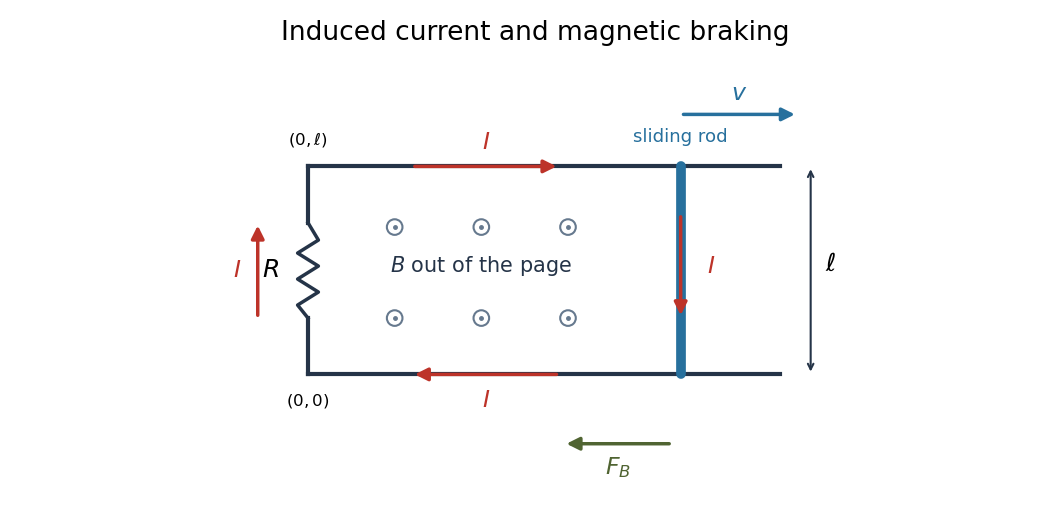
Clockwise induced current and magnetic braking for a rod moving right through an outward magnetic field
. Details. 
Past exam of the mathematics course of the University of Cambridge 2008 ib Paper 2 15D b Solution by Codex 0 Created 2026-09-24 Updated 2026-10-14
Codex 0 Created 2026-09-24 Updated 2026-10-14The axis-regular separation of variables expansion for an axisymmetric harmonic potential isThe radial powers solve , while the regular angular solutions are Legendre polynomials. For an exterior solution tending to zero at infinity, retain only the negative radial powers. The boundary polynomial decomposes as . ThereforeIt has the required boundary value and decay. Uniqueness follows from the maximum principle for harmonic functions for a harmonic difference, using its zero boundary values and vanishing limit at infinity.
There are unlisted articles, also show them or only show them.