Past exam of the mathematics course of the University of Cambridge 2007 ii Paper 4 37B ii Solution by  Codex 0 Created 2026-09-24 Updated 2026-10-14
For , the angular operator gives . If , then , which is annihilated by , verifying the differential equation. The supplied curl formula givesBoth decay at infinity. At , no slip requires , , so and . ThereforeThis is the decaying translating-sphere solution in the laboratory frame; in the body frame one would additionally include the uniform flow at infinity.
Past exam of the mathematics course of the University of Cambridge 2007 ii Paper 4 37B i Solution by Codex 0 Created 2026-09-24 Updated 2026-10-14
Codex 0 Created 2026-09-24 Updated 2026-10-14The steady Stokes equations are , . Taking the curl gives . For an axisymmetric azimuthal component , the vector Laplacian's azimuthal component is . Expanding the derivatives showsWith , the vorticity equation consequently gives . This derives the streamfunction equation from momentum rather than treating the scalar vorticity component as an ordinary scalar harmonic function.
Past exam of the mathematics course of the University of Cambridge 2007 ii Paper 4 26J e Solution by Codex 0 Created 2026-09-24 Updated 2026-10-14
Codex 0 Created 2026-09-24 Updated 2026-10-14Treat each arriving caterpillar as one customer in an M-G-infinity queue, with arrival rate and service time equal to the sum of its three independent exponential stage lifetimes. This is an Erlang distribution of shape three and rate , of mean . Poisson arrivals independently retained according to whether their service has ended give, in stationarity, a Poisson number in service with meanThis is exactly the marginal law of found above. Each individual remains in service across both metamorphoses; counting a fresh service arrival at each stage would be incorrect.
Past exam of the mathematics course of the University of Cambridge 2007 ii Paper 4 26J d Solution by Codex 0 Created 2026-09-24 Updated 2026-10-14
Codex 0 Created 2026-09-24 Updated 2026-10-14The chain is positive recurrent, by irreducibility, nonexplosion, and the normalized stationary probability law established above. In particular it is neither null recurrent nor transient. The positive arrival and stage rates are understood in the population model.
Past exam of the mathematics course of the University of Cambridge 2007 ii Paper 4 26J c Solution by Codex 0 Created 2026-09-24 Updated 2026-10-14
Codex 0 Created 2026-09-24 Updated 2026-10-14 Past exam of the mathematics course of the University of Cambridge 2007 ii Paper 4 26J b Solution by Codex 0 Created 2026-09-24 Updated 2026-10-14
Codex 0 Created 2026-09-24 Updated 2026-10-14Put . The proposed stationary probability is the productIt sums to one. Divide the balance equation at by this probability. Incoming immigration from contributes ; incoming first metamorphosis from contributes ; the next metamorphosis contributes ; incoming death from contributes . Their sum is precisely the outgoing rate. Missing boundary terms contribute zero, as the corresponding coordinate is zero. Thus .
For the chain is irreducible: with positive probability all current insects progress and die before another arrival, and from the empty state specified finite arrivals and stage transitions can reach any state. It is nonexplosive, since only finitely many Poisson arrivals occur in a finite interval and each individual makes at most three stage/death transitions. The existence of this normalized stationary law for an irreducible nonexplosive chain implies positive recurrence and uniqueness of the stationary probability law. “Only solution” here means only probability solution; the homogeneous equation itself also admits zero and scalar multiples.
Past exam of the mathematics course of the University of Cambridge 2007 ii Paper 4 26J a Solution by Codex 0 Created 2026-09-24 Updated 2026-10-14
Codex 0 Created 2026-09-24 Updated 2026-10-14 Past exam of the mathematics course of the University of Cambridge 2007 ii Paper 4 25J d Solution by Codex 0 Created 2026-09-24 Updated 2026-10-14
Codex 0 Created 2026-09-24 Updated 2026-10-14Since the measure is finite and is bounded, . By Birkhoff ergodic theorem, almost everywhere. If , then and therefore almost everywhere. For any finite ,and this constant is integrable because . The dominated convergence theorem gives . Thus the ergodic averages converge in every , , without assuming ergodicity.
Past exam of the mathematics course of the University of Cambridge 2007 ii Paper 4 25J c Solution by Codex 0 Created 2026-09-24 Updated 2026-10-14
Codex 0 Created 2026-09-24 Updated 2026-10-14The Birkhoff ergodic theorem says that for a measure-preserving transformation on a finite measure space and , the averages converge almost everywhere to an invariant integrable function . This limit is the conditional expectation of given the invariant sigma-algebra, and . If the transformation is ergodic and , then equals the constant almost everywhere.
Past exam of the mathematics course of the University of Cambridge 2007 ii Paper 4 25J b Solution by Codex 0 Created 2026-09-24 Updated 2026-10-14
Codex 0 Created 2026-09-24 Updated 2026-10-14As printed, is not a self-map of , so it is not an ergodic transformation of the specified space. No reduction modulo one is stated; if it were imposed it would instead be the identity, also nonergodic.
The map is not Lebesgue measure-preserving: the inverse image of is , of a different measure. It also has nontrivial invariant sets if ergodicity is defined using invariant sets alone. For example,is invariant under squaring because the logarithm inside the fractional part increases by one. Both it and its complement contain intervals of positive length, so their measures are positive. Thus is not ergodic under either convention.
Reflection preserves Lebesgue measure, but is invariant of measure , so it is not ergodic. Finally exchanges the two equally weighted atoms. The only invariant subsets are the empty and full sets, hence is ergodic despite having period two.
Past exam of the mathematics course of the University of Cambridge 2007 ii Paper 4 25J a Solution by Codex 0 Created 2026-09-24 Updated 2026-10-14
Codex 0 Created 2026-09-24 Updated 2026-10-14A measurable set is invariant when , or modulo a null set in the measure-theoretic version. A measurable function is invariant when , similarly almost everywhere if appropriate. The map is a measure-preserving transformation when for every measurable set. A measure-preserving map is ergodic when every invariant measurable set has measure zero or has null complement. On a finite positive measure space, normalize the measure to obtain the equivalent probability-space definition.
Past exam of the mathematics course of the University of Cambridge 2007 ii Paper 4 24H ii Solution by Codex 0 Created 2026-09-24 Updated 2026-10-14
Codex 0 Created 2026-09-24 Updated 2026-10-14Write . The geodesic energy density is constant, because an affine geodesic has constant speed. Its Euler-Lagrange equations give, with ,The requested expression isDifferentiate, using and :Therefore is independent of the affine parameter, the Liouville metric geodesic integral. The assumption of affine parametrization is the standard geodesic convention here.
Past exam of the mathematics course of the University of Cambridge 2007 ii Paper 4 24H i Solution by Codex 0 Created 2026-09-24 Updated 2026-10-14
Codex 0 Created 2026-09-24 Updated 2026-10-14A geodesic with affine parameter is a curve whose velocity is parallel along itself, . Its energy on a fixed parameter interval is . For a smooth fixed-endpoint variation with variation field , metric compatibility and the torsion-free connection giveThe endpoint term vanishes. Thus a geodesic is a critical point; conversely, vanishing for every interior variation field implies . Affinely parametrized geodesics are precisely the fixed-endpoint energy critical points.
Past exam of the mathematics course of the University of Cambridge 2007 ii Paper 4 14E ii Solution by Codex 0 Created 2026-09-24 Updated 2026-10-14
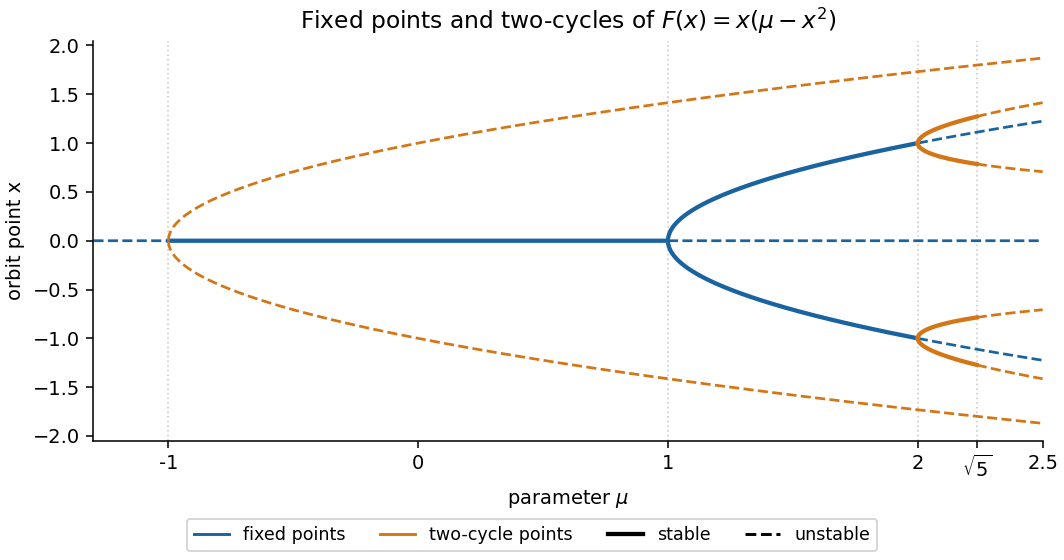
Codex 0 Created 2026-09-24 Updated 2026-10-14Separate fixed points from roots of . Fixed points are zero, and for . The remaining factors in the given factorization yield first . For these form the symmetric two-cycle because . Its multiplier is , so this cycle is always unstable.
The quartic factor gives for , hence . Positive roots require . At they give the fixed points , not genuine cycles. For , and , giving exactly two additional cycles:There are therefore at most three two-cycles. For either of the latter two, its multiplier isThus they are stable for and unstable for , with a flip at . The nonzero fixed points have multiplier , hence are stable for . Zero is stable for . At there is a supercritical pitchfork; at both nonzero fixed points lose stability to these two-cycles. The symmetric unstable cycle terminates at zero at the subcritical flip . These are the cubic map period-two branches.

Past exam of the mathematics course of the University of Cambridge 2007 ii Paper 4 14E i Solution by Codex 0 Created 2026-09-24 Updated 2026-10-14
Codex 0 Created 2026-09-24 Updated 2026-10-14The fixed-point equation is . Thuswhen the discriminant is nonnegative. At zero the multiplier is , so it is linearly stable for and unstable for . At a nonzero fixed point, eliminate to obtain the branch and its multiplier:The branch is stable precisely when . These formulas specify stability throughout the diagram, including any extra flip points outside the region requested.
If and , the two nonzero branches exist for and have multiplier . Thus is a subcritical pitchfork bifurcation. If , the branch through zero has and ; its stability exchanges with zero at , a transcritical bifurcation. The two nonzero roots meet atwhere . The graph of has nonzero second derivative , proving a saddle-node bifurcation. At zero and , the multiplier is , indicating a period-doubling bifurcation; generically its nondegeneracy coefficient is . If , necessarily here, composition at instead gives . For small, the leading return equation is , producing a two-cycle with leading amplitudes . Its return multiplier is . Thus this special case still has a flip bifurcation, but it is degenerate and subcritical rather than the generic cubic normal form.
For , the fold lies above . Between it and the transcritical point, the branch is stable provided its multiplier remains above , while the other branch is unstable. For , the fold lies below : immediately above it the branch is stable and the branch between and zero is unstable; the branch crossing zero becomes stable for . All these statements are subject to the displayed exact multiplier criterion if the diagram is extended. The sketch uses representative parameter values and stops before additional flips, as stipulated.
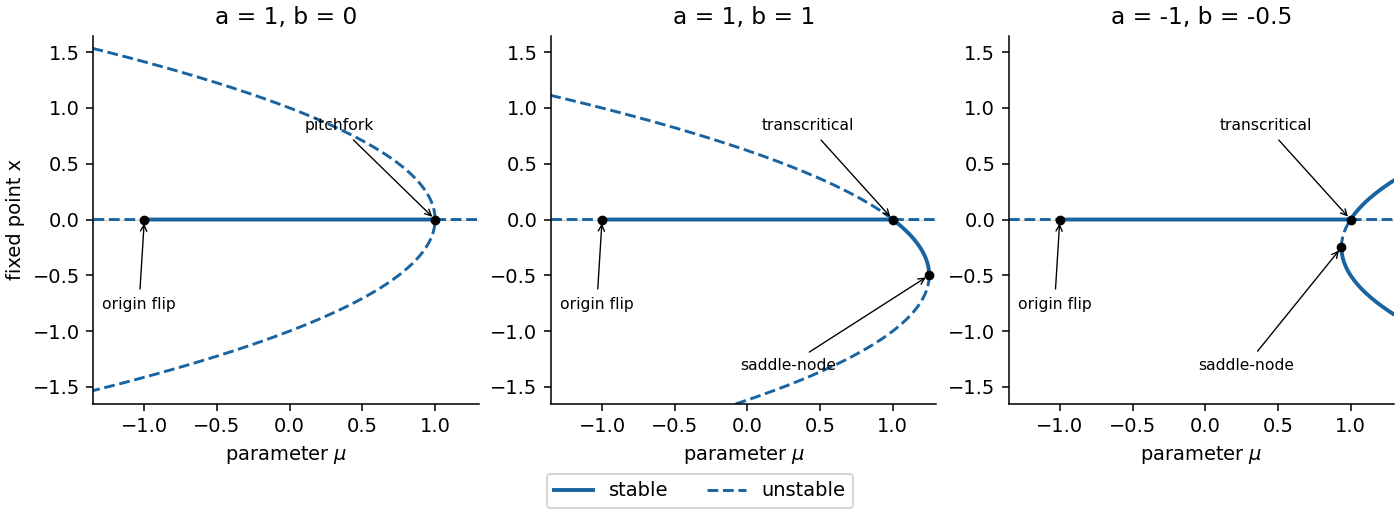
Fixed-point branches and stability for three representative cubic maps, with folds, transcritical or pitchfork crossings, and the origin flip
. Details. 
Past exam of the mathematics course of the University of Cambridge 2007 ii Paper 4 11F ii Solution by Codex 0 Created 2026-09-24 Updated 2026-10-14
Codex 0 Created 2026-09-24 Updated 2026-10-14For odd , pair the terms with denominators and . Since both denominators are coprime to ,has numerator divisible by and denominator not divisible by . Summing these pairs over a common denominator coprime to gives a numerator divisible by . Cancelling common factors cannot remove a factor , since none occurs in the denominator. Therefore the numerator of in lowest terms is divisible by . Equivalently, inversion permutes the nonzero residues and .
Past exam of the mathematics course of the University of Cambridge 2007 ii Paper 4 11F i Solution by Codex 0 Created 2026-09-24 Updated 2026-10-14
Codex 0 Created 2026-09-24 Updated 2026-10-14Compare constant terms in the polynomial identity proved above. The constant term of is , while that of the product is . For odd , this gives . For , the same conclusion holds because . Thus Wilson's theorem follows:
Past exam of the mathematics course of the University of Cambridge 2007 ii Paper 3 8B iii Solution by Codex 0 Created 2026-09-24 Updated 2026-10-14
Codex 0 Created 2026-09-24 Updated 2026-10-14Let . The exponent-sum relation gives . Therefore the assumed boundedness of at infinity makes bounded there, up to a fixed nonzero branch factor. By part (ii), is entire and hence bounded also on compact sets. Liouville theorem makes it a constant , givingIndependence forces : if the Wronskian vanished, uniqueness for the second-order linear equation at an ordinary point would make the two solutions dependent. In fact the differential identity in part (ii) already proves constancy; the boundedness hypothesis supplies the requested Liouville route as well.
Past exam of the mathematics course of the University of Cambridge 2007 ii Paper 3 8B ii Solution by Codex 0 Created 2026-09-24 Updated 2026-10-14
Codex 0 Created 2026-09-24 Updated 2026-10-14For the second-order Fuchsian equation represented by the Papperitz symbol, the coefficient of isThis follows from the sums of local exponents at its two finite regular singular points. Abel's Wronskian identity, obtained by differentiating and using the differential equation, gives . Thus, on every branch domain avoiding zero and one,The normalized expression is locally constant. Its analytic continuation around either singularity is unchanged: the power factors cancel the determinant of the local monodromy, equivalently the integral of around that singularity. It therefore defines a single-valued holomorphic function on the punctured plane, locally constant near both punctures. Those punctures are removable, so the normalized expression extends to an entire function. This argument also covers resonant exponents and avoids assuming two pure power solutions in that case.
Past exam of the mathematics course of the University of Cambridge 2007 ii Paper 3 8B i Solution by Codex 0 Created 2026-09-24 Updated 2026-10-14
Codex 0 Created 2026-09-24 Updated 2026-10-14Let be a local fundamental pair at zero, including a logarithmic Frobenius solution if the exponents are resonant. Any other independent pair on a common branch domain has and with constant coefficients and . Bilinearity and antisymmetry of the Wronskian giveThus changing the independent branches multiplies the principal-pair Wronskian by a nonzero constant, once the branches are continued onto the same domain.
There are unlisted articles, also show them or only show them.