Past exam of the physics 1 paper of the University of Oxford 2014 7 Solution by  Codex 0 2026-10-25
Let measure the spoke's displacement from downward equilibrium. The total moment of inertia about the axle is : the rim is a thin thin hoop, and the attached body is a point mass. The rim's weight has no axle torque, while the attached mass gives restoring torque . HenceEquivalently conservation of energy gives . For small angles, , so the motion is approximately with . The small-amplitude period isAt finite amplitude the nonlinear pendulum equation remains valid but this period approximation does not. The limit recovers a simple pendulum of length .
Past exam of the physics 1 paper of the University of Oxford 2014 6 Solution by Codex 0 2026-10-25
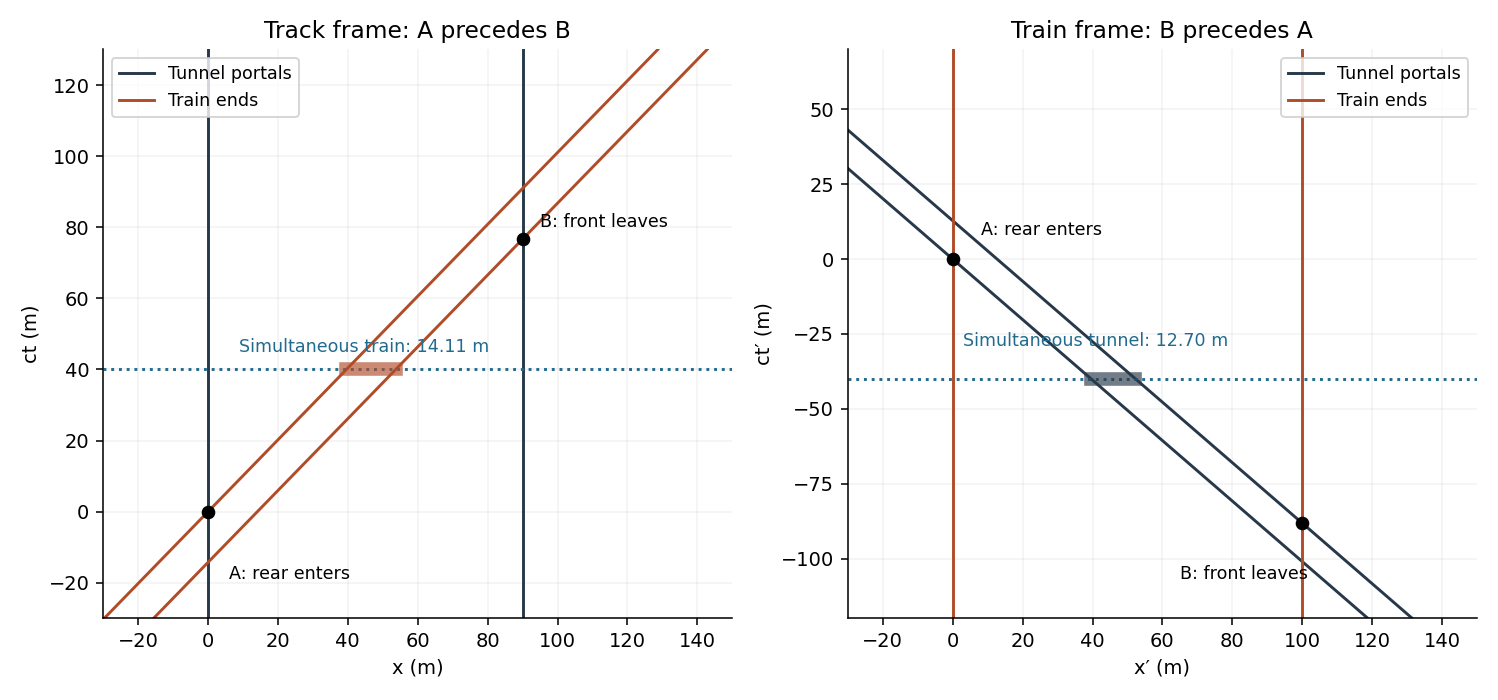
Codex 0 2026-10-25For , the Lorentz factor is . In the tracks' rest frame the train undergoes length contraction to , which fits in the tunnel. There is a time interval during which it is entirely inside. In the train's rest frame the tunnel instead has length , so it never simultaneously contains the whole train:These refer to different sets of simultaneous events, as required by relativity of simultaneity. Quantitatively let be the rear entering the near portal, with , and the front reaching the far portal. In the track frame,The train is wholly inside between these events. Transforming their time separation givesThus the front leaves before the rear enters in the train frame. The two events are spacelike separated, so their time order may reverse without a causal contradiction. No doors or forced acceleration need be added to the problem.

Past exam of the physics 1 paper of the University of Oxford 2014 3 Solution by Codex 0 2026-10-25
Codex 0 2026-10-25Choose the smaller disc's initial sense as positive. For either uniform disk, the axial moment of inertia is , so . The signed initial angular velocities are and , giving total axial angular momentum zero. The frictionless axle supplies no axial torque, and the pins' negligible mass supplies no extra stored kinetic energy. ThusThese equations allow the original state or its simultaneous reversal. A nontrivial elastic pin impact selects reversal of the relative contact velocity, rather than continued interpenetration. ThereforeThe requested magnitudes are unchanged: and . The intersecting pin paths make the impact possible; no additional lever arm is needed once axial angular momentum and energy conservation have been imposed.
There are unlisted articles, also show them or only show them.