Past exam of the physics 1 paper of the University of Oxford 2015 8 Solution by  Codex 0 2026-10-25
Let be the equilibrium, so . For , the Taylor expansion of the potential givesAn ordinary small-amplitude simple harmonic motion therefore requires a nondegenerate local minimum, , with the quadratic term dominating the higher terms over the excursion. ThenA local minimum with , such as a quartic minimum, need not give small-amplitude harmonic motion with a nonzero limiting angular frequency. If , the equilibrium is unstable rather than oscillatory.
Past exam of the physics 1 paper of the University of Oxford 2015 7 Solution by Codex 0 2026-10-25
Codex 0 2026-10-25Work in the parent's rest frame, with . Four-momentum conservation givesso both daughter momenta have magnitude . Their relativistic energy-momentum relations give and . Subtracting these two relations and using the total energy yieldsSubstitution back gives the relativistic two-body decay momentum:The unit vector is not fixed by four-momentum conservation alone. The expression under the square root is the Källén function . The physical two-body decay threshold is ; for massive daughters equality gives zero outgoing momentum. For two massless daughters, each has energy and momentum magnitude .
Past exam of the physics 1 paper of the University of Oxford 2015 6 Solution by Codex 0 2026-10-25
Codex 0 2026-10-25Align both frames' axes with the motion and make their origins coincide at . With moving along at speed relative to , the Lorentz transformation and its inverse arewhere ; the transverse coordinates are unchanged. Along the object's path, . Taking differentials of the inverse transformation givesThis is relativistic velocity addition. For it reduces to the Galilean sum; if , the result is still . Two subluminal positive speeds give a subluminal result.
Past exam of the physics 1 paper of the University of Oxford 2015 5 Solution by Codex 0 2026-10-25
Codex 0 2026-10-25Let the projectile's initial laboratory velocity be . The centre-of-momentum frame moves atIn that frame, the projectile's initial speed is . An elastic collision preserves that speed, but can change its direction. Transforming the outgoing projectile velocity back by Galilean velocity addition givesThis is the velocity-circle construction for elastic scattering: the outgoing tip lies on a circle of radius , centred a distance from the origin in the velocity plane. Since , and the origin lies outside this circle. The largest scattering angle occurs when the ray from the origin is tangent to it. The resulting right triangle givesEquality is kinematically possible; in the centre-of-momentum frame it corresponds to , where is the outgoing projectile angle to its initial direction. In particular, a heavier projectile cannot reverse its laboratory direction in an isolated elastic collision with an initially stationary lighter target.
Past exam of the physics 1 paper of the University of Oxford 2015 2 Solution by Codex 0 2026-10-25
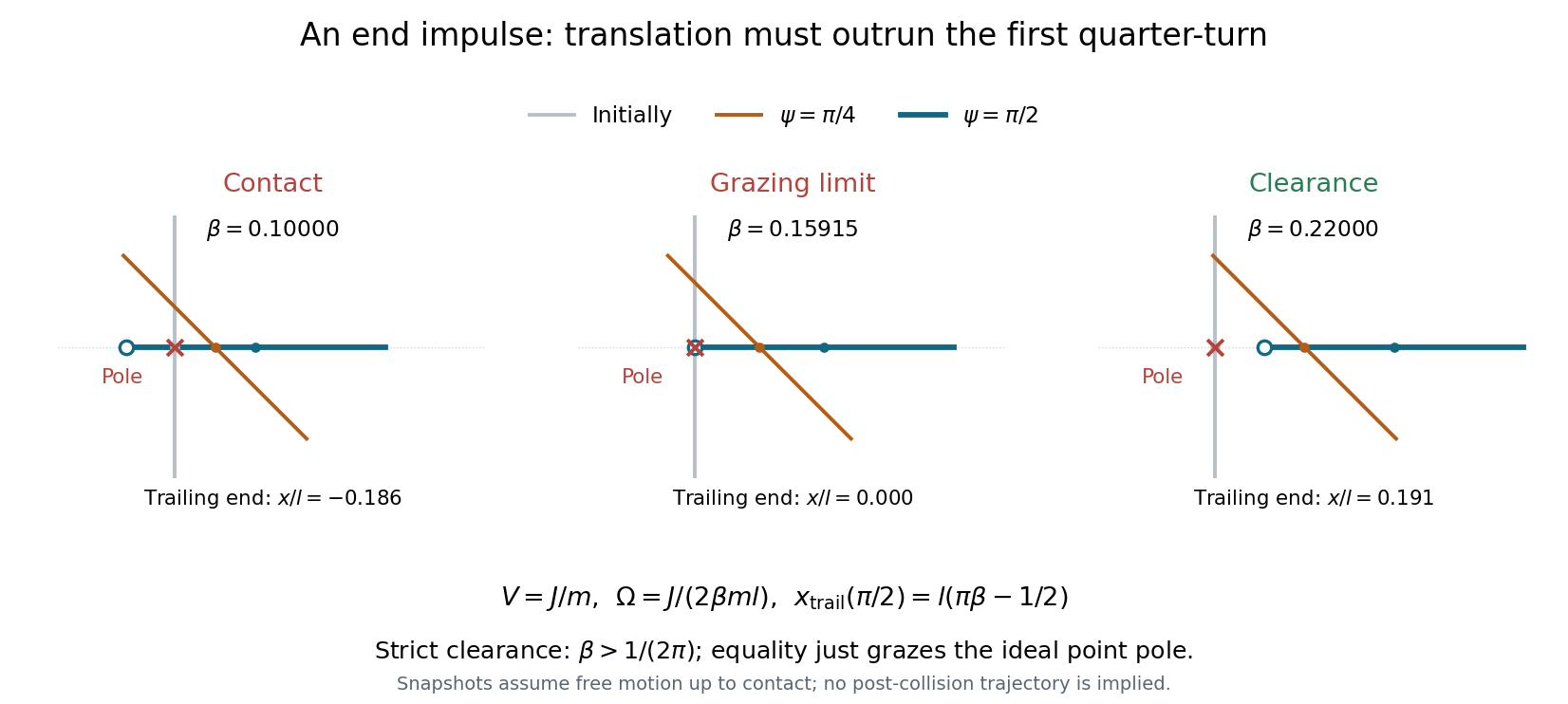
Codex 0 2026-10-25Idealize the pole and stick as having negligible transverse thickness. Put the pole at the origin, the stick initially along the axis, and the struck lower end at , as in the source diagram. A short horizontal impulse along gives the centre of mass a constant speed . The angular impulse about the centre is , giving constant counterclockwise angular velocityThe pole exerts no further force while the stick moves clear of it. Let . The trailing upper end has coordinatesThe pole can lie on the translating straight stick again only when the stick becomes horizontal: for other orientations, its intersection with is the moving midpoint . At the first horizontal orientation, , the trailing end is atConsequently the grazing clearance of an impulsively struck rod occurs atFor the whole stick has passed the pole by its first horizontal orientation, and the continually advancing centre makes all later passes safe. Equality is the limiting grazing contact of the endpoint; strict avoidance requires the strict inequality. If , the pole lies within the stick at that first horizontal pass, so contact occurs before the freely moving trailing end can pass the pole. A uniform thin stick has , below the threshold: sufficient mass near the ends is needed to increase its moment of inertia and reduce the rotation relative to translation.

Let be the runner's inertial frame, with origin at the entry event. The Lorentz transformation isThe emission event has coordinates , . It is earlier than entry in : entry and far-end emission are simultaneous only in the tunnel frame. This is relativity of simultaneity, not an extra delay of the light source.
Past exam of the physics 1 paper of the University of Oxford 2015 1 Solution by Codex 0 2026-10-25
Codex 0 2026-10-25Take the launch point as and ignore air drag. In projectile motion with constant gravitational acceleration , a launch at angle above the horizontal givesAt the wall , the height isThis is a concave quadratic polynomial in , so its unique maximum satisfies . HenceFor , the best trajectory has and reaches the wall at launch height. For , the mathematical maximum height is negative. If the ball must stay above level ground, it lands before reaching the wall: is the maximum same-level projectile range. If there is no intervening ground and the wall extends below the launch height, the same optimum still applies, but its impact point is below that height.
Past exam of the physics 1 paper of the University of Oxford 2015 resit 9 Solution by Codex 0 2026-10-25
Codex 0 2026-10-25Orbital energy. Treat the star as stationary to leading order in , with Newtonian gravitational parameter . For velocity components in plane polar coordinates, . The kinetic energy is . Integrating Newton's law of universal gravitation with zero gravitational potential energy at infinite separation gives . Thuswhere is the satellite's angular momentum. The first term is radial kinetic energy; the second is transverse kinetic energy, also the centrifugal contribution to the radial effective potential; the last is the attractive gravitational potential energy. These are not three independent sources of energy: the centrifugal term is already part of the ordinary kinetic energy.
For an elliptic Kepler orbit of semi-major axis and orbital eccentricity , the polar equation of a Kepler orbit has semilatus rectum . Substituting into the preceding expression reduces it toFor a circular Kepler orbit, , , , and . Negative total energy describes a bound orbit.
Rapid, symmetric mass loss. Assume the mass is removed on a timescale short compared with the satellite's orbital period, without an impulsive kick or appreciable wind drag on the satellite. The post-loss gravitational parameter is with . At the change, , , and are unchanged. Spherical symmetry keeps the force central, so the specific angular momentum is conserved. Orbital energy is not conserved across the changing gravitational field:The new semi-major axis is consequentlyThe original speed now exceeds the new circular speed at , and the outward radial acceleration is . Thus the release point is the new pericentre, not the apocentre. The impulsive orbital expansion under isotropic mass loss givesFor the stated one-percent loss,An independent angular momentum check is . The impulsive orbit stays bound for ; loss of half the central mass is the zero-orbital energy limit.
What the wind timescale changes. The source specifies a spherically symmetric wind but does not give its duration. The preceding nearest and furthest distances require the rapid-loss assumption. In the opposite, slow limit, adiabatic orbital expansion under isotropic mass loss preserves an initially circular orbit to leading adiabatic order. Conserved specific angular momentum then gives , hence . After the same loss,For a finite intermediate timescale, the orbit depends on the mass-loss history; the percentage alone does not select a unique pair of turning distances. Neglecting wind recoil and wind drag is common to both idealizations.
There are unlisted articles, also show them or only show them.