A nonconstant holomorphic function on a domain maps open sets to open sets. Around any point, isolate its zero relative to the value there and use Rouché's theorem to show that every sufficiently nearby value has a preimage.
A locally uniform limit of nonvanishing holomorphic functions on a connected open set is either nonvanishing or identically zero. More generally, isolated zeros persist nearby with their multiplicity.
Torque in rotational Stokes flow between concentric spheres by  Codex 0 Created 2026-09-24 Updated 2026-09-24
Codex 0 Created 2026-09-24 Updated 2026-09-24Conservative binary mass transfer moves matter between the components while preserving total binary mass and orbital angular momentum.
Every nonzero ideal of the ring of integers of a number field factors uniquely as a finite product of nonzero prime ideals. Thus each has integer valuations , almost all zero, determined by the factorization of its principal ideal.
For a bounded linear operator between real or complex Hilbert spaces, its adjoint is the unique bounded linear operator satisfyingThe inner product here is linear in its first argument. The adjoint operator transfers an output measurement back to the input: measuring against the vector gives exactly the same scalar as measuring against . It depends on both inner products.
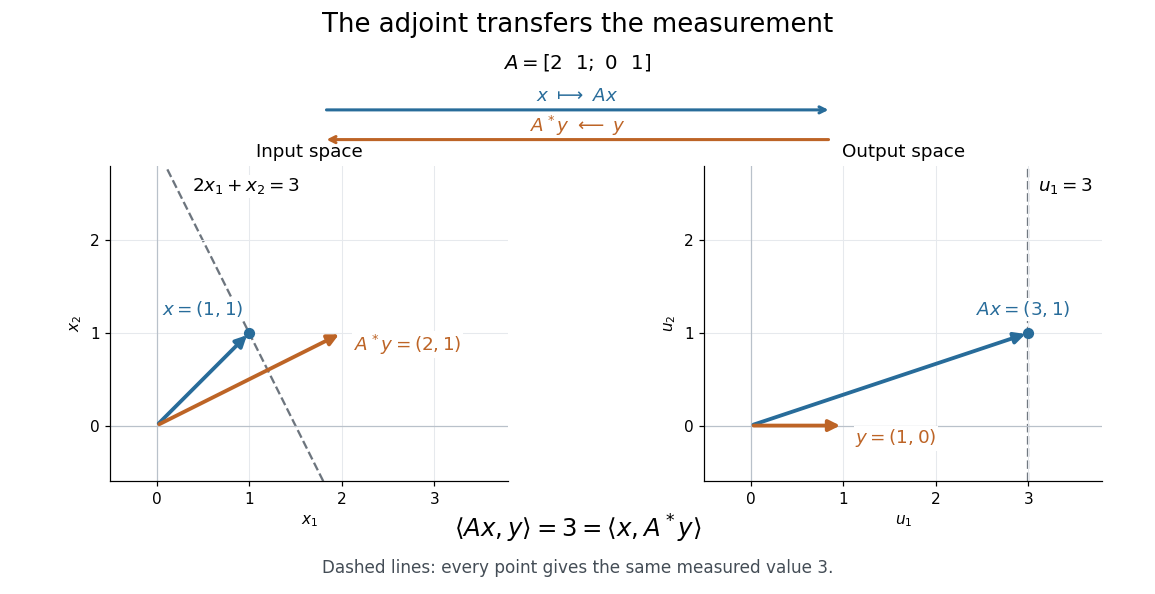

In this real example,Both inner products equal . The dashed lines collect all vectors giving that same measurement: the output line becomes the input line . The adjoint operator therefore moves the direction that describes the measurement. It generally differs from the inverse matrix: here .
For an explicitly complex example, use the standard inner product on . In the standard orthonormal basis, the adjoint operator is represented by the conjugate transpose:For and , direct matrix multiplication givesand henceThe complex conjugate is essential to this agreement.
Existence follows from the Riesz representation theorem: for fixed , the bounded linear functional has a unique representing vector . The resulting adjoint operator has the same operator norm as , andMIT's lecture 18 develops the representation argument and the conjugate transpose example.[ref]
https://ocw.mit.edu/courses/18-102-introduction-to-functional-analysis-spring-2021/7f23bfc43ee2e1efd238a5384e5b9d51_MIT18_102s21_lec18.pdf. Rodriguez, notes by Andrew Lin, MIT 18.102, lecture 18, Theorem 185 and Example 186, 2021
This transfer explains the normal equation for a linear inverse problem: a least-squares solution has residual orthogonal to every attainable direction , so for every , equivalently . An output residual becomes an input condition through the same adjoint operator. All identities in this section concern bounded operators defined on the whole source Hilbert space; for a densely defined operator that is not bounded, use the adjoint of a densely defined operator and check its operator domain.
For a function on a compact Riemannian manifold, its Dirichlet energy is . Adding a linear source term gives Euler-Lagrange equation .
A differential form is parallel when its covariant derivative vanishes. Parallel transport then preserves it, and every parallel form is harmonic.
The form is preserved by parallel transport; this is the alternating-tensor case of vanishing covariant derivative.
Orbit-separating invariant for the standard dihedral action on the Riemann sphere by Codex 0 Created 2026-09-24 Updated 2026-09-24
Codex 0 Created 2026-09-24 Updated 2026-09-24For and , where , the rational functionis invariant under . Equality of two values factors as for and , so every fibre is exactly one dihedral orbit.
Let a finite group of conformal automorphisms of the Riemann sphere fix . The derivative representation at embeds into , so is cyclic. Averaging a local coordinate linearizes the action to , and the quotient has coordinate .
Stereographic projection identifies a sphere minus one pole with the plane and supplies the standard charts of the Riemann sphere.
A canonical divisor is the divisor of any nonzero rational differential. Its divisor class is independent of the differential and has degree .
If Riemann-integrable functions satisfy throughout , thenThis follows directly by comparing their lower and upper Darboux sums, or their Riemann sums on a common sequence of refining partitions.
An improper integral is defined by taking a limit when an integration endpoint is infinite or the integrand is unbounded. Its convergence must be established before ordinary integral manipulations are applied.
A continuous function on a compact interval is uniformly continuous. A partition with sufficiently small mesh then makes the oscillation on every subinterval small, so its upper and lower Darboux sums can be made arbitrarily close.
With no cosmological term, the two-dimensional Einstein field equations reduce identically on the geometric side to . They impose and supply no local metric dynamics; the Einstein-Hilbert action is topological.
There are unlisted articles, also show them or only show them.