A complex-valued function is holomorphic on an open set when it has a complex derivative at every point of . Requiring a derivative throughout a neighbourhood is much stronger than complex differentiability at a point. It forces locally convergent Taylor series and derivatives of every order, as follows from the Cauchy integral formula and Cauchy derivative formula.
To see the restriction in real coordinates, write and . The real and imaginary increment quotients must agree, giving the Cauchy-Riemann equationsConversely, if have continuous partial derivatives on and satisfy the Cauchy-Riemann equations there, then is a holomorphic function. The equations at a lone point, without a differentiability hypothesis for the real coordinate map, are insufficient. Their role is to force the Jacobian matrix to have the special formSuch a matrix represents multiplication by a complex number; it has only two free real entries. [ref]
For , and , so and . Directly,At , multiplication by scales lengths by its modulus and rotates by its argument . A horizontal increment gives the exact displacement ; a vertical increment gives . The first-order predictions and are perpendicular, and the errors have modulus .
At every nonzero , this local rotation and scaling makes a local conformal map. At zero, the first-order map vanishes: becomes , so the argument doubles and the origin is a critical point. Globally and have the same square. Local preservation of angles therefore coexists with global folding, a useful warning when using holomorphic functions as coordinate changes.
For susceptible, infective, and recovered populations , mass-action infection coefficient , recovery rate , and immunity-loss rate , the SIRS equations areThey conserve and have basic reproduction number .
With susceptible, infective, and immune populations , equal per-capita birth and death rate , mass-action transmission coefficient , and recovery rate , the equations areThe conserved population is , and the threshold population is .
The basic reproduction number is the expected number of secondary infections caused by one infective in an otherwise susceptible population.
Susceptible-infective model with exponential density-dependent birth by  Codex 0 Created 2026-09-24 Updated 2026-10-14
Codex 0 Created 2026-09-24 Updated 2026-10-14The equationscombine mass-action infection with an exponential density-dependent birth model. Susceptibles reproduce at per-capita rate , while infectives have no reproductive term and die at total per-capita rate .
An endemic equilibrium is an equilibrium at which infection persists, so at least one infected compartment is positive.
A disease-free equilibrium is an equilibrium of an epidemic model at which every infected compartment is zero.
Under mass action, random pairwise encounters between populations of sizes and occur at a rate proportional to .
The SEIR model divides a population into susceptible, exposed, infectious, and recovered compartments.
If every transition transfers individuals between compartments without births, deaths, immigration, or emigration, the sum of all compartment sizes is constant.
For an ideal of a commutative ring , reducing coefficients modulo is a surjection with kernel . Hence
Module theory studies abelian groups with scalar multiplication by a ring. It extends linear algebra: a module over a field is a vector space, while ring scalars let the same language describe integer arithmetic and linear operators. The new phenomena are visible before any abstract classification: some nonzero scalars cannot be divided out, some modules have torsion elements of a module, and some have no basis of a module.
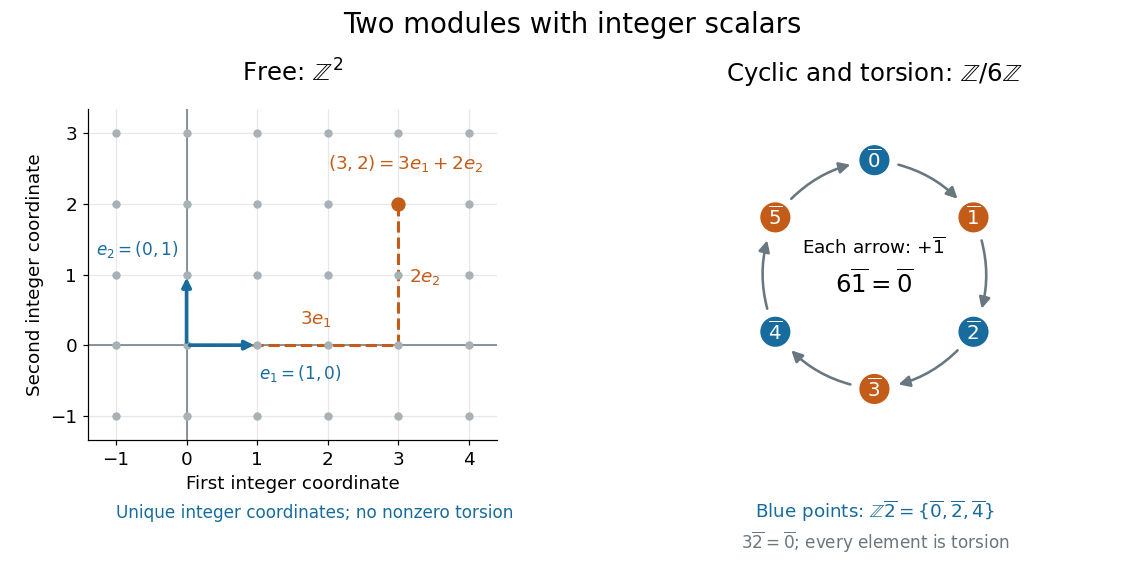

The distinction is useful because an integer relation such as carries information which disappears if one assumes all nonzero scalars have multiplicative inverses. A finitely generated module over a principal ideal domain can be separated into a finite free module and a torsion module; the structure theorem for finitely generated modules over a principal ideal domain unifies the classification of finitely generated abelian groups with the study of linear operators through polynomial rings. See Keith Conrad's Modules over a PID, Theorem 4.1 and the operator applications.
A historical anchor is Emmy Noether's 1921 paper [ref]
https://gdz.sub.uni-goettingen.de/id/PPN235181684_0083. Idealtheorie in Ringbereichen, Mathematische Annalen 83, pages 24–66
. Its first section studies rings and ideals under the condition that every ideal is a finitely generated module over its ring, and connects this to the ascending chain condition; later sections develop primary decomposition. This is an early source for the structural viewpoint underlying Noetherian rings. [ref] makes those statements accessible in English. Odd-valuation obstruction to a rational-function square by Codex 0 Created 2026-09-24 Updated 2026-09-24
Codex 0 Created 2026-09-24 Updated 2026-09-24For a primitive polynomialif a prime does not divide , divides every for , and has , then is irreducible. If , reduction modulo forces both and to be positive-degree monomials. Their constant terms are consequently divisible by , making , a contradiction. Gauss lemma for polynomials transfers the result between and .
There are unlisted articles, also show them or only show them.