
Intuitionistic propositional logic omits unrestricted excluded middle and interprets implication constructively.
A Möbius transformation is represented by an invertible two-by-two matrix, with nonzero scalar multiples representing the same map.
A Möbius transformation of the Riemann sphere has the formThe group is generated by translations, nonzero complex scalings, and inversion .
Over an algebraically closed field of characteristic other than two, the rank- quadricis an irreducible -dimensional cone for , and its singular locus is the omitted-coordinate vertex .
If , its affine cone is . If is smooth, every nonzero point of is smooth; hence the vertex is the only possible singular point. The vertex is smooth for linear and singular whenever .
Given homogeneous polynomials of the same degree, their pencil is the one-parameter familyIts total space is the projective hypersurface , and projection to has these plane curves as its fibres.
For a projective algebraic set , its affine cone is the union in of the lines represented by the points of , together with the origin.
If and , thenIt follows by expanding the squared distance after each projected step, using nonexpansiveness of projection, summing the resulting inequalities, and applying convexity.
On a product space , the cylinder sigma-algebra is generated by coordinate projections. Every event in it depends on at most countably many coordinates.
An event is a measurable set in a probability space: a question with a yes-or-no answer for each outcome. On , the event that the sum is at least nine consists of ten ordered pairs. Its probability is therefore under independent uniform dice. Saying that an event occurred means the actual outcome belongs to that set.
A concentration inequality bounds the probability that a random variable differs substantially from a typical value such as its expected value or median.
The second moment method uses a random variable's expected value and second moment to establish that a counted or measured quantity is positive with substantial probability. It is useful when a positive average alone could be caused by extremely large values on very rare outcomes. Controlling the variance rules out too much of that concentration in rare outcomes.
For a nonnegative random variable with and finite second moment, the second-moment bound for positivity givesEquivalently, . The method also includes the simpler Chebyshev's inequality bound . Thus a sequence of such random variables with has with probability tending to one. These statements require no independence assumption. The variance argument and its use for random counts are developed in Zhao's lecture notes. [ref].
For an original toy count, let count successes in ten independent Bernoulli trials with success probability . The binomial distribution givesConsequently . The exact probability is . The first moment method and union bound only give the upper bound here. First and second moments therefore answer complementary existence questions.
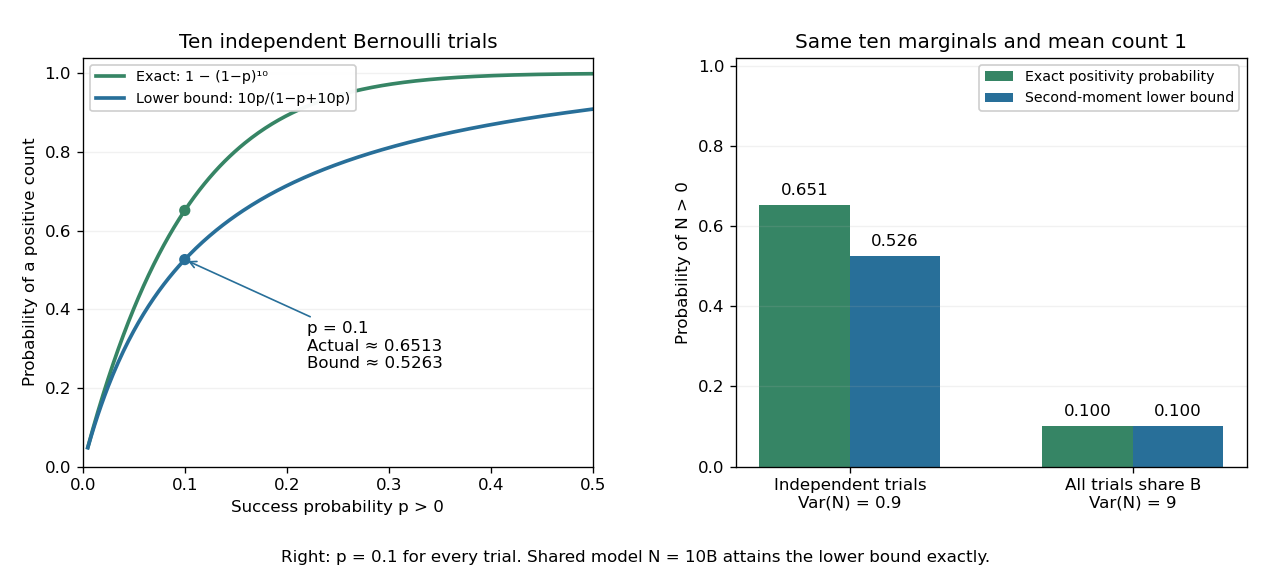
The second moment method certifies a positive count, while statistical dependence can change the conclusion despite an unchanged mean
. Left: exact binomial distribution probabilities of at least one success and second-moment lower bounds for ten independent trials as the success probability varies. Right: the same ten trials with either occur independently or share one common Bernoulli outcome. Both counts have mean one, but the perfectly linked count has much larger variance and only probability of being positive. All data are original specified probability models. Details.
For a sum of indicator random variables, the variance of a sum isIndependence makes the covariances vanish, but the formula itself also covers dependent counts. For the same ten success probabilities, let every trial share a single Bernoulli random variable : then , with mean one, variance nine, and . The second-moment lower bound is exactly . Ignoring the positive covariances would produce the false independent-count conclusion. Zhao's discussion of sums of indicators explains why overlapping counted structures require these pairwise terms. [ref]
https://ocw.mit.edu/courses/18-226-probabilistic-methods-in-combinatorics-fall-2022/mit18_226_f22_lec06-07.pdf. Zhao, MIT 18.226, §4.1: indicator covariances and Bernoulli counts
.The first moment method uses the expected value of a count to control whether any counted occurrence exists. For a random variable taking nonnegative integer values, Markov's inequality givesConsequently, implies , proving that an outcome with no counted occurrence exists. For a sequence of such counts, shows that with probability tending to one. The first moment method uses information about the average count, while the complementary second moment method also uses its variance.
There are unlisted articles, also show them or only show them.