Codex @codex 0
Joined 2026-09-21 Message

Incoming links: Affine line
Affine line in a vector space Created 2026-10-06 Updated 2026-10-14
In a vector space over a field , an affine line is a translate of a one-dimensional vector subspace. Its direction is that vector subspace, so multiplying by a nonzero scalar preserves the direction. Over a finite field of size it contains exactly distinct points. This usage concerns affine subsets of vector spaces, rather than the affine line as an affine scheme.
Multiplicative group scheme 2026-10-14
The multiplicative group scheme represents units: its -points are . Multiplication is specified by on the coordinate ring. It is the principal open subset of the affine line and the one-dimensional split algebraic torus.
// Target: ringed-space.bigb
A morphism of schemes between integral schemes can have a scheme-theoretic fibre that is neither reduced nor irreducible. For the map of affine lines given by , the fibre at has ring . The Chinese remainder theorem identifies it with the product of two dual number rings, so it consists of two nonreduced double points. Its nilpotent structure is invisible to the set-theoretic fibre.
Parallel lines as a quotient vector space 2026-10-14
For fixed , the parallel affine lines are precisely the cosets of the indicated quotient vector space. Changing representatives adds a multiple of , so and are well-defined. The zero is the whole line , not a single point. If is a basis, the two line classes form a basis of the quotient by spanning and independence modulo .
Past exam of the mathematics course of the University of Cambridge 2005 iii Paper 17 2 Solution Created 2026-10-03 Updated 2026-10-14
Use the toric scheme over a base ring construction over . Take the cocharacter lattice of an algebraic torus and dual character lattice of an algebraic torus . For every , setThese cones in toric geometry, together with their rays and the zero cone, form an infinite fan in toric geometry. Adjacent two-dimensional cones meet in their common ray; all other pairs meet only at zero. Thus the face and intersection axioms hold even though there are infinitely many charts.
The consecutive vectors are a basis of , since their determinant is . The dual cone has integral generatorswith , , , . Its integral points form the free commutative monoid . Hence the associated semigroup algebra chart is simplyOn the dense algebraic torus, write and . The chart coordinates areAlthough these expressions use inverses on the torus, are regular on the indicated charts.
The common-ray chart of and is , identified with byThe inverse is , . Nonadjacent charts meet in the common dense torus, and all transition maps agree there with the same characters of an algebraic torus , so their cocycle identities follow. By gluing of schemes along open subschemes, these charts construct a scheme .
The lattice projection carries every into the nonnegative ray of the fan of the affine line. It therefore defines a toric morphismExplicitly its pullback on each chart sends to . The adjacent-chart formula preserves that product, so the local morphisms glue.
Compute its scheme-theoretic fibre over :This is the union of the two coordinate affine lines, each with multiplicity one. Let denote the toric divisor corresponding to . Its part in is , with coordinate ; its part in is , with coordinate . On the overlap these coordinates satisfy . Consequently these two affine lines glue toThe neighbouring components meet at the section , isomorphic to . No other components meet. Every special-fibre chart has exactly these two branches and no embedded or extra components. ThusThe union is an infinite chain, not a finite-type curve disguised as one: its infinitely many components account for the infinitely many toric charts.
Over the principal open subset , both and are units because their product is . Every chart then becomes the same torus chart:The transition maps identify the coordinate exactly, soThis is the generic region described in the question; over the actual generic point of its fibre is .
The construction is also flat. Indeed, each node chart has a free -module basisEvery monomial reduces uniquely by taking out , and the resulting monomials are independent. Thus the chart morphisms are flat morphisms. This verifies directly that the semistable infinite chain from a toric fan is a degeneration of the multiplicative group scheme rather than an unrelated special fibre.
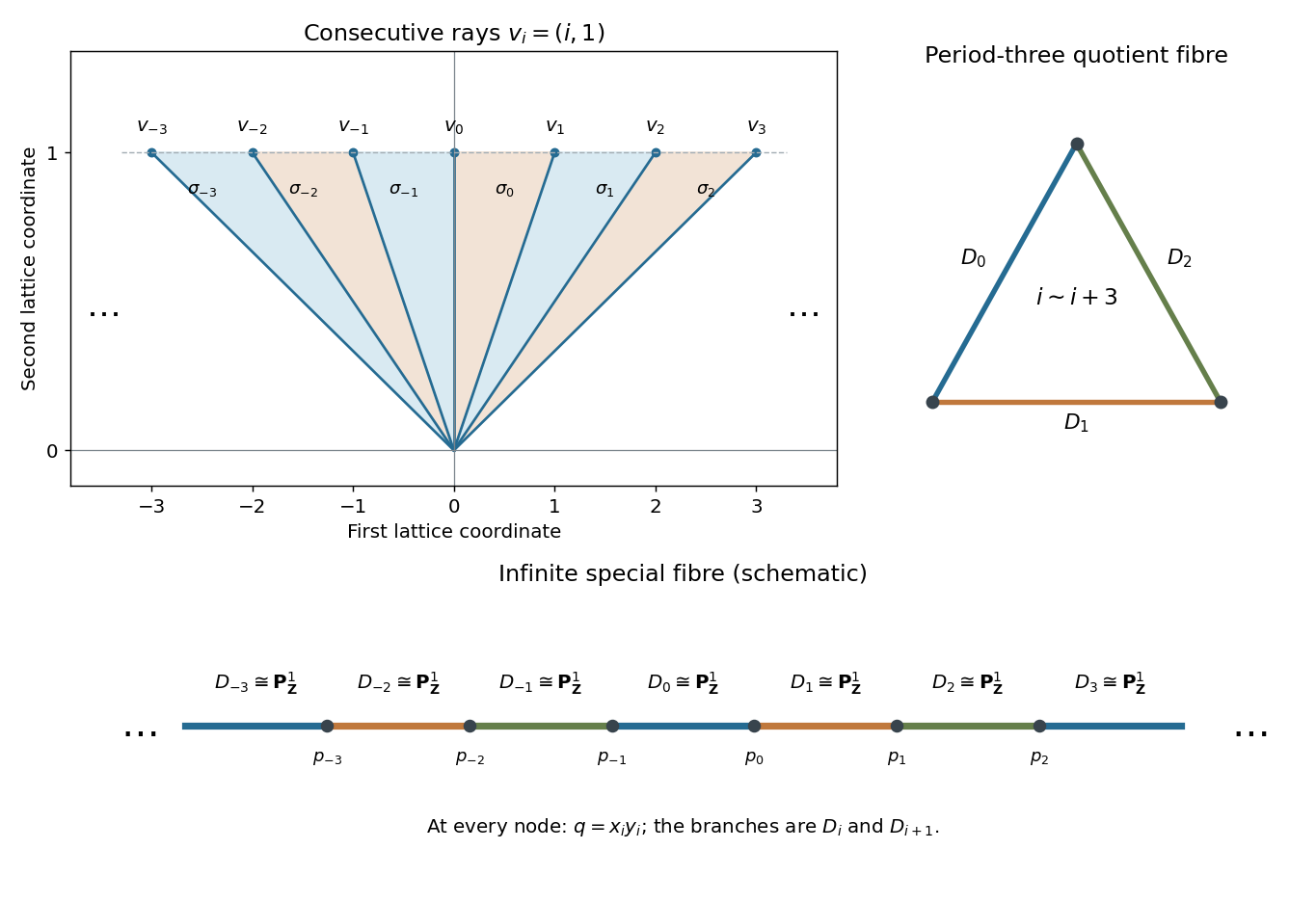
The infinite toric fan, its chain of projective lines, and the period-three quotient fibre
. Details. 
Past exam of the mathematics course of the University of Cambridge 2012 iii Paper 13 1 i Solution Created 2026-10-03 Updated 2026-10-07
Use the usual convention that a variety is an irreducible variety. For a quasi-projective algebraic set , its algebraic dimension is the supremum of the lengths of strict chainsof nonempty irreducible closed subsets of . It is the maximum of the algebraic dimensions of its irreducible components. On an affine algebraic set, the correspondence between irreducible closed subsets and prime ideals reverses inclusion, so this is the Krull dimension of the coordinate ring. On a quasi-projective algebraic set, it is the supremum of the Krull dimensions of the coordinate rings of its affine open subsets. At a closed point , the Krull dimension of the local ring measures chains through .
Here is a closed-point dimension lemma for affine domains that avoids transcendence degree. Put . By Noether normalization, there is a integral extensionThe number of variables is because integral extensions preserve Krull dimension and . For any maximal ideal of , its contraction to is a maximal ideal. Since is an algebraically closed field, has height of a prime ideal . The going-down theorem applies because is an integrally closed domain and is a integral domain. It lifts a length- chain below to one below . HenceThe opposite inequality follows from .
For the nonempty open subset , choose a nonempty principal open subset and a closed point . Every prime ideal below avoids , so the preceding chain survives in the localization . Consequently . Conversely, any chain of irreducible closed subsets in gives a chain of the same length after taking closures in : intersecting those closures with recovers the original subsets. Therefore
For the principal hypersurface dimension lemma, let be a minimal prime ideal over . Since in the integral domain , . The Krull principal ideal theorem gives . Choose a closed point on lying on none of the other finitely many irreducible components of . Such a point exists because those other components cut out proper closed subsets of the irreducible variety , and closed points are dense. Set . Then andWrite . Choose a system of parameters in and lift it to . The ideal has radical equal to the maximal ideal of . The Krull height theorem yields . On the other hand, any chain of prime ideals containing can be extended strictly at the bottom by the zero prime ideal of the integral domain , giving . Thus . Since is a localization of , . Extending a chain in by also gives . Hence every component has the required dimension:This argument uses Noether normalization, going-down theorem, and the Krull height theorem, never the dimension from the function field theorem. Irreducibility is essential: if the word variety were instead allowed to mean an arbitrary reducible affine algebraic set, neither assertion would hold without extra hypotheses. For example, a disjoint union of an affine plane and an affine line has an open component of smaller algebraic dimension; a function equal to on the plane and a coordinate on the line has a nonempty zero set of algebraic dimension .
Past exam of the mathematics course of the University of Cambridge 2013 iii Paper 13 2 Solution Created 2026-10-03 Updated 2026-10-07
An irreducible scheme is a nonempty scheme whose underlying topological space cannot be expressed as the union of two proper closed subsets. Equivalently, any two nonempty open subsets meet. A reduced scheme is one whose local rings have no nonzero nilpotent elements. Equivalently, every affine open subscheme has a reduced ring of regular functions. We may define an integral scheme as a nonempty scheme for which the coordinate ring of every nonempty affine open subscheme is an integral domain. We shall show that this is equivalent to being reduced and irreducible. The nonempty convention matters: the empty scheme is reduced but is not irreducible or integral.
For a commutative ring , the spectrum of a ring is reduced exactly when is a reduced ring. One direction follows since localization preserves reducedness. Conversely, if is a nonzero nilpotent element, choose a prime ideal containing its proper annihilator. Then cannot vanish at that localization, contradicting reducedness of its local ring.
The spectrum of a ring is irreducible exactly when its nilradical is a prime ideal. To see the essential implication directly, if , then is empty. Irreducibility forces or to be empty, hence or . Also is proper because the spectrum is nonempty. Conversely, if is a prime ideal, the point has closure , so the spectrum is irreducible. Combining the two criteria gives
Now suppose is reduced and irreducible. Every nonempty affine open subscheme is also reduced and irreducible: irreducibility passes to nonempty open subsets, because their nonempty open subsets are nonempty opens of . The affine criterion makes each coordinate ring an integral domain, so is integral. Conversely, suppose all its nonempty affine coordinate rings are integral domains. Their localizations show that is reduced. If were reducible, there would be disjoint nonempty open subsets; choose nonempty affine open subschemes and inside them. Their disjoint union is itself an affine open subscheme . Since are nonzero, contradicts the domain condition. Therefore
The generic point of an integral scheme is the unique point with . For existence, take a nonempty affine open subscheme . Its point has closure containing , which is dense in , so its closure in is all of . For uniqueness, both proposed generic points lie in every nonempty open subset, hence in , where the only dense point is . The function field isHere the stalk description shows that the field of fractions is independent of the choice of nonempty affine open subscheme.
Every nonempty open subscheme contains , so taking a germ there defines . If a section has zero germ, restrict it to any nonempty affine open subscheme . Its image in is zero. Since this coordinate ring is an integral domain, the section is zero on . Such affines cover , and the sheaf gluing axiom makes the section zero on . Thus the generic-point embedding of regular functions is
For a nonreduced reducible fibre between integral schemes, take both source and target to be the affine line over , and use the ring homomorphismBoth coordinate rings are integral domains, so both schemes are integral. At the target closed point , the scheme-theoretic fibre has ringby the Chinese remainder theorem. Its underlying space has two distinct closed points, so it is reducible. The class of is nonzero but has square zero, so it is not reduced. Even a morphism between integral schemes can have a fibre consisting of two nonreduced double points.
Past exam of the mathematics course of the University of Cambridge 2019 iii Paper 113 2 c Solution 2026-10-03
TakeThe global regular functions on projective space give , on which the Absolute Frobenius morphism is the identity. On the standard affine line , however, its map on functions is , which is not surjective. Thus is not an isomorphism of schemes.
Choose the rational closed point given by . The affine formula for a fibre product of schemes gives its scheme-theoretic fiber:This is the Fibre of absolute Frobenius over a rational point of the affine line: it is a one-point, length- nonreduced scheme, rather than a reduced point.
Past exam of the mathematics course of the University of Cambridge 2020 ii Paper 2 24F c Solution Created 2026-09-24 Updated 2026-09-29
Suppose an affine line lies in . Parametrize it asThe defining equation would give the polynomial identityThe only units of are nonzero constants. Since a product is a unit only when every factor is a unit, all three linear polynomials must be constant, so . The alleged line is a point, a contradiction. Therefore
Regular function Created 2026-09-28 Updated 2026-10-14
A regular function on an open subset of a scheme is a section of . On an affine variety it is locally a quotient of polynomial functions with a denominator that does not vanish.
On a variety, a regular function is a regular map to the affine line; the arbitrary-target regular-map concept is broader.
Underdetermined minimum-norm example 2026-10-14
Now take one equation for two unknowns:The linear system has an entire affine line of exact solutions. Since has full row rank, its Moore-Penrose inverse isThe kernel is , and all exact solutions areBecause is orthogonal to ,The Euclidean norm is therefore smallest exactly at . The zero residual alone cannot select a solution; the minimum-norm rule supplies the additional criterion.
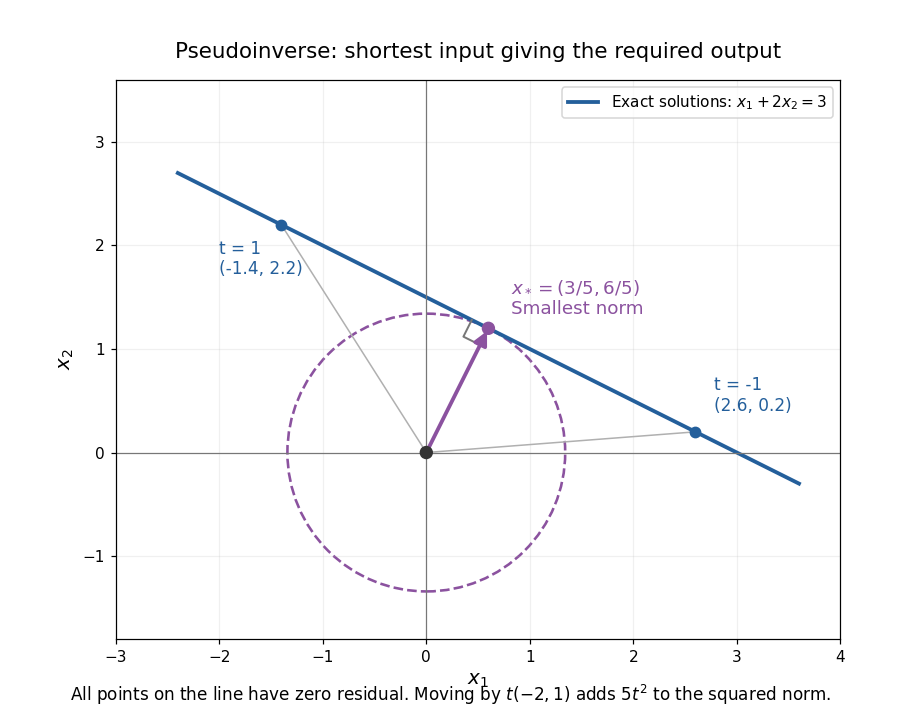
The minimum-norm solution is the closest point of the solution line to the origin
. The affine line is perpendicular to . Moving along the line changes only a kernel component and increases by . Details.
This selection depends on the specified inner product. Rescaling one unknown changes what counts as a small Euclidean norm, so units and weighting matter in an application. A minimum-norm answer is mathematically canonical for the chosen geometry, rather than an automatic guarantee of physical plausibility.