Source PDF: mmathphys.physics.ox.ac.uk/sites/g/files/vzsiac2991/files/mmathphys/documents/media/a18926h1.pdf
These solutions use the source paper's crossing convention for anyon R-matrices, its physics normalization of anyon diagrams in Question 1, and its isotopy normalization of anyon diagrams in Question 2. In particular, its normalized Kirby color is .
TODO: establish the year coverage of the lecturer's prior-exam solutions collection: www-thphys.physics.ox.ac.uk/people/SteveSimon/topological2026/topological2026.html.
Read the arrows upwards through the central part of the diagram. The lower anyon fusion tree first splits into , then into and into . The upper anyon fusion tree combines into , into , and finally into . The two interior crossings are not vertices. Thus admissibility requires the six anyon fusion multiplicitiesIf any factor vanishes, the diagram has zero value.
Make an anyon vertex gauge transformation by multiplying each splitting vertex by an independent wave phase and its adjoint fusion vertex by . The diagram changes byTherefore the label-matching condition for cancellation of all anyon vertex gauge transformation factors iswith otherwise unrestricted apart from the anyon fusion rules. This statement also allows coincident labels: the three ordered vertex triples in the numerator must equal those in the denominator as multisets; matching the triples in any of the six possible orders still forces . Conversely, these equalities visibly give .
Closure of the drawing alone does not guarantee invariance under an anyon vertex gauge transformation: unmatched fusion and splitting vertices retain their independently chosen basis phases. A zero value is, of course, invariant regardless of phases; the boxed condition describes cancellation of the vertex factors themselves.
Write for braiding and for anyon monodromy. Transparency says for every . The hexagon identities for braiding express braiding a composite past as successive braidings of its two factors past . If are both transparent anyons, move around and then around ; both full moves are identities, henceThis is the fusion closure of transparent anyons at the level of the composite object.
For completeness, let and be an inclusion and projection for an allowed anyon fusion summand, with . Naturality of braiding givesThusThe vacuum anyon belongs to this collection, and taking duals preserves transparency, so it is also closed under antianyons.
There is a further restriction on the spin of a transparent anyon. Apply the anyon balancing identity to the vacuum anyon channel of :Here ribbon duality gives and . ConsequentlyTheir topological spins are those of bosons or fermions. This does not imply : a transparent anyon can have several anyon fusion channels, with nontrivial exchange action within them, even though every full anyon monodromy is trivial. If the theory is additionally a modular tensor category, the only transparent anyon is the vacuum anyon; Question 1 need not impose that extra hypothesis.
The two crossings of make their full anyon monodromy. For a transparent anyon , this is the identity, so that pair of crossings can be removed together. No single-crossing exchange phase, and no topological spin from a twist, is introduced.
After this removal the upper and lower anyon fusion trees differ only in their intermediate labels. In the physics normalization of anyon diagrams, successive split-fuse bubbles give the Kronecker deltas and . The remaining closed normalized state has norm one. Hence, for the admissible labelings of a,In particular, every admissible diagram satisfying the label matching in a evaluates to . There is no factor here: the source explicitly permits the physics normalization of anyon diagrams, in which a closed normalized state has value .
Use an anyon fusion tree in which the two crossing charges combine first. With external charges in the order , define the normalized treesThe desired value is the matrix element of anyon monodromy between and . Their closure is understood in the physics normalization of anyon diagrams.
First apply the anyon F-matrix to the three charges , and then an inverse anyon F-matrix to . With the source convention , this givesOnly allowed anyon fusion channels enter the sums: in the second tree these require . The complex conjugate in comes from the inverse change of parentheses, not from reversing a crossing.
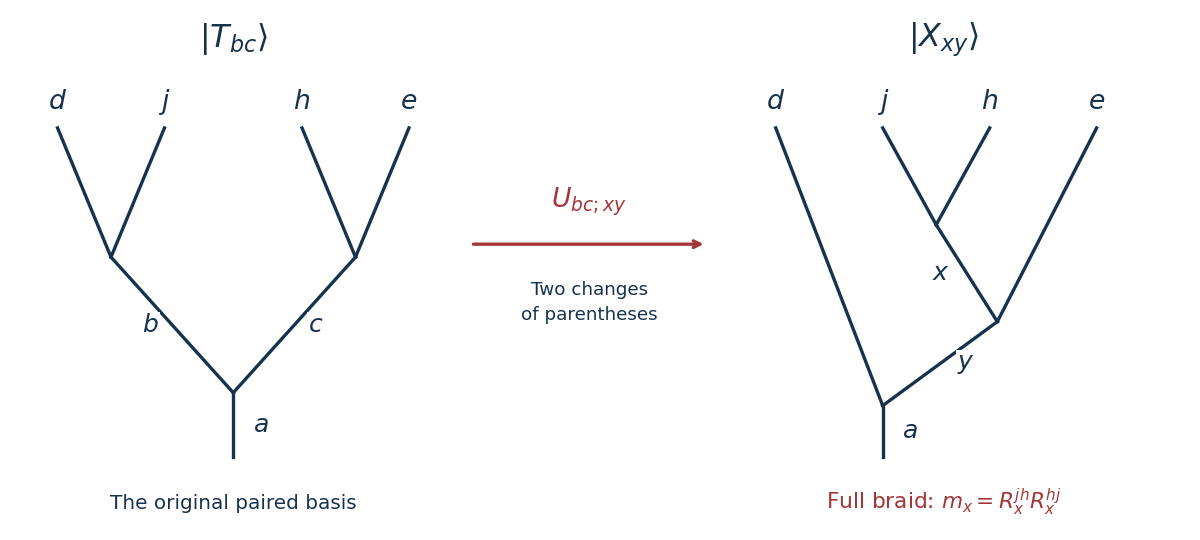

Reading the actual overcrossings from bottom to top gives two positive exchanges in the source's anyon R-matrix convention. Their product isThe order of is restored after the second exchange. In the basis this anyon monodromy is diagonal, soEquivalently, entirely in terms of anyon F-matrices and anyon R-matrices,This expression is also meaningful for or : it then carries the unmatched anyon vertex gauge transformation factors identified in a.
To check the transparent limit, put in every allowed channel. The unitary matrix identity for first givesOnce , the unitary matrix identity for givesas in c. The same cancellation proves that the recoupling expression is an identity operator whenever the full anyon monodromy is trivial, including when the individual exchanges have fermionic signs.
Cut one nonseparating circle on each handle of the closed orientable surface of genus . The cut surface is a sphere with boundary circles. Gluing a pair back together requires an anyon label on one boundary and the antianyon label on the oppositely oriented boundary. Sum over these labels independently for the handles.
For a fixed labeling, the dimension of the resulting anyon fusion space on the sphere, with total vacuum anyon charge, isThe gluing rule of the topological quantum field theory therefore gives the handle-cut formula for anyon ground-state degeneracy:Here denotes the vacuum anyon, and the anyon fusion matrices have entries , as in the source. At , the empty product is the identity matrix, giving one ground state. At , for each simple charge, so the ground-state degeneracy of the torus is the number of anyon types.
Put . The Verlinde formula diagonalizes every anyon fusion matrix using the same modular S-matrix:Because , the eigenvalue of in column isThe last equality uses unitary matrix orthogonality. ThereforeFinally, insert , where is the quantum dimension and is the squared total quantum dimension:Although only quantum dimensions remain, the result is an integer because a counts an anyon fusion space.
The sphere value is , and the torus value is . If all simple anyons have quantum dimension one, the answer is , agreeing with the Abelian handle count. These checks also fix the exponent .
Let denote the split-fuse diagram with a charge- edge joining the lower fusion vertex to the upper splitting vertex, and outer strands . Completeness in the isotopy normalization of anyon diagrams readsResolve the two strands inside the encircling normalized Kirby color loop in this way. Move that loop onto the intermediate charge- edge. The Kirby killing property multiplies it by , leavingThe vacuum anyon channel is allowed only for , and then and . Erasing the vacuum edge turns into the cup-cap diagram , which connects the incoming pair by a cap and the outgoing pair by a cup. Thus the requested two-strand Kirby projector isHere is the orthogonal projection onto total vacuum anyon charge; for it is zero. Both strands in the source point upwards, so the condition is , not unless is self-dual.
The coefficient can be checked without a convention guess: stacking two cup-cap diagrams creates one charge- loop, so . Consequently , as required of an orthogonal projection. Omitting would fail this check.
Use the Witten-Reshetikhin-Turaev invariant with the source's normalized Kirby color on all surgery components. Since the signature of the linking matrix is zero, the framing-anomaly factor is one, and the TQFT partition function isAll evaluations in this part use the isotopy normalization of anyon diagrams and preserve the indicated blackboard framing.
Expand the long component as and fix its charge . Each pair of auxiliary components is in the Borromean rings arrangement with this component. Eliminate such a pair using the two-strand Kirby projector from c: bend the long component to expose its two oppositely oriented portions, viewed as equally oriented strands labeled . The first encircling normalized Kirby color loop replaces these by a vacuum cup-cap with coefficient . This vacuum connection opens the second encircling loop so that the same two-strand Kirby projector applies once more. Removing the resulting vacuum edges and straightening the bends restores the original charge- strand. Thus the Borromean handle-pair evaluation multiplies the bare strand byThere is no residual twist. This is a relative strand evaluation: the final closure of the long component is counted separately. As a normalization check, when the two auxiliary components become two unlinked normalized Kirby color loops, each of value , giving .
The pairs occupy disjoint portions of the long component, so their factors multiply. Closing that component gives its quantum dimension . Combining this with its normalized Kirby color coefficient givesApplying the overall surgery prefactor yieldsFinally, the topological quantum field theory assigns the identity map to a cylinder over . Closing its time direction takes the trace of that identity, soThis independently reproduces b. For the surgery link is one zero-framed normalized Kirby color unknot: its value cancels the surgery prefactor and gives . For the result is the number of simple anyons, as required for the torus.
Articles by others on the same topic
There are currently no matching articles.