Take independent steps, each with probability and with probability . Reverse a step sequence by reading it backward and changing each sign; use the same biased law for both experiments. With positive steps, the forward sequence weight is and its reversed weight is . Their logarithm ratio isHere is dimensionless entropy production, not an entropy in joules per kelvin. A Markov chain on a three-state ring gives a state-space realization: start uniformly, take a clockwise step with probability and a counterclockwise step with probability . The uniform stationary distribution makes endpoint weights cancel. A physical interpretation as exchanged heat requires local detailed balance with bath entropy per directed step; the abstract model alone specifies path probabilities.
For an allowed value , the binomial distribution givesThis is an exact same-law finite fluctuation theorem, with no long-time approximation. For , and , and . The positive mean is , although the all-negative path has nonzero probability . Directly, .
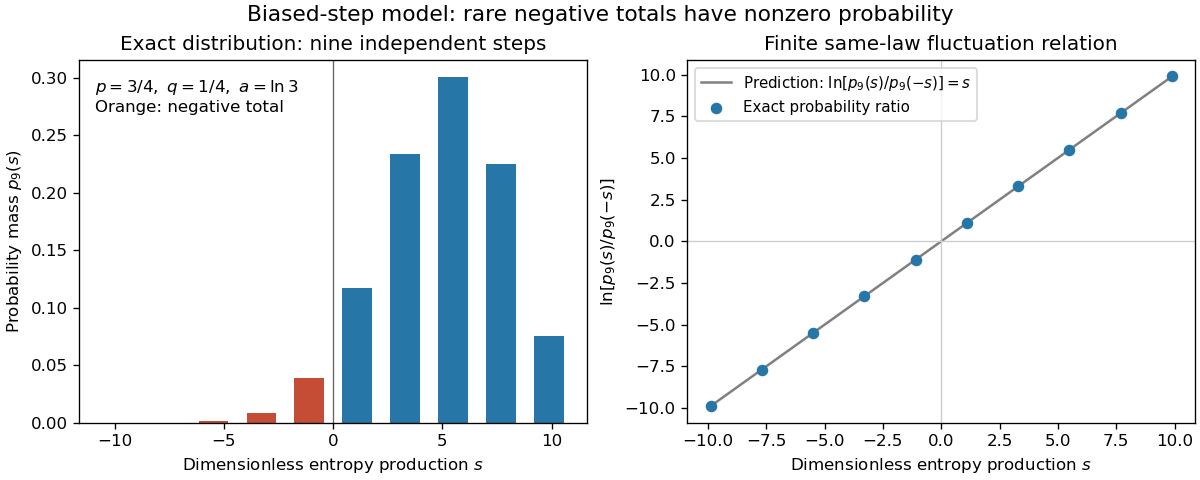
Exact biased-step model: discrete entropy-production probabilities and their log ratio at nine steps
. Details. 
The left panel shows exact probability masses for , with negative values highlighted; the right panel tests the logarithm ratio against . These are model values, without experimental measurements or simulated measurement noise.
A single step has negative entropy production with probability , independent of how long an observation lasts. A whole window is negative only if negative steps outnumber positive ones:For even , the tie has zero entropy production and is excluded. At , the negative-window probabilities for are approximately , , and . Longer windows still contain negative increments: their expected number is . Their total is usually positive because the expected number of positive increments is .
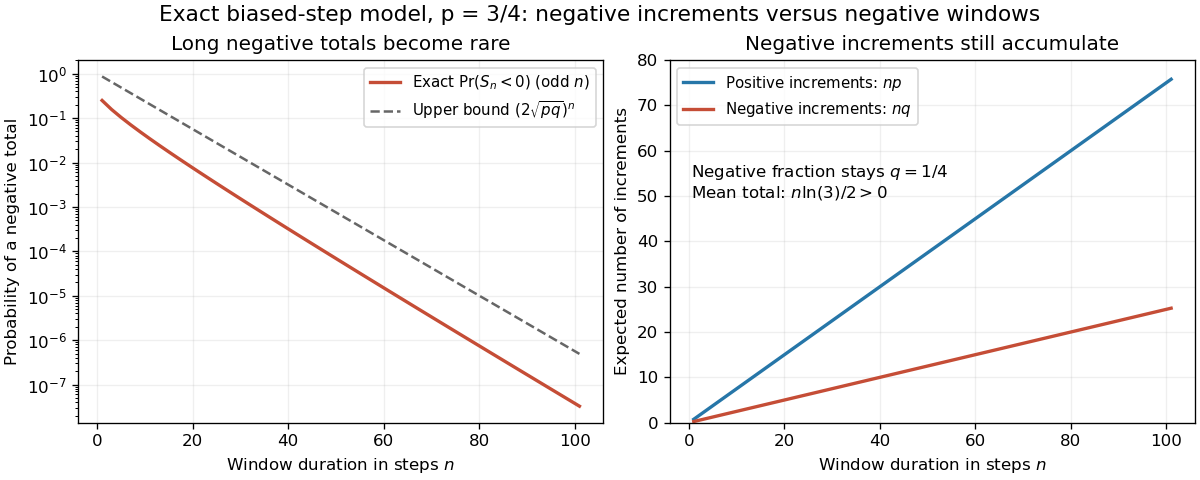
Exact biased-step model: negative totals become rare with duration while negative increments remain frequent
. Details. 
Only odd window lengths are plotted to avoid alternating tie effects. The left panel gives the exact negative-window probability and the upper bound ; the right gives expected counts and . For steps of fixed duration , physical duration is . These are counts and probabilities predicted by the model, not bead traces. The bound follows from . Since for , negative totals are exponentially suppressed even though the negative-step fraction stays .
Articles by others on the same topic
There are currently no matching articles.