A fluctuation theorem compares the probability of a fluctuating sample trajectory with that of its reverse. Positive mean entropy production permits negative individual realizations: what is constrained is their relative probability, not a prohibition on every reversal. The finite statement below compares specified forward and reverse probability laws; replacing the reverse law by the forward law requires an additional symmetry. The biased-step entropy production model exhibits that symmetry exactly, while the Crooks fluctuation theorem compares two different driving protocols.
Consider a finite-duration Markov process with discrete, time-even states coupled to one thermal reservoir at positive temperature . Let include the initial probability of the sample trajectory . Define by reversing the control protocol and initializing it with the actual forward final probability distribution . Write for the same states visited in reverse time order. Require normalized path laws with matching probability support: a path has positive forward weight exactly when its reverse has positive reverse weight. This excludes irreversible forbidden transitions and missing initial states.
Under local detailed balance, with positive heat delivered to the thermal reservoir, the full path-weight logarithm isThe endpoint term is the change in stochastic system entropy; the conditional path ratio alone accounts for the thermal reservoir. Here is the Boltzmann constant. Both terms matter even for a short observation. [ref]
Entropy production along a stochastic trajectory and an integral fluctuation theorem by Udo Seifert. Seifert, 2005, Eqs. (14)–(18) and (30): conditional and full path weights, endpoint distributions, total entropy
Define the conjugate reverse functional by , so . Summing the path identity over paths with a given value gives the exact finite fluctuation theoremfor nonzero denominator, using probability masses or corresponding probability density functions. This is defined by the paired laws: it need not be the total entropy production obtained by independently restarting the thermodynamic construction for the reverse experiment. A generic driven experiment therefore does not imply .
Normalization of the reverse law gives an exact finite identity:The sum notation describes discrete paths; the corresponding path integral has the same change-of-variable argument. Jensen's inequality for the exponential function then gives , hence . Equivalently this mean is the Kullback-Leibler divergence between the forward path law and the reverse path law pulled back by . Equality requires those two laws to agree. [ref]
Entropy production along a stochastic trajectory and an integral fluctuation theorem by Udo Seifert. Seifert, 2005, Eqs. (17)–(18): integral relation and its mean inequality
Rare negative entropy production contributes disproportionately to this expectation through . Missing such events in a finite sample can spoil an estimate of the identity. Matching probability support is also essential: reverse paths absent from the forward law cannot be recovered by cancelling forward weights. This Second law of thermodynamics statement concerns an ensemble average; an individual negative value is compatible with it.
Take independent steps, each with probability and with probability . Reverse a step sequence by reading it backward and changing each sign; use the same biased law for both experiments. With positive steps, the forward sequence weight is and its reversed weight is . Their logarithm ratio isHere is dimensionless entropy production, not an entropy in joules per kelvin. A Markov chain on a three-state ring gives a state-space realization: start uniformly, take a clockwise step with probability and a counterclockwise step with probability . The uniform stationary distribution makes endpoint weights cancel. A physical interpretation as exchanged heat requires local detailed balance with bath entropy per directed step; the abstract model alone specifies path probabilities.
For an allowed value , the binomial distribution givesThis is an exact same-law finite fluctuation theorem, with no long-time approximation. For , and , and . The positive mean is , although the all-negative path has nonzero probability . Directly, .
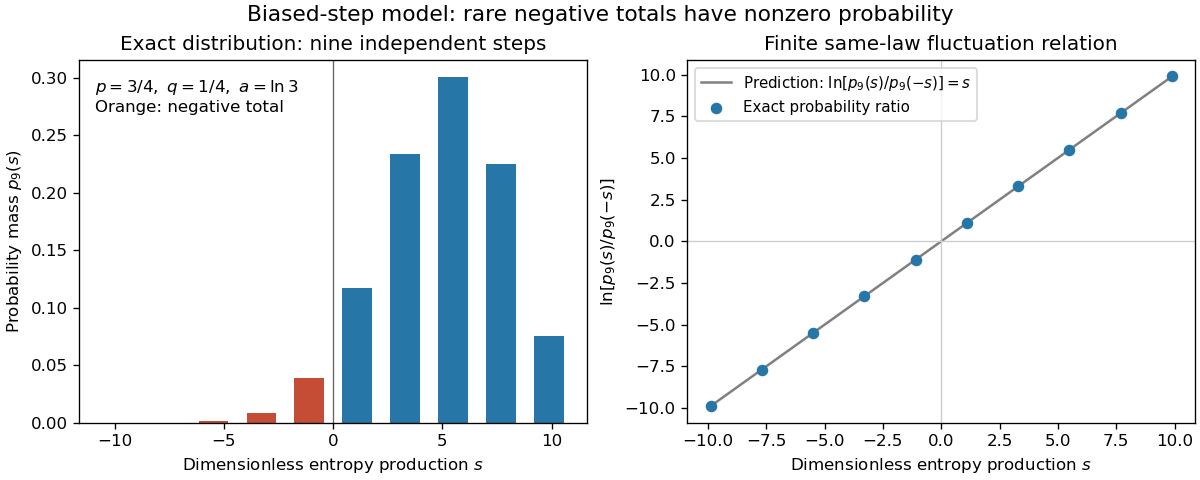
Exact biased-step model: discrete entropy-production probabilities and their log ratio at nine steps
. Details. The left panel shows exact probability masses for , with negative values highlighted; the right panel tests the logarithm ratio against . These are model values, without experimental measurements or simulated measurement noise.
A single step has negative entropy production with probability , independent of how long an observation lasts. A whole window is negative only if negative steps outnumber positive ones:For even , the tie has zero entropy production and is excluded. At , the negative-window probabilities for are approximately , , and . Longer windows still contain negative increments: their expected number is . Their total is usually positive because the expected number of positive increments is .
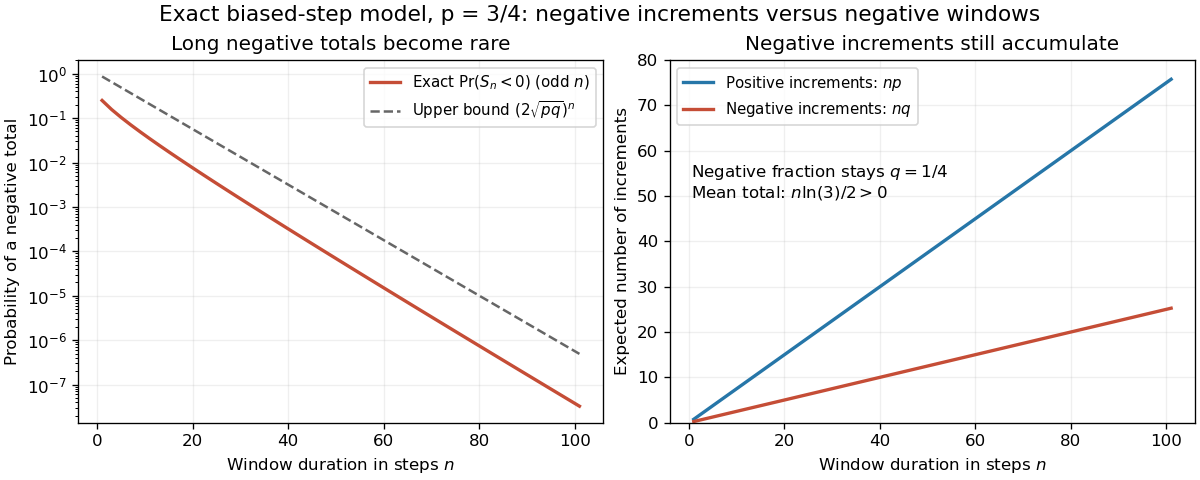
Exact biased-step model: negative totals become rare with duration while negative increments remain frequent
. Details. Only odd window lengths are plotted to avoid alternating tie effects. The left panel gives the exact negative-window probability and the upper bound ; the right gives expected counts and . For steps of fixed duration , physical duration is . These are counts and probabilities predicted by the model, not bead traces. The bound follows from . Since for , negative totals are exponentially suppressed even though the negative-step fraction stays .
A steady state does not by itself give every fluctuating observable an entropy production symmetry. If the dimensionless total entropy production has the same-law finite relation and a large deviation principle with rate function for , then, on its common domain,The first expression denotes leading exponential scaling; the second follows by taking the scaled logarithm of the probability ratio. A finite-state, autonomous Markov process with time-even states, positive bidirectional rates and a positive stationary distribution supplies a standard setting for a finite total-entropy production relation. The stochastic system entropy is then bounded, so its endpoint contribution does not change the long-time rate function of bath entropy production. [ref]
Unbounded state spaces can have endpoint fluctuations on the scale relevant to a large deviation principle. Dropping system entropy, changing the measured observable to heat, or changing the reverse preparation therefore requires a fresh argument. The exact finite integral fluctuation theorem, a same-law finite relation, and an asymptotic rate function symmetry are distinct claims.
For a system coupled to a thermal reservoir at fixed temperature , prepare the forward process in the initial canonical ensemble and the reverse process in the final control parameter's canonical ensemble. Reverse the protocol, assume microscopic reversibility and matching path probability support, and count as work done on the system. With Helmholtz free energy difference and ,The final forward distribution need not already be in thermal equilibrium. Its reverse preparation is prescribed equilibrium preparation, rather than the actual forward final distribution used in finite trajectory entropy production. Thus the paired path logarithm is dissipated work in thermal units, not automatically the instantaneous total stochastic entropy production at the end of an arbitrary driven protocol. [ref]
The Entropy Production Fluctuation Theorem and the Nonequilibrium Work Relation for Free Energy Differences by Gavin E. Crooks. Crooks, 1999, Eqs. (5)–(7), (9)–(11): reversal, equilibrium weights and work relation
[ref]Entropy production along a stochastic trajectory and an integral fluctuation theorem by Udo Seifert. Seifert, 2005, Eq. (19) and following paragraph: actual final distribution versus final equilibrium distribution
Integrating the Crooks fluctuation theorem over work and using normalization of the reverse probability distribution givesConsequently Jensen's inequality gives . Some realizations may nevertheless have . This is a work relation with equilibrium endpoint preparations, while the integral fluctuation theorem for total entropy production uses the actual final forward distribution. [ref]
The Entropy Production Fluctuation Theorem and the Nonequilibrium Work Relation for Free Energy Differences by Gavin E. Crooks. Crooks, 1999, Eq. (3) and derivation from Eqs. (10)–(11)
The 2002 experiment trapped a bead in water with a laser, a , numerical aperture objective and a piezo-driven microscope stage. A quadrant photodiode tracked bead position at with approximately bandwidth and reported resolution. Stage translation drove water past the fixed optical trap at . Weak trapping prolonged the transient; stationary recording before translation established the position reference. Stokes drag law calibration was checked against the bead's measured diffusion coefficient. [ref]
Experimental Demonstration of Violations of the Second Law of Thermodynamics for Small Systems and Short Time Scales by G. M. Wang and others. Wang and colleagues, 2002, p. 050601-2: apparatus, calibration and trajectory protocol
From calibrated displacement and calibrated harmonic optical trap force, the experimenters evaluated the dimensionless driven-bead dissipation functionalAmong 540 trajectories, negative values became less frequent with duration. Figure 2 compared the negative/positive count ratio with ; its agreement tested the paper's integrated transient relation. The detailed log-ratio plot in Figure 4 used simulated particle sample trajectories, not bead measurements. Near-zero sign discrimination and stage-start transients limited the earliest points. [ref]
For any continuous probability distribution satisfying the same-law relation, integration over yieldsThis conditional relation explains the comparison without equating it to the unconditional integral fluctuation theorem. The experiment supports a specified driven-system relation; it does not establish a universal same-law symmetry for any definition of heat or entropy production. In particular, a transient work-like functional should not silently acquire the actual-distribution endpoint term in finite trajectory entropy production. Negative realizations are compatible with positive mean dissipation and the Second law of thermodynamics; they do not provide a cyclic machine with reliable work output from a single thermal reservoir.
Articles by others on the same topic



The Fluctuation Theorem is a significant result in statistical mechanics and nonequilibrium thermodynamics that describes the likelihood of observing certain fluctuations in the thermodynamic properties of systems far from equilibrium. It provides a mathematical framework for understanding how thermodynamic quantities, such as entropy, deviate from their average values during fluctuations in small systems.