In 1932 John Douglas Cockcroft and Ernest Thomas Sinton Walton accelerated hydrogen ions from a discharge source through an evacuated tube onto lithium at . A side-facing zinc sulfide screen, viewed by microscope, showed particle scintillations. Mica stopped scattered protons; switching off or blocking the beam removed the flashes. An external screen allowed absorption-range measurements.[ref]
Experiments with High Velocity Positive Ions. II. The Disintegration of Elements by High Velocity Protons by John Douglas Cockcroft and Ernest Thomas Sinton Walton. Experiments with High Velocity Positive Ions. II. The Disintegration of Elements by High Velocity Protons, 1932, pp. 230–232, sections 2–3, Fig. 1; primary text inspected in the Scribd transcription
Magnetic deflection checked voltage calibration. Opposite screens and independent observers found excess coincidences for a thin lithium target, supporting paired alpha particle emission; geometry and screen efficiency limited detection.[ref]
Experiments with High Velocity Positive Ions. II. The Disintegration of Elements by High Velocity Protons by John Douglas Cockcroft and Ernest Thomas Sinton Walton. pp. 231, 237–238, section 4, Figs. 5–6: corrected voltage calibration, paired screens and random-coincidence comparison
John Douglas Cockcroft's 1951 lecture recalls detection at and an absorption range about , then refined alpha particle energies about each. He places the work under Ernest Rutherford's direction. The inferred nuclear reaction was lithium-7 plus a proton producing two alpha particles.[ref]
Experiments on the interaction of high-speed nucleons with atomic nuclei by John Douglas Cockcroft. Experiments on the interaction of high-speed nucleons with atomic nuclei, lecture delivered 11 December 1951, pp. 167–170, Figs. 2–4; primary text inspected in the Scribd transcription
The logic has several independent links. Beam blocking tests whether the flashes depend on bombardment. An absorber tests whether scattered beam particles could reach the screen. A particle range tests product identity and kinetic energy, while coincidences test whether two products belong to one event. These tests support a reaction interpretation jointly; counting flashes alone is not an isotope identification, and a range-to-energy conversion needs calibration. The lithium proton reaction energy below is a modern calculation, separate from those historical measurements.
The nuclear reactionconserves electric charge and total nucleon count: and . Its nuclear reaction Q-value is the initial minus final rest energy. It is additional to the incoming beam kinetic energy; the accelerator triggers a rearrangement whose products can carry much more kinetic energy than the incident proton.
Use one consistent set of neutral-atom isotope masses, in unified atomic mass units, from the National Institute of Standards and Technology:These are isotope masses, not element-averaged atomic weights.[ref]
Atomic Weights and Isotopic Compositions for All Elements by National Institute of Standards and Technology. Atomic Weights and Isotopic Compositions for All Elements, entries atomic number 1 mass number 1; atomic number 2 mass number 4; atomic number 3 mass number 7
With ,[ref]CODATA recommended values of the fundamental physical constants: 2022 by National Institute of Standards and Technology. CODATA recommended values of the fundamental physical constants: 2022, atomic mass constant, energy equivalent in MeV
The four electron rest masses cancel between sides. Differences of total electronic binding energies do not cancel exactly: this atomic-mass result approximates the bare-nucleus nuclear reaction Q-value at the displayed scale, not at arbitrary precision. No mixture of rounded nuclear binding energies is needed. At chosen incident kinetic energy on a stationary target, the two outgoing alpha particles together carry approximately before losses in the target and detector window.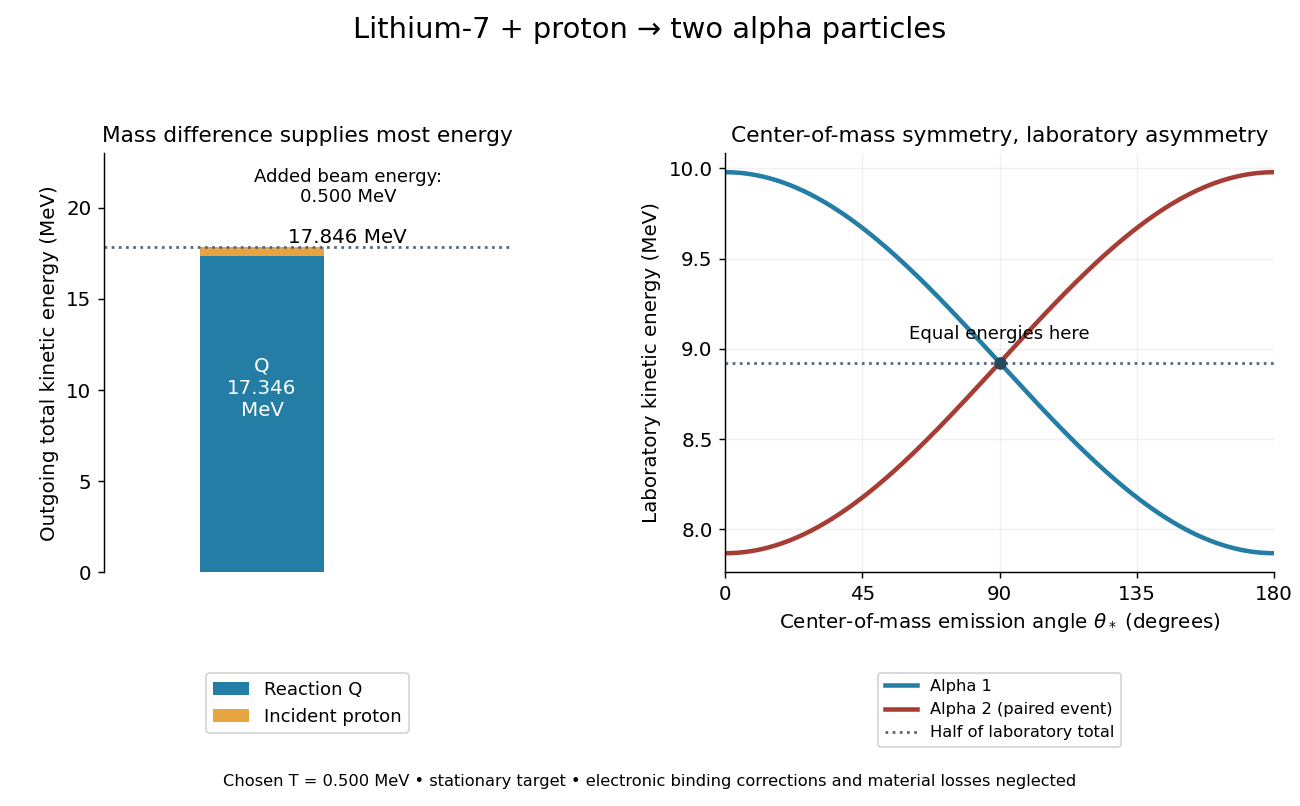

Equal product masses imply equal kinetic energies and opposite momenta in the center of mass frame. The laboratory frame has nonzero initial momentum because the proton is moving. Conservation of momentum therefore forbids the two laboratory momenta from always being equal and opposite. The products are equal in laboratory kinetic energy only for particular emission directions, not for every event.
An exact two-body calculation makes this distinction quantitative. Write , , , and for incident kinetic energy. Express every quantity below in the same energy units; is momentum times the speed of light. For a stationary target,Here is the center-of-mass energy, and is the center-of-mass speed divided by the speed of light. Each outgoing alpha particle has center-of-mass total energy and momentum-times- magnitude . A Lorentz transformation gives the paired laboratory kinetic energies, with measured from the incident beam in the center of mass frame:Their sum is independent of and equals . Their difference is ; the symmetry belongs to the product interchange and the center of mass frame.
For the chosen model, subtract electron rest masses from each neutral-atom mass, neglect electronic binding energies, and use .[ref]
CODATA recommended values of the fundamental physical constants: 2022 by National Institute of Standards and Technology. CODATA 2022 wall chart, electron mass, energy equivalent in MeV
At , the paired laboratory kinetic energies are approximately and ; at both are approximately . In the latter case both products have a forward laboratory momentum component, so even equal laboratory kinetic energies do not imply back-to-back laboratory trajectories. A real thick target and finite detector acceptance would broaden or select these ideal kinematic possibilities. Articles by others on the same topic
There are currently no matching articles.