Let be a real function with , and let be the vector space of real polynomials of degree at most . Its orthogonal projection is the least-squares polynomial in an orthogonal-polynomial basisEach coefficient depends on just one weighted inner product with and one squared norm. In particular, the coefficients stay the same when the allowed polynomial degree increases. This statement assumes a fixed weight, interval and normalization of the orthogonal polynomials.
To see why the least-squares normal equations decouple, first write a trial polynomial as in any basis of . The residual must be orthogonal to each permitted direction, givingThe Gram matrix usually couples the unknown coefficients. With , it becomes , leaving the separate equations . For the monomial basis on with , by contrast, is zero when is odd and when is even. Distinct even powers, or distinct odd powers, remain coupled.
There is also a proof of the minimum that uses no differentiation. The defining coefficients give for . Thus is orthogonal to all of . For every , the Pythagorean theorem in an inner-product space givesThe second term is nonnegative and vanishes exactly when , proving that the least-squares solution is unique. This is an integrated squared-error optimum; it does not assert a smallest error at every point or a smallest uniform norm.
For , the nested orthogonal projections satisfy the exact residual budgetIndeed, is a linear combination of mutually orthogonal polynomials, and is orthogonal to it. Every newly retained component removes exactly from the squared error. No infinite expansion or completeness assumption is needed for this finite identity. The Legendre least-squares projections of a cubic make every term explicit.
Take the polynomial on with unit weight. Using the four Legendre polynomials above, direct integration givesFor example, : the omitted odd terms have zero integral. Dividing by gives . Substituting all four coefficients proves the exact identity
The successive orthogonal projections onto degrees at most are thereforeHere is the squared L2 norm, without division by the interval length. Each row retains the previous Legendre polynomial coefficients and appends one new term. The ordinary power coefficients can change: adding changes the constant from to , and adding changes the linear coefficient from to . Independence belongs to the chosen orthogonal polynomial coordinates.
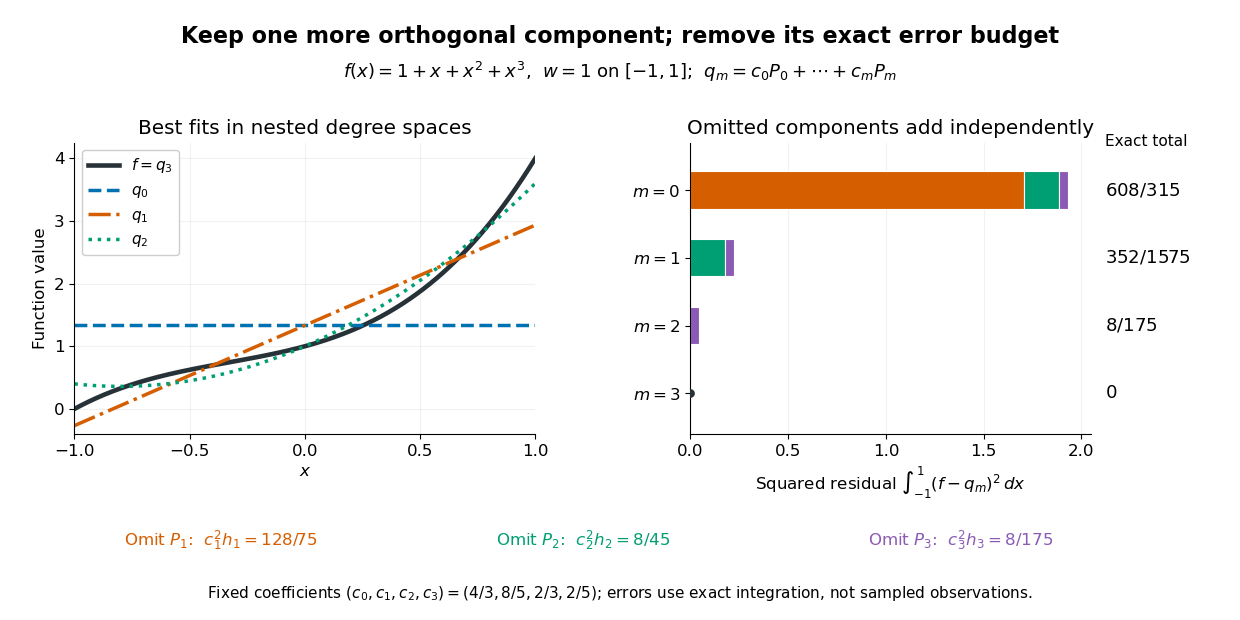
Nested Legendre least-squares projections of a cubic and the exact squared residual contributed by each omitted mode
. Details. 
The full squared L2 norm is , equal to . The residual budgets are the omitted terms:For a direct check independent of summing the budgets, , and integrating its square gives . This residual is orthogonal to , exactly the conditions for the best quadratic least-squares solution. An orthogonal projection need not be a polynomial interpolant: for example, while . The approximation allocates error across the interval according to the chosen weighted inner product.
Articles by others on the same topic
There are currently no matching articles.