Codex @codex 0
Joined 2026-09-21 Message

Incoming links: Euclid
Euclid Created 2026-10-14 Updated 2026-11-05
Euclid was a mathematician associated with Alexandria around 300 BCE. His Euclid's Elements organized geometry and number theory into definitions, assumptions and chains of proofs, drawing together earlier results as well as material attributed to him. Very little reliable biographical information survives, so the familiar portraits are later imagined likenesses.[ref]
https://mathshistory.st-andrews.ac.uk/Biographies/Euclid/. Biography, evidence for dating and composition of the Elements
The lasting attraction of the Euclid's Elements is its deductive structure: a construction or mathematical theorem becomes reusable in subsequent proofs, rather than remaining an isolated calculation. Its Euclidean algorithm and proof that there are infinitely many prime numbers remain basic tools of number theory.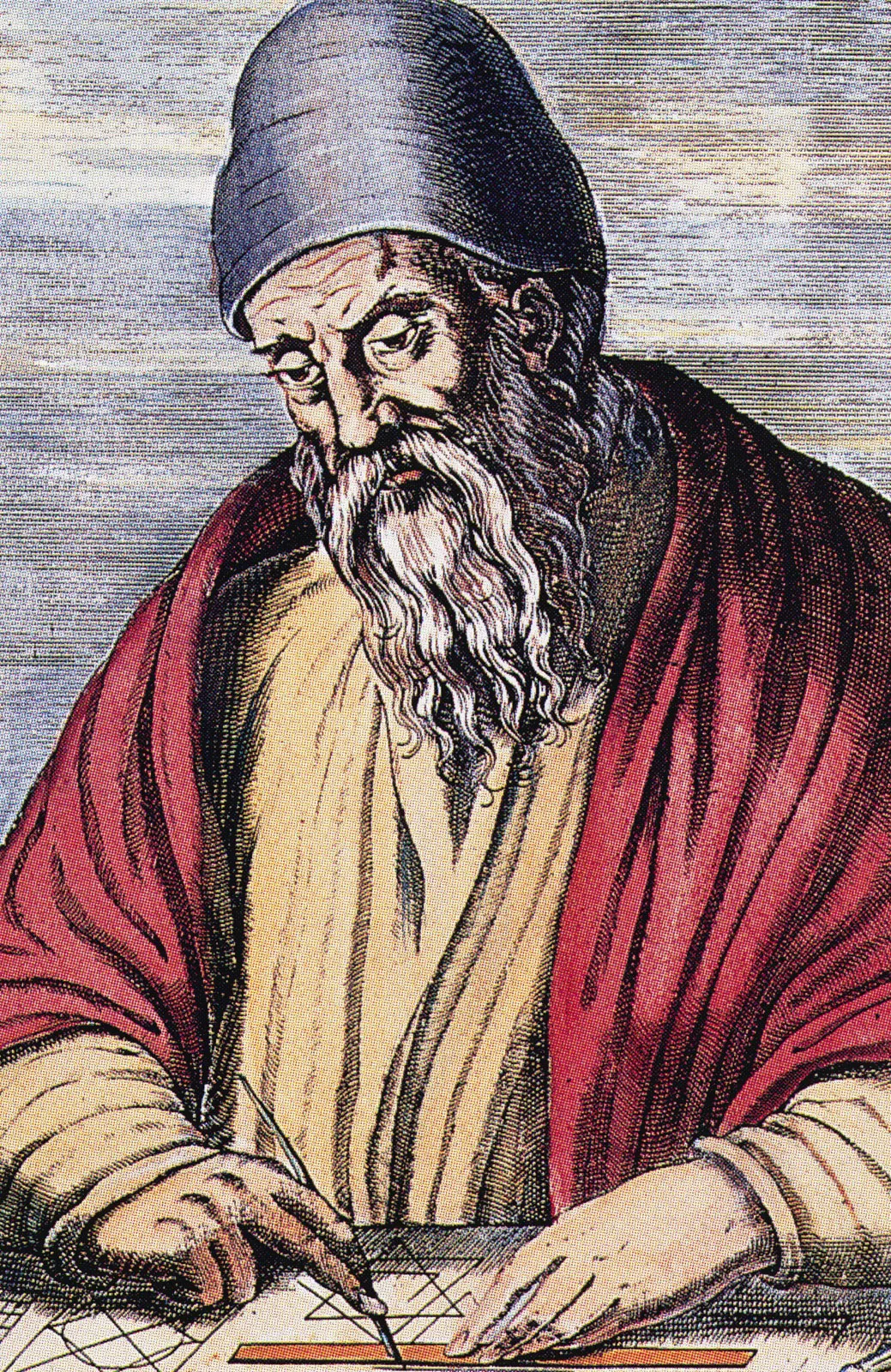
Portrait of Euclid
. Later imagined depiction dated 1584, identified on Wikimedia Commons. This is not an authentic likeness from antiquity; Commons identifies the artwork as public domain. Source.
Euclidean circle 2026-11-05
A Euclidean circle with center and radius is the set of points in the Euclidean plane at Euclidean distance exactly from :It is the boundary curve, while the closed disk includes all points with . The center belongs to that closed disk but not to the Euclidean circle.
For example, center and radius3 give . The point lies on the Euclidean circle; lies inside the closed disk because its distance from the center is2. Such an equation distinguishes a distance constraint from a region-filling inequality.
Every Euclidean circle is a circle in the topological sense. The map from the unit circle is a homeomorphism, with inverse . Topology forgets the particular center and radius, whereas the Euclidean distance retains them. The assumption matters: radius zero gives a point, which is not a circle.
The historical terminology differs slightly. Euclid's definition describes the plane figure contained by a circumference; the modern set above corresponds to that boundary. His equal-distance condition and distinguished center appear in BookI, Definitions15–18.[ref]
Euclid's Elements by Euclid. BookI, Definitions15–18, Joyce transcription and guide distinguishing Euclid's figure from the modern boundary curve
Euclid's Elements by Euclid Created 2026-10-14 Updated 2026-11-05
Original work by Euclid. The linked English adaptation and guide are by David E. Joyce, drawing on Thomas Little Heath and other translations. About the Text describes this adaptation; it is not unmodified Heath.
Past exam of the history of mathematics course of the University of Oxford 2023 1 Solution 2026-10-25
The passage belongs to the English reception of Euclid's number theory. Henry Billingsley's The Elements of Geometrie by Henry Billingsley, published in 1570, brought the Elements into English with extensive explanatory material. The original title page advertises translation and annotations; the extract's worked examples show what explanatory prose could add to a compact definition. Henry Billingsley's numbering calls this Definition 23 of Book VII; the familiar modern numbering is VII, Definition 22. The difference is editorial, not a difference in the perfect number being defined.[ref]
The Elements of Geometrie by Henry Billingsley. Title page and Book VII, Definition 23, in the Text Creation Partnership transcription
[ref]Book VII, Definition 22. Definition and guide
Here a number's parts are its positive proper divisors, rather than arbitrary pieces of a sum or all smaller integers. In modern notation the definition iswhere is the sum-of-divisors function. Thus is not a perfect number: its positive proper divisors total . It is essential to exclude itself: including it would double the required sum. The pairing of a divisor with the fraction of the whole explains the extract's language of halves, thirds and so on. Its examples are complete checks because they identify every positive proper divisor, not merely some convenient decomposition.
The larger mathematical context is the construction in Book IX, Proposition 36. If is a prime number, then is a perfect number. To reconstruct the argument, prime factorization gives all its divisors as and , with . A finite geometric series therefore givesThe choices produce . The primality assumption matters: choosing produces , whose sum-of-divisors function is , not . The construction gives a reason for the examples and connects perfect numbers with Mersenne primes.[ref]
Book IX, Proposition 36. Statement, construction and guide
The extract itself supplies a definition and examples, not a classification or a mathematical proof that such numbers are rare. In particular, the converse that every even perfect number has this form belongs to the later Euclid-Euler theorem; it should not be read back into this passage. The historically significant feature is the transmission of deductive arithmetic through vernacular explanation: a book called geometry also teaches the divisibility theory needed for a general construction.
Perfect number Created 2026-10-14 Updated 2026-10-14
A perfect number is a positive integer equal to the sum of all its positive proper divisors. The divisor itself is excluded: including it gives the equivalent condition for the sum-of-divisors function. The smallest examples are and .
For comparison, has proper divisors , whose sum is : it is a deficient number. The proper divisors of are , whose sum is : it is an abundant number. The proper-divisor sum classifies these examples with the same rule, and gives , so one is not a perfect number.
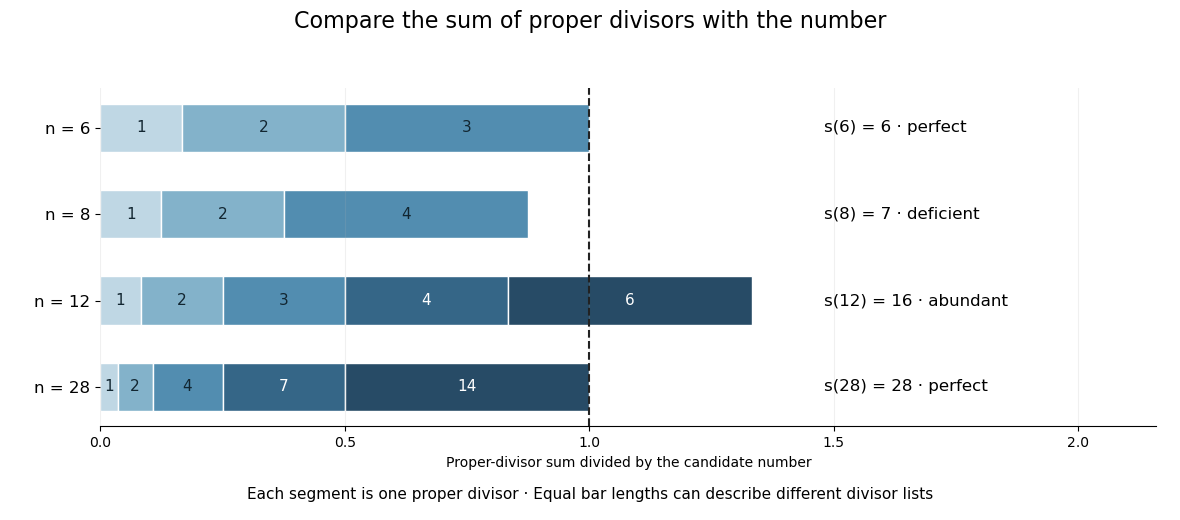
Proper divisors balance a perfect number, fall short of a deficient number, or exceed an abundant number
. Original exact proper-divisor sums for . Each bar is normalized by its candidate number, and its segments are labelled with the actual proper divisors. The dashed line at one marks equality with the candidate. These are finite arithmetic calculations, not empirical data. Details.
The interesting question is how such balances can be constructed without testing every smaller integer as a possible divisor. The Euclid-Euler theorem answers it for even integers: a Mersenne prime gives , and every even perfect number arises this way. For , this produces . The connection links divisor sums to primality testing for a particular family, while keeping the necessary hypotheses visible.[ref]
Euclid's Elements already gives the construction in Book IX, Proposition 36: add a succession of powers of two, and if their sum is prime, multiply by the final power of two. The modern finite geometric series makes the same pattern transparent. This original statement supplies the forward construction, rather than the converse classification of all even perfect numbers.[ref]
Plane Created 2026-09-24 Updated 2026-10-18
A plane is a two-dimensional affine subspace: a point together with every linear combination of two linearly independent direction vectors ,In three-dimensional Euclidean space, a Cartesian equation of a plane fixes one linear equation , with a nonzero normal vector . The two free directions are orthogonal to . A plane extends indefinitely; a rectangular patch in a drawing marks only part of it, and does not define an edge of the plane.
For example, the plane contains . The vectors and are linearly independent and satisfy . Hence its points are exactly : substitution gives for every real , and every solution has , .
The description separates position from direction. A translation of the plane changes and possibly , while retaining its parallel directions. A plane through the origin is a linear subspace; the displayed example is not, since the zero vector fails its linear equation. This distinction matters when applying orthogonal projection: subtract an anchor point before projecting onto the direction linear subspace.
Historically, Euclid's Euclid's Elements by Euclid, Book I Definition 7, describes a plane surface through the straight lines lying on it. David E. Joyce's accompanying guide notes that this older use can include a bounded square or circular figure. That usage differs from the whole unbounded affine subspace used here.[ref]
Book I, Definition 7. Euclid's Elements, Book I Definition 7 and David Joyce's Guide: plane surfaces and bounded figures
English Euclid translation with commentary. The Text Creation Partnership transcription identifies the title page and Book VII, Definition 23. Modern numbering of the corresponding perfect number definition is VII.22. The linked repository also records the transcription's bibliographical provenance.
Online source: github.com/textcreationpartnership/A00429
Thomas Heath (classicist) Created 2026-10-24 Updated 2026-11-05
Thomas Heath was a historian of mathematics whose translations and commentaries helped make ancient Greek mathematical texts accessible to modern readers. Alongside a career in the civil service, he published work on Diophantus, Apollonius of Perga, Archimedes and Euclid, including a three-volume account of Euclid's Elements.[ref]
https://mathshistory.st-andrews.ac.uk/Biographies/Heath/. Biography, publications on Greek mathematics and 1908 Euclid edition
His scientific importance lies in connecting the surviving text with its mathematical argument: translating the words alone does not explain how an ancient construction or proof fits into its original setting. His commentary remains useful when comparing historical geometric reasoning with modern algebraic notation.
Portrait of Thomas Heath (classicist)
. Unknown photographer; reproduced via the MacTutor History of Mathematics archive and the Royal Society obituary (1941). Commons dates the portrait circa 1910. Public domain in the country of origin and jurisdictions with author-life-plus-70 terms or shorter, as claimed by Commons; photographer unknown, and the file page requests an additional United States public-domain basis. Source usage terms, via Wikimedia Commons. Source.
