In a two-level system, let the Hamiltonian operator have matrix in the orthonormal basis . The normalized real trial quantum states and their Rayleigh quotient areThe excited-state probability amplitude is , so its probability is . Thus , with equality if and only if the excited-state probability amplitude vanishes: . The remaining quantum state is up to a global phase. At the trial energy is ; at it is . These are upper bounds on the ground-state energy, even though neither is a minimizing trial.
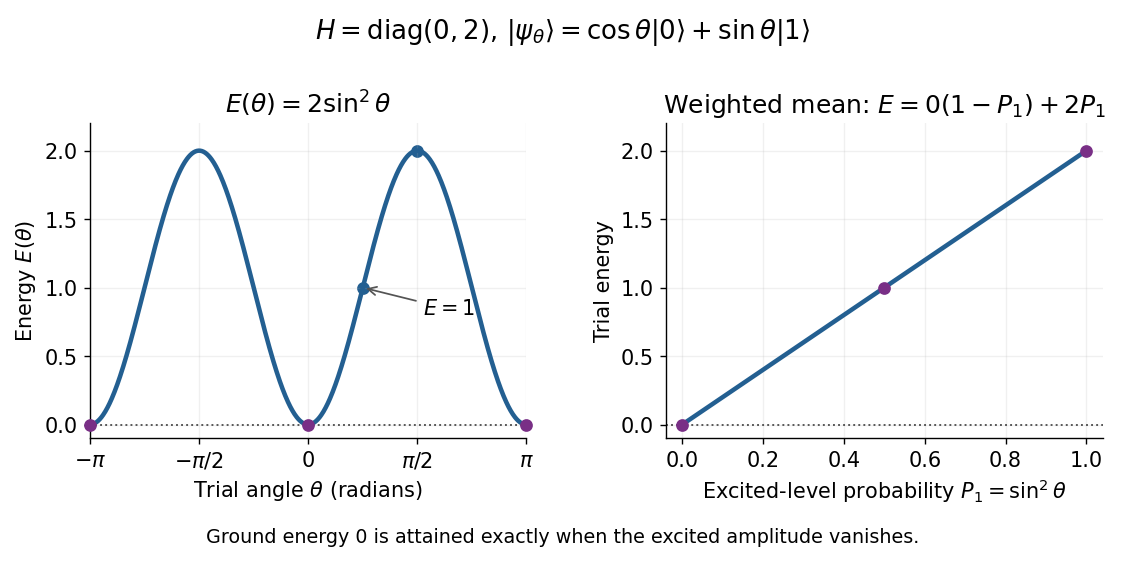
Two-level variational energy is twice the excited-level probability and reaches zero only when the excited amplitude vanishes
. Details. 
The real trial family contains the ground state, so it attains the exact minimum despite not covering every complex quantum state. More generally, a family covering all normalized vectors in a two-dimensional Hilbert space gives the exact lowest eigenvalue of any Hermitian matrix by minimizing its Rayleigh quotient. For a complex trial with , the same calculation gives : a relative quantum phase cannot change this diagonal Hamiltonian energy. This finite example is the weighted mean proof of the variational method with just two energy eigenstates.
Articles by others on the same topic
There are currently no matching articles.