The variational method estimates the lowest energy of a Quantum Hamiltonian by choosing a trial wavefunction, evaluating its energy, and optimizing the trial parameters. It uses the quantum variational principle, the Rayleigh-Ritz variational principle expressed for quantum states. Let be a self-adjoint operator bounded below, and define , the bottom of its spectrum. Every normalized admissible trial quantum state satisfiesWhen is an energy eigenvalue, it is the ground-state energy; equality holds precisely for a quantum state in the ground-state subspace. Otherwise the bottom of the spectrum need not be attained by any normalizable wavefunction.
Admissible means finite form energy. Choose a real and use the shifted quadratic form of a positive quantum Hamiltonian:The form domain is independent of this choice of and can be larger than the operator domain . For , is the usual expectation value; for nonzero unnormalized trials, divide by to get the form version of the Rayleigh quotient. See the quantum variational principle for the general domain justification.
Thus each trial energy is an upper bound on , and minimizing within a trial family improves that upper bound. It is not a lower bound on . The Gaussian variational energy for the harmonic oscillator reaches because its family contains an exact ground state. The exact variational solution in a two-level system makes the equality condition visible as vanishing excited-state probability amplitude.
The method is useful when solving the Schrödinger equation exactly is difficult but integrals of a trial wavefunction are tractable. Enlarging a trial family cannot increase its optimal energy, although an optimum need not be attained. The beauty is that even an imperfect trial gives a rigorous bound, provided its form energy is computed exactly: numerical integration errors require separate control. The Gaussian variational estimate for a solvable sextic potential provides an existing example beyond a quantum harmonic oscillator.
A short proof explains the direction. With a complete orthonormal eigenbasis of energy eigenstates, write , where and . ThenThis is a weighted mean of nonnegative energy differences; equality requires every occupied energy eigenstate to have energy . [ref]
https://ocw.mit.edu/courses/8-05-quantum-physics-ii-fall-2013/61bc31b8d8bf0680c322733910a71aa0_MIT8_05F13_Chap_01.pdf. Barton Zwiebach, Wave Mechanics, MIT 8.05, 2013, §5, pp. 18–20
. For continuous spectrum, the spectral theorem replaces the sum by an integral against the scalar spectral measure of , with the same nonnegative integrand. This proves the bound without assuming an orthonormal eigenbasis exists.The historical setting predates quantum mechanics: Rayleigh's The Theory of Sound, volume I, appeared in 1877, and Ritz's paper on solving variational problems of mathematical physics appeared in volume 135 of Crelle's journal, catalogued by its publisher as 1909, pp. 1–61. These are original works associated with the Rayleigh-Ritz method; the dates here identify the publications rather than assert priority. [ref]
https://archive.org/details/theorysound06raylgoog. Lord Rayleigh, The Theory of Sound, volume I, 1877
; [ref]https://doi.org/10.1515/crll.1909.135.1. Walter Ritz, Über eine neue Methode zur Lösung gewisser Variationsprobleme der mathematischen Physik, original article and publisher metadata
.The trial , , satisfies the wall condition in the half-line square-root potential well. Its norm is , kinetic energy is and potential energy is . The optimal satisfies . At the minimum, and . The quantum variational principle makes this an upper bound on the ground-state energy.
An even one-dimensional confining potential preserves even and odd parity. Restricting a normalized trial state to the odd sector makes its Rayleigh quotient an upper bound on the lowest odd energy, which is the first excited energy for the usual nonsingular one-dimensional bound-state problem. This avoids contamination by the even ground state. For an adjustable-width odd Gaussian, optimize its own width rather than borrowing the ground-state optimum.
A product of two normalized orbitals proportional to , combined with a singlet state, gives the fixed-nucleus helium atom trial energy in atomic units. Minimization gives and Hartree. Nuclear charge remains two in the Hamiltonian operator; varying changes only the trial orbitals. The reduced orbital charge describes screening, while explicit dependence on electron separation can further lower the trial energy under the quantum variational principle.
If a trial quantum state is dominated by two energy eigenstates of distinct energies , then its Rayleigh quotient is approximately their probability-weighted mean. Rearranging that mean gives the displayed relative admixture. Neglected states must make small contributions to the energy numerator as well as to wavefunction normalization; small probabilities alone need not suffice if their energies are large.
For with , the normalized even trial wavefunction has Rayleigh quotientThe Gaussian moment recurrence gives the potential term, and integration by parts gives the kinetic term. Its minimum is at , proving the displayed upper bound by the Rayleigh-Ritz variational principle.
An odd trial family is orthogonal to the exact even ground state. The Sturm oscillation theorem identifies the lowest odd state as the first excited state, so minimizing within this family bounds :Orthogonality to an approximate ground trial alone would not justify this excited-state bound; odd parity ensures orthogonality to the exact ground state. Both bounds exhibit the characteristic quartic-oscillator energy scale .
For , use the normalized real wavefunction , . The Gaussian integral gives and , while the kinetic contribution is . Thus the Rayleigh quotient is the displayed expression. For positive , its stationary width satisfies . At the unique positive solution is , giving by the Rayleigh-Ritz variational principle. For , taking makes the negative quartic contribution dominate, so the energy is unbounded below even within this normalized family. The positive-coupling bound and negative-coupling instability concern different signs of the same variational expression.
Use the quantum harmonic oscillator in units with reduced Planck constant , mass , and angular frequency . Its Hamiltonian operator and trial Gaussian wave packet areThis is the same Gaussian wave packet used for the Heisenberg uncertainty relation: is a normal distribution with mean zero and variance . The Gaussian integral gives wavefunction normalization and . These smooth, rapidly decaying trials lie in the one-dimensional harmonic oscillator form domain and even in the operator domain.
Since , integration by parts with vanishing boundary terms gives the kinetic energy and potential energy:Narrow trials cost kinetic energy, while broad trials cost potential energy. The exact differenceshows that the unique optimal width is , with . At and , the trial energies are both ; the kinetic energy and potential energy contributions exchange places.
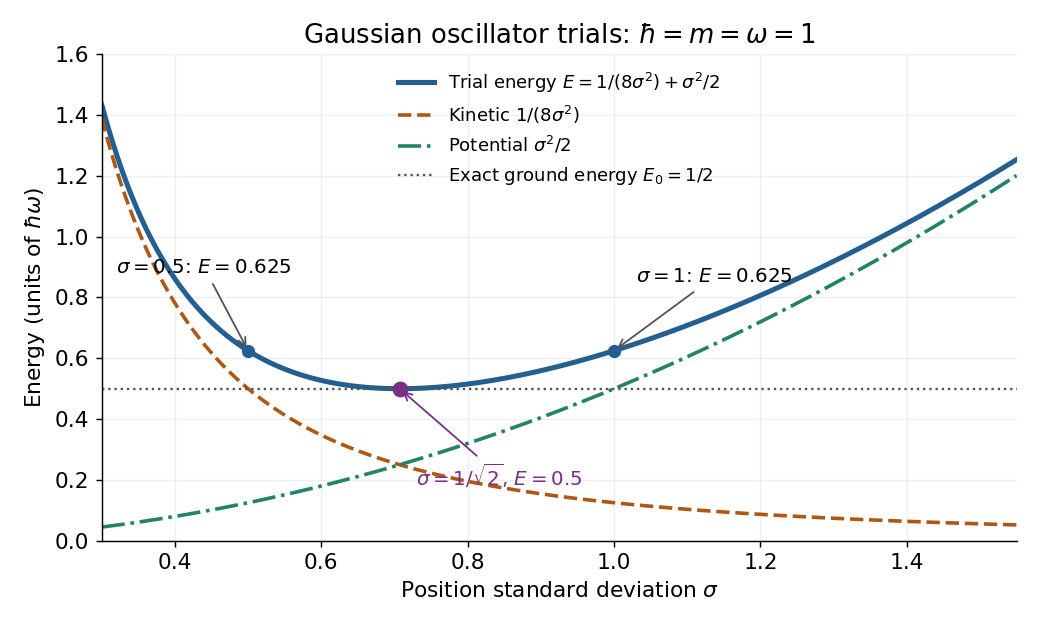
Gaussian oscillator trial energies: widths 0.5 and 1 both give 0.625, while the optimal width gives 0.5
. The kinetic energy decreases and the potential energy increases with the width of the Gaussian wave packet. Their sum touches the exact ground-state energy only at . Details.
Minimizing within this trial family alone establishes . To establish exactness, use the Heisenberg uncertainty relation to obtain for every admissible quantum state, as in its existing oscillator example. Together the bounds give . Direct substitution also yields , agreeing with the Gaussian eigenstate for a quadratic potential. This is a useful distinction: the variational method supplies the upper bound, while the Heisenberg uncertainty relation supplies the complementary lower bound.
For a regular one-dimensional confining potential, the bound-state eigenfunctions can be ordered by their number of nodes. The unique nodeless normalizable eigenfunction is the ground state.
For the trial state , the dimensionless Rayleigh quotient isIts unique minimizer isand at the minimum .
If pointwise for Hamiltonians with the same kinetic term, using the ground state of as a trial state for gives .
For a normalized dilation and a homogeneous potential of degree , the energy is . Stationarity at an eigenstate gives .
For an attractive potential with , dilations make the negative potential energy grow faster than kinetic energy, sending the Rayleigh quotient to minus infinity.
For the formal one-dimensional operator with and , take a smooth normalized test function supported away from the origin. Its normalized dilation hasAs , this tends to minus infinity. Thus the unregularized expression has fall to the centre for a supercritical inverse-power potential and cannot define a semibounded Hamiltonian operator on a domain containing these test functions.
If a putative bound state has separately finite and admits norm-preserving dilation variations inside its operator domain or energy domain, stationarity gives , hence , incompatible with a negative-energy bound state below the zero continuum threshold. For a putative ground state, the second scaling derivative is , also incompatible with a minimum. The argument's finite-energy and domain assumptions are essential: it proves absence of a stable ground state and excludes bound states to which this ordinary virial calculation applies. An unqualified assertion about all formal square-integrable solutions at the singular origin needs a specified self-adjoint realization; adding a short-distance cutoff changes the problem.
In a two-level system, let the Hamiltonian operator have matrix in the orthonormal basis . The normalized real trial quantum states and their Rayleigh quotient areThe excited-state probability amplitude is , so its probability is . Thus , with equality if and only if the excited-state probability amplitude vanishes: . The remaining quantum state is up to a global phase. At the trial energy is ; at it is . These are upper bounds on the ground-state energy, even though neither is a minimizing trial.
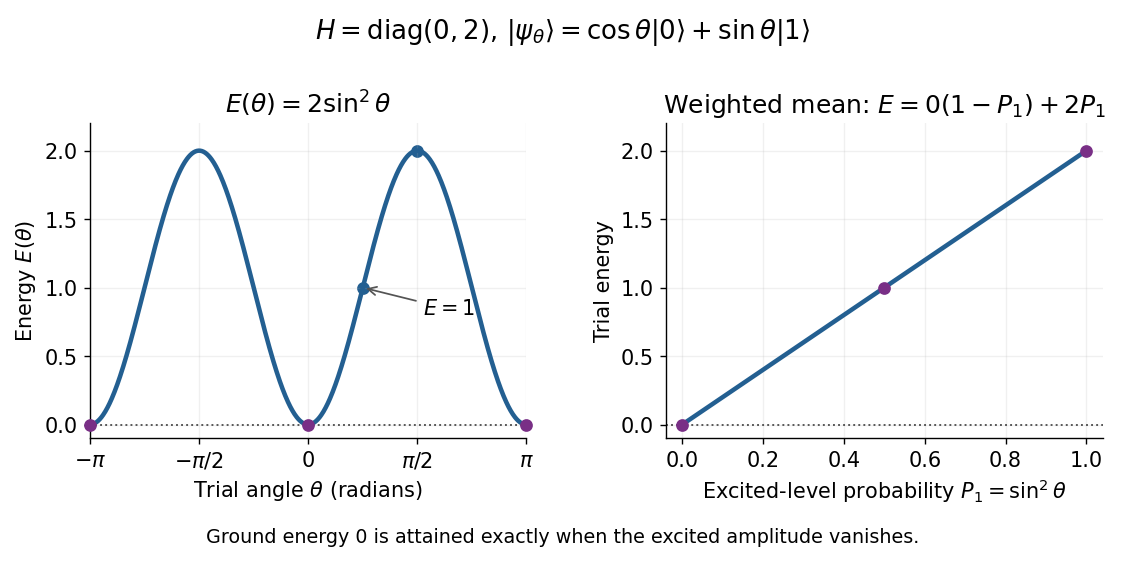
Two-level variational energy is twice the excited-level probability and reaches zero only when the excited amplitude vanishes
. Details. 
The real trial family contains the ground state, so it attains the exact minimum despite not covering every complex quantum state. More generally, a family covering all normalized vectors in a two-dimensional Hilbert space gives the exact lowest eigenvalue of any Hermitian matrix by minimizing its Rayleigh quotient. For a complex trial with , the same calculation gives : a relative quantum phase cannot change this diagonal Hamiltonian energy. This finite example is the weighted mean proof of the variational method with just two energy eigenstates.
Articles by others on the same topic
There are currently no matching articles.