The Euler method approximates an initial value problem , , by evaluating the derivative at the current point and moving along that tangent line for a time . With , its displayed update needs one evaluation of per step. This simple rule turns local slope information into a whole approximate trajectory. MIT's course notes derive it by dropping the second-order Taylor remainder.[ref]
Take , , whose exact solution is the exponential function . The Euler method givesAt , the first values are . At , five steps give , compared with . The result decays but is too small: absolute stability alone does not ensure accuracy. At , the first values are , and at five steps give , while the exact solution is about .
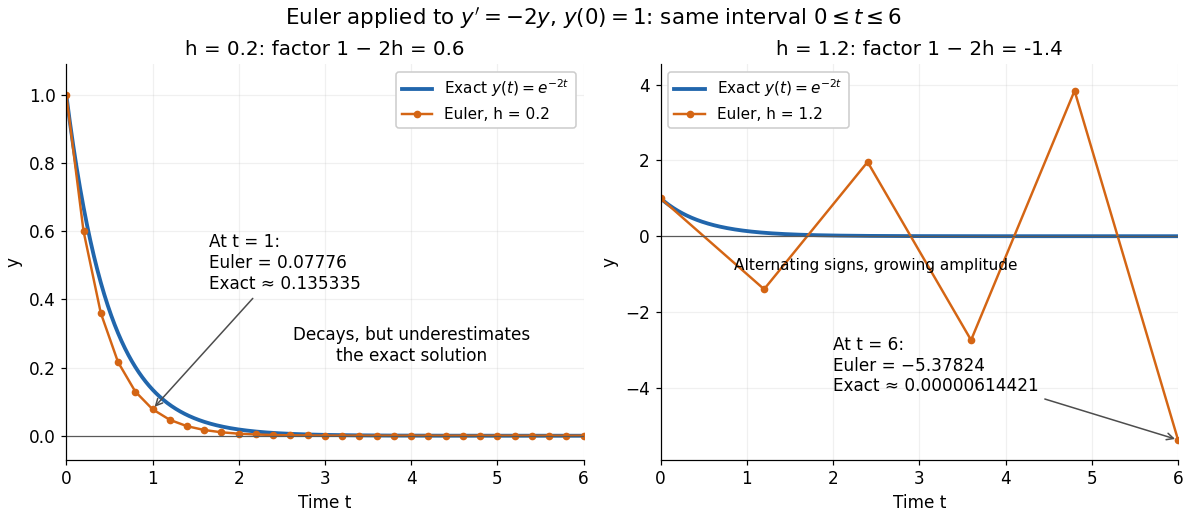

For the Dahlquist test equation , the Euler method has stability function with . Its absolute stability region is , the closed disk centred at with radius one. For the present real decay problem and , bounded numerical values require ; strict decay requires . At the values alternate without decay. These conditions follow directly from the amplification factor , matching MIT's criterion for .[ref]
https://web.mit.edu/10.001/Web/Course_Notes/Differential_Equations_Notes/node3.html. MIT 10.001, Forward and Backward Euler Methods, linear decay example
The Euler method is first order: with bounded second derivative and suitable Lipschitz continuity, its global error is on a fixed interval. In this example the logarithm gives for small positive . At , this means . It explains both the downward bias and why halving the step roughly halves the error once is sufficiently small.
For a smooth solution of , Taylor's theorem gives the displayed local truncation error when an Euler method step starts at an exact solution value. Thus the one-step defect is . Dividing it by gives a normalized local truncation error of ; these are different conventions for reporting the same residual. Also along the solution by the chain rule. A global error conclusion additionally requires the usual regularity and stability control over successive steps.
Articles by others on the same topic
There are currently no matching articles.