Prepare the same ideal monoprotic acid model at initial pH , with appropriate accompanying ions to balance electric charge. To predict the new pH after a finite signed addition , solve using the chemical equilibrium expression above. For of added chemical base, the calculated final pH is at , but at . The initial local approximation gives changes of about and , respectively; its accuracy decreases as the partner balance changes appreciably.
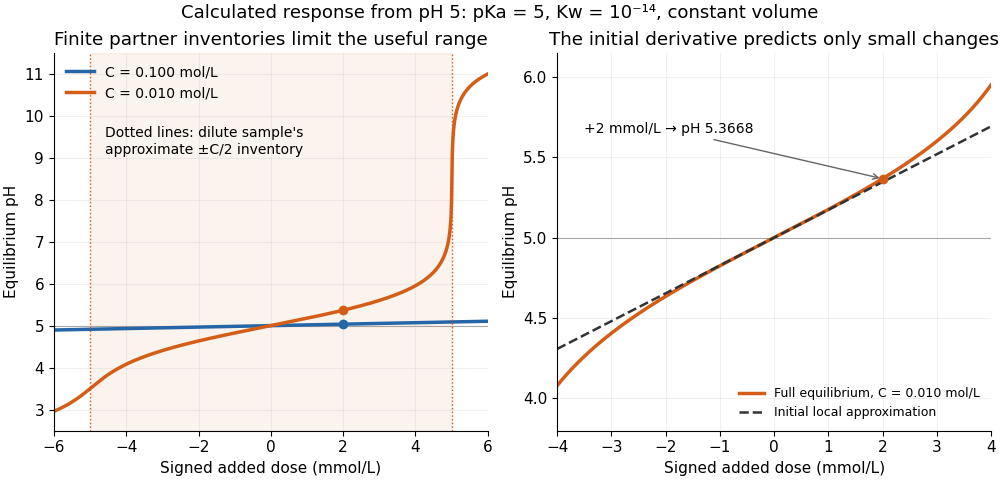

For the dilute example, additions beyond approximately in either direction exceed the initial inventory of one partner. The full chemical equilibrium calculation still produces a finite pH; an inventory-only Henderson-Hasselbalch equation calculation would attempt to use a negative partner quantity. At the dilute example reaches pH , whereas the concentrated example reaches only . This demonstrates a finite operating range, not an abrupt cessation of all buffer capacity.
Articles by others on the same topic
There are currently no matching articles.