The Henderson-Hasselbalch equation estimates buffer solution pH using a weak acid's acid dissociation constant and the conjugate base to weak acid concentration ratio.
Its activity form is an exact rearrangement of the chosen chemical equilibrium relation. Write the acid dissociation step as , with hydrated hydrogen ions understood in water and the solvent convention incorporated into the acid dissociation constant. For consistent standard states,Here each is a dimensionless thermodynamic activity at chemical equilibrium. Exactness refers to this specified acid dissociation constant relation and the chosen single-ion thermodynamic activity convention, not to identifying the ratio with quantities initially mixed. If water is instead written explicitly as a reactant, its thermodynamic activity must be treated consistently. See Hippler and Metcalfe, Using activities to correct the Henderson-Hasselbalch equation (2020), equations 3–4.
For a toy weak acid with stipulated pKa , use the ideal dilute concentration approximation and put . The Henderson-Hasselbalch equation becomes :More conjugate base relative to weak acid means higher pH. Each tenfold increase in the ratio contributes exactly one to the calculated pH. The stipulated pKa is not a tabulated value for an identified substance.
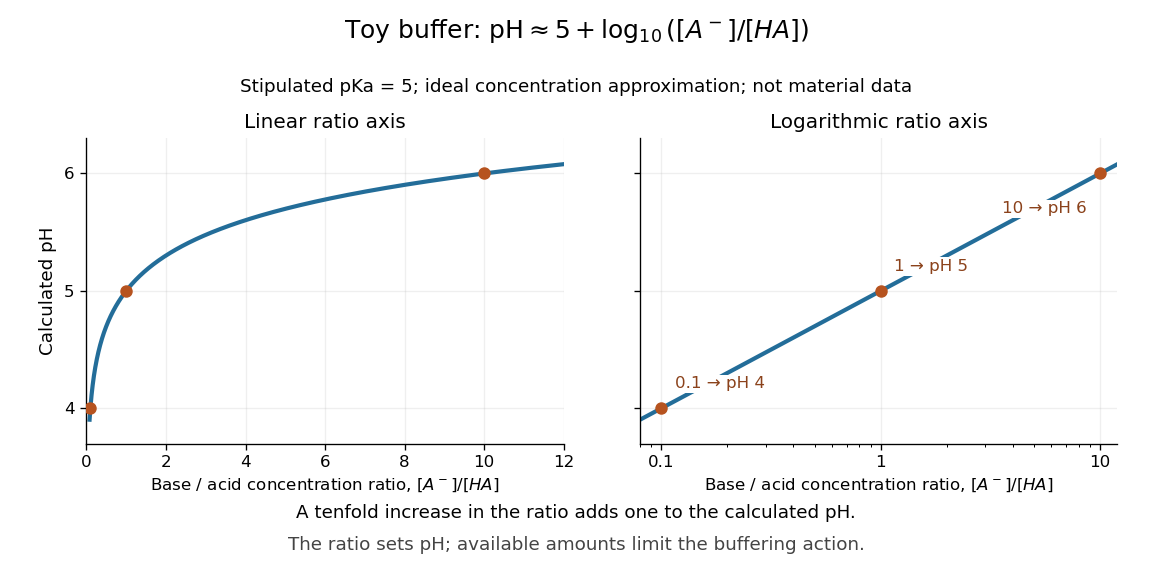
The distinction between thermodynamic activity and concentration is explicit when , where is an activity coefficient and is the reference concentration:Neglecting the final term gives the usual approximate Henderson-Hasselbalch equation. It is justified when the ratio of activity coefficients is sufficiently close to one, as in a suitable dilute ideal approximation. Ionic strength, including contributions from other dissolved ions, affects activity coefficients; a nominally dilute weak acid alone does not establish that all corrections are small. The ratio must use chemical equilibrium concentrations. Replacing these by prepared amounts or post-neutralization inventories is a further approximation, suitable only when subsequent redistribution is small. See Hippler and Metcalfe, concentration, activity, and analytical-concentration approximations.
The short derivation is to solve the acid dissociation constant relation for , take a negative base-ten logarithm, and use the definitions of pH and pKa. Its useful beauty is that a chemical equilibrium becomes a simple rule about a ratio: select a weak acid with pKa near the desired pH, then adjust the partner ratio. Scaling both partner concentrations equally leaves the ideal pH prediction unchanged, while changing buffer capacity. In practical buffer solutions, temperature, ionic strength, and the available inventories still matter.
Articles by others on the same topic


The Henderson–Hasselbalch equation is a fundamental equation in biochemistry and pharmacology that relates the pH of a solution to the pKa of an acid and the ratio of the concentration of its dissociated (conjugate base) and undissociated (acid) forms. It is often used to estimate the pH of buffer solutions.