Förster resonance energy transfer is a nonradiative transfer of energy from an excited state of a FRET donor to a nearby FRET acceptor, through coupling of their electric dipoles. The transfer step does not emit a photon that the FRET acceptor subsequently absorbs. It competes with the FRET donor's own fluorescence and other routes out of its excited state. A fluorescent FRET acceptor can then emit fluorescence; an absorbing but nonfluorescent FRET acceptor can still receive the transferred energy.[ref]
Advanced Fluorescence Microscopy Techniques—FRAP, FLIP, FLAP, FRET and FLIM by Hellen C. Ishikawa-Ankerhold and others. §3.1: nonradiative dipole coupling and a potentially nonfluorescent acceptor
The striking use of FRET is to turn a change in molecular proximity into an optical readout. Proteins carrying a FRET donor and a FRET acceptor may change the readout when they associate, as in the chemotaxis FRET assay; two labels on one protein may report a change in its shape. Interpretation depends on the FRET spectral overlap, FRET dipole orientation factor and labeling geometry, as well as separation. A change in FRET is therefore evidence about proximity under specified conditions, rather than a direct measurement of an arbitrary distance.[ref]
Advanced Fluorescence Microscopy Techniques—FRAP, FLIP, FLAP, FRET and FLIM by Hellen C. Ishikawa-Ankerhold and others. §3.1 and §3.3: dependence on distance and orientation; inter- and intramolecular applications
For a single pair with fixed Förster distance and label separation , the FRET efficiency isAt , half the FRET donor excitations transfer energy. At , the model gives ; at , it gives . The sixth power makes FRET especially useful near the Förster distance, with little sensitivity to further separation once transfer is already negligible. These are model calculations, not measurements of a particular pair.
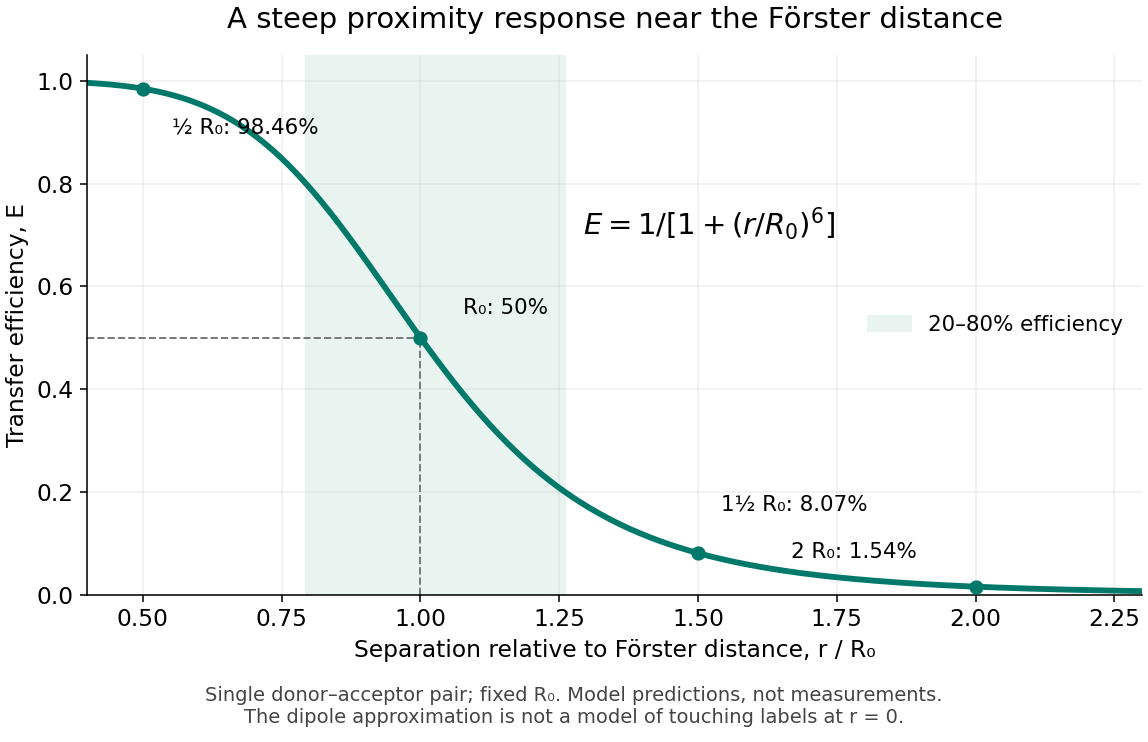
FRET efficiency versus separation relative to the Förster distance
. Original single-pair mathematical model with fixed Förster distance. The shaded interval is . The curve does not establish a universal working range or justify the electric dipole approximation for overlapping labels. Details.
A FRET donor supplies the initial excited state energy. Its fluorescence provides both an emission channel and a reference FRET donor lifetime when no FRET acceptor is present. Calling a label a FRET donor describes its role in a chosen pair, rather than a permanent classification of the molecule.
A FRET acceptor receives the excited state energy. Its absorption must support FRET spectral overlap with the FRET donor. FRET sensitized emission requires a fluorescent FRET acceptor; measuring a shortened FRET donor lifetime does not.
FRET efficiency is the probability that an excitation of the FRET donor ends in transfer to the FRET acceptor. Write for the total decay rate without a FRET acceptor, including radiative fluorescence and other decay, and for the transfer rate. For constant competing rates,The integral counts transfer events among all excitations in a population with exponential decay. Substitution gives the separation law above. This short rate argument assumes one FRET donor, one FRET acceptor, weak coupling, an available FRET acceptor, and fixed geometry during the decay; it is not a model for arbitrary interacting labels.[ref]
Advanced Fluorescence Microscopy Techniques—FRAP, FLIP, FLAP, FRET and FLIM by Hellen C. Ishikawa-Ankerhold and others. §3.1, equations 14–16 and discussion before §3.3: single-pair assumptions and transfer efficiency
The Förster distance is the separation giving FRET efficiency for the specified pair and conditions. It is a property of the optical pair and its environment, rather than a universal length. In the usual pair model,where is the FRET dipole orientation factor, the FRET donor quantum yield, the FRET spectral overlap integral, and the medium's refractive index. The omitted proportionality constant depends on the unit convention for .[ref]
Advanced Fluorescence Microscopy Techniques—FRAP, FLIP, FLAP, FRET and FLIM by Hellen C. Ishikawa-Ankerhold and others. §3.1, equations 16–18: factors controlling Förster distance
If FRET efficiency is known and those assumptions hold, inversion givesThe derivative explains why errors become troublesome near or . An illustrative pair with nanometres and another with nanometres both give at their different Förster distances: knowing FRET efficiency alone does not determine .
A heterogeneous population adds another ambiguity. In a synthetic example with equal weights per FRET donor excitation, efficiencies and average to , but their separations are and . Their average separation is approximately , whereas inverting the average FRET efficiency gives . A measured emission ratio has additional detection weights; it need not equal even this excitation-weighted average. The transferable lesson is that an average readout does not uniquely specify a distribution of molecular separations.
FRET spectral overlap quantifies overlap between the FRET donor's emission and the FRET acceptor's absorption as functions of wavelength . With normalized donor emission and acceptor molar absorption coefficient , one convention isMatching two emission colors is insufficient: the receiving absorption matters.[ref]
Advanced Fluorescence Microscopy Techniques—FRAP, FLIP, FLAP, FRET and FLIM by Hellen C. Ishikawa-Ankerhold and others. §3.1, equation 17 and Figure 19: normalized donor emission and acceptor absorption overlap
The FRET dipole orientation factor describes the geometry of the two transition electric dipoles relative to their separation. Let , and be their unit vectors. ThenFor a separation along , parallel electric dipoles along give , parallel ones along give , and one along with the other along gives . Thus rotating a pair can change FRET efficiency without changing its separation.
The familiar value requires suitable rapid, independent orientation averaging during the FRET donor lifetime. Random orientations across a population of slowly rotating fluorescent proteins do not establish that dynamic condition. [ref]
The FRET donor quantum yield is the emitted fluorescence photon fraction per absorbed excitation photon, measured without a FRET acceptor. In the constant-rate model used for FRET efficiency, . Changing the FRET donor quantum yield changes the Förster distance, even if label positions remain fixed.
The FRET donor lifetime is the mean time spent in the excited state. For the constant-rate model of FRET efficiency,After a sufficiently brief excitation pulse, the FRET donor's fluorescence follows exponential decay, . With the illustrative values nanoseconds and nanoseconds, the inferred FRET efficiency is . Multiplying changes brightness without changing this decay time.
The lifetime comparison requires the same nontransfer decay rates in the reference and paired samples. Changes in the FRET donor's environment or a different nonradiative loss can also shorten the FRET donor lifetime. Heterogeneous FRET efficiencies or slowly varying FRET dipole orientation factors need an appropriate decay model; substituting any fitted average lifetime into the single-pair formula can mislead. [ref]
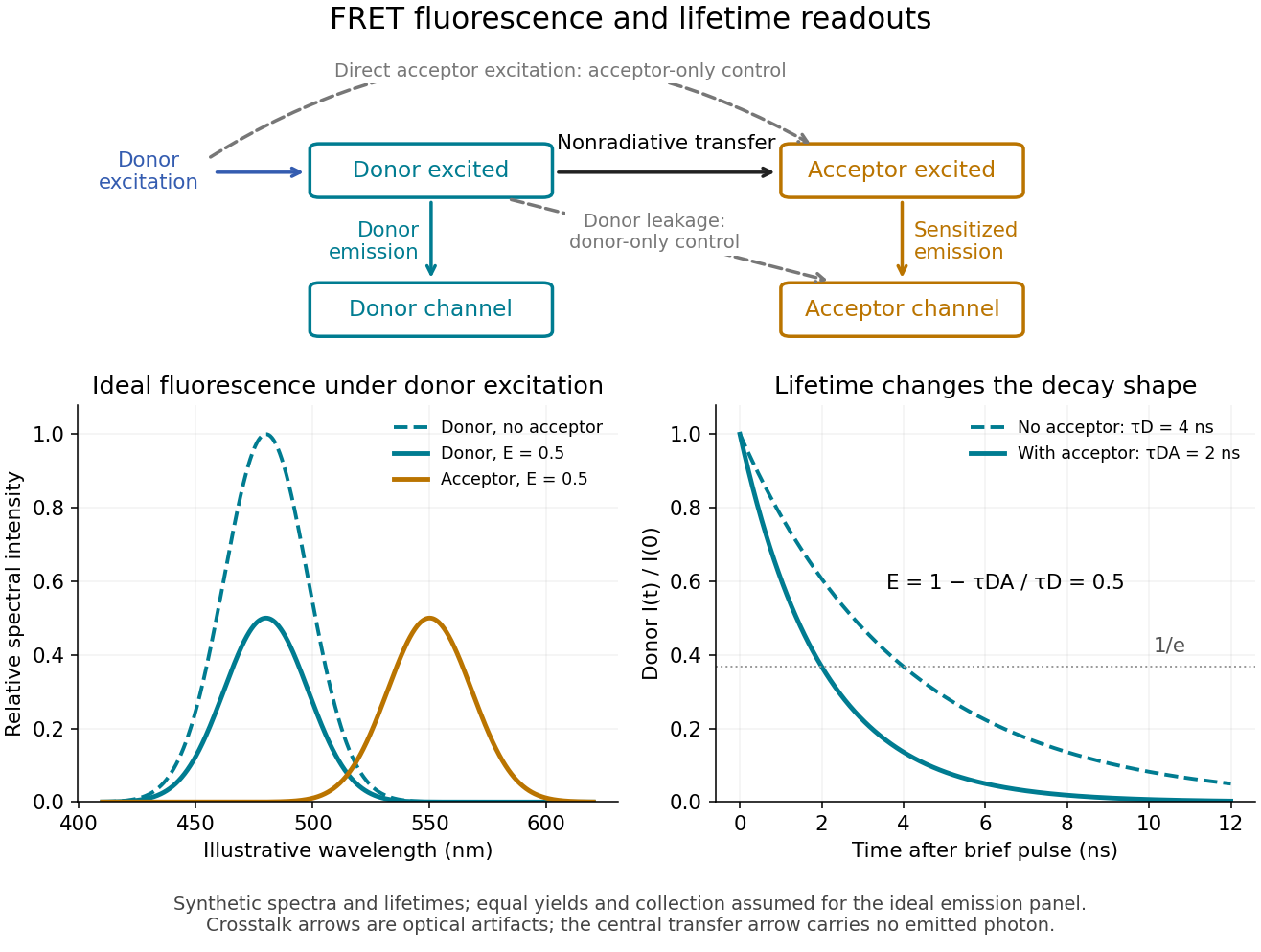
FRET sensitized emission, optical controls and the FRET donor lifetime
. Original schematic and synthetic curves. The spectral panel assumes equal fluorescence yields and collection efficiencies for the two labels; its amplitudes are illustrative, not a calibration or measured cyan/yellow spectra. The lifetime panel uses and nanoseconds. Dashed optical paths require FRET optical crosstalk controls; they do not represent the nonradiative transfer mechanism. Details.
FRET sensitized emission is FRET acceptor fluorescence caused by transfer from an excited FRET donor. Excite predominantly the FRET donor and collect both emission bands. Reduced FRET donor emission and increased FRET acceptor emission are useful together, but an acceptor-to-donor emission ratio is not automatically the FRET efficiency: brightness, label abundance and channel collection also enter.[ref]
Advanced Fluorescence Microscopy Techniques—FRAP, FLIP, FLAP, FRET and FLIM by Hellen C. Ishikawa-Ankerhold and others. §3.4.2: sensitized emission and dependence on optical correction and label concentrations
FRET optical crosstalk includes FRET donor emission leaking into the FRET acceptor detection band and direct excitation of the FRET acceptor by the nominal FRET donor excitation light. Measure donor-only, acceptor-only and unlabeled preparations with the same fluorescence microscope settings to separate these contributions and background.[ref]
Advanced Fluorescence Microscopy Techniques—FRAP, FLIP, FLAP, FRET and FLIM by Hellen C. Ishikawa-Ankerhold and others. §3.4.2, samples i–iii and equations 20–21: spectral correction controls
An explicit linear measurement model makes the controls' purpose clear. Let be background-subtracted donor-band counts under donor excitation, acceptor-band counts under acceptor excitation, and acceptor-band counts under donor excitation. Donor-only and acceptor-only preparations determine leakage coefficients and . Thenis a corrected FRET sensitized emission signal under the assumed linear, fixed optical response. In a synthetic example , , , and give . Even a nontransferring sample would give from these two contaminants. Correcting that signal still does not convert into FRET efficiency without a calibration of excitation, yields and detection.
A biological comparison also needs a pairing-negative preparation and a known transferring positive preparation. Match label abundance and localization where possible; changing concentration can change encounter frequency as well as brightness. Check that attaching the labels preserves the protein function being investigated. Otherwise the measurement can faithfully report a perturbation introduced by the labels themselves.
In FRET photobleaching controls, selectively destroy the FRET acceptor's ability to absorb and test whether FRET donor fluorescence increases. Under unchanged excitation and detection, complete loss of transfer, and an intact FRET donor,This is a destructive comparison. Monitor acceptor loss, donor-only samples exposed to the bleaching illumination, and an unbleached reference region or time trace. Incomplete bleaching, donor damage, movement or label replenishment violate the comparison. During ordinary recordings, gradual unequal bleaching can instead produce an apparent change of FRET without a biological change.[ref]
In Receptor sensitivity in bacterial chemotaxis by Victor Sourjik and others, Victor Sourjik and Howard C. Berg used a cyan fluorescent tag on CheZ as FRET donor and a yellow tag on CheY as FRET acceptor. Escherichia coli biological cells adhered to a polylysine-coated coverslip in a continuously perfused chamber. A fluorescence microscope excited them with a -nanometre laser; split emission bands fed two photon-counting detectors. The yellow/cyan emission ratio fell when attractant was added and rose when it was removed.[ref]
Receptor sensitivity in bacterial chemotaxis by Victor Sourjik and others. Introduction, Materials and Methods: Preparation of Cells and Data Acquisition; Results and Figure 1
Saturating attractant increased cyan emission by an amount matching selective bleaching of the yellow tag: removing the FRET acceptor supported relief of FRET donor transfer. Strains carrying the tagged pair but lacking other chemotaxis machinery showed no stimulus-dependent emission ratio change. Weak illumination reduced bleaching drift.[ref]
Receptor sensitivity in bacterial chemotaxis by Victor Sourjik and others. Data Analysis and Results: acceptor bleaching comparison, low illumination, and flhC negative control
The inference is a change in the population of nearby tagged CheY/CheZ pairs associated with CheY phosphorylation. It neither measures each pair's separation nor directly observes motor motion. The readout also averages many biological cells, and perfusion takes finite time. The pathway interpretation belongs to the chemotaxis FRET assay; the general measurement lesson is that molecular association can alter FRET while the geometry of an individual associated pair stays the same.
Articles by others on the same topic
There are currently no matching articles.