Ivar Giaever's gap experiment used a metal–insulator–metal sandwich. His lecture describes evaporating aluminium onto glass, briefly exposing it to air to form an oxide barrier, then evaporating lead cross-strips. Cooling in liquid helium made the lead superconducting while the aluminium stayed normal in the measurements compared. A voltmeter and ammeter supplied the junction electric potential difference and electric current readouts. Thick oxides initially gave unmeasurably small electric currents; the thinner barrier made the measurement practical. Temperature comparisons and a subsequent controlled magnetic field test changed the current-voltage characteristic with the superconducting state. [ref]
The 1960 letter compares measurements at and . An applied parallel magnetic field of kept the lead normal; removing the magnetic field strongly suppressed the small-voltage electric current. Figure 2 divides the superconducting by the normal-state slope. The letter calls its gap estimates preliminary and notes a temperature-dependent broadened peak. It also flags a limitation of interpreting tunneling directly through the density of states; the ideal NIS calculation above states additional assumptions explicitly. [ref]
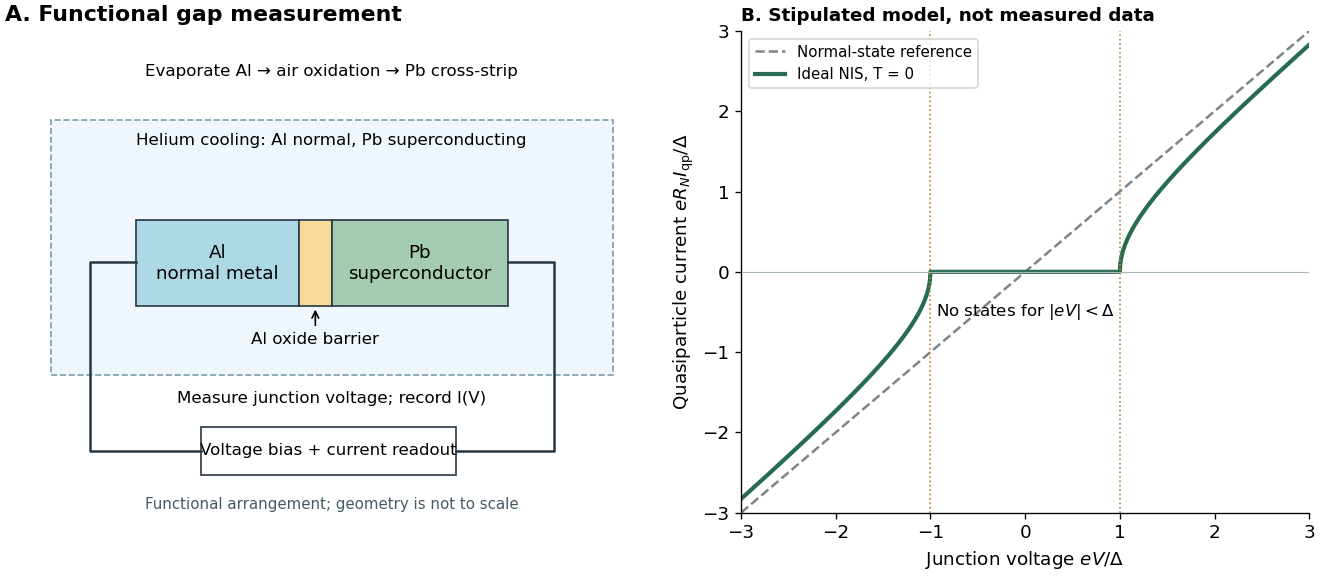

The central inference is that the barrier lets electric current interrogate available quasiparticle states. Suppression at small electric potential difference and the rise near the gap edge support a gapped spectrum; tracking the superconducting state helps distinguish that feature from an arbitrary nonlinear barrier. A leakage path through a metallic short, imperfect barrier, or an energy-dependent tunneling matrix element limits a literal density of states interpretation. The preparation and state controls therefore matter as much as seeing a nonlinear current-voltage characteristic.
Articles by others on the same topic
There are currently no matching articles.