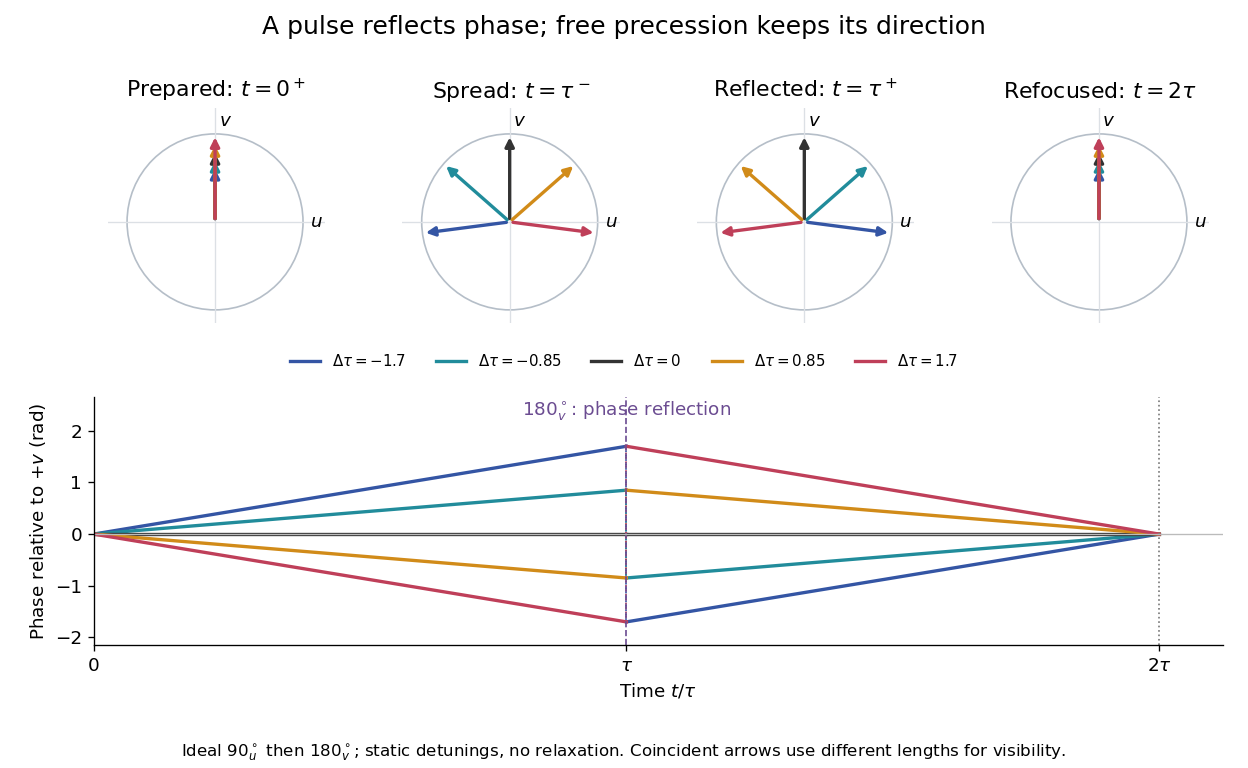
A spin echo is a reappearance of transverse magnetization after a pulse sequence reverses an earlier spread of phases. An ensemble can have almost no net transverse magnetization while its components retain enough individual phase memory to reassemble. In the ideal Hahn echo below, a short 90° pulse prepares transverse magnetization, a 180° pulse follows after time , and the signal refocuses at . The receiver observes freely precessing magnetization, as in free induction decay; no third driving pulse is needed at the echo time.
The useful distinction is between cancellation in an ensemble average and loss of recoverable phase memory. A static spread of Larmor precession frequencies can make free induction decay much faster than transverse nuclear magnetization decay. A spin echo can remove that static spread from the echo amplitude, allowing a more selective measurement of transverse relaxation. It does not in general reverse noise, population relaxation, or every interaction between spins.
Use the rotating frame and positive gyromagnetic ratio convention of free induction decay. Let be each component's fixed detuning, and normalize its magnetization by the equilibrium value. An instantaneous resonant pulse along rotates through about , preparing . A second pulse along rotates through about . These ideal pulses require a drive much stronger than the relevant detunings and negligible relaxation during either pulse. The corresponding rotation matrices, acting on column vectors, areHere is free Larmor precession in the rotating frame, before including transverse relaxation. Define a calibrated complex signal so the prepared component has . The pulse sends to its negative complex conjugate, hence sends to . Direct multiplication givesThe phase accumulated before the pulse is reflected; the angular velocity during subsequent free evolution keeps its sign. At every fixed detuning has zero residual phase. Equivalently, , so . This is not the identity on arbitrary three-dimensional magnetization: it returns the prepared component because . The two transverse pulse axes specified here also fix the receiver sign of the echo.
For an original ensemble example, let the static detunings have a Gaussian distribution with mean zero and standard deviation , independent of a common homogeneous . Averaging uses the characteristic function of that Gaussian distribution:Choose , and . Immediately before the refocusing pulse the normalized signal is only , yet . A one-pulse free induction decay at 80 ms would instead be about . These chosen numbers describe a calculation, not a measured trace. Increasing narrows the echo without changing in this ideal model. Because this Gaussian distribution produces a Gaussian factor rather than an exponential decay, its inhomogeneous decay is not characterized by a unique exponential .
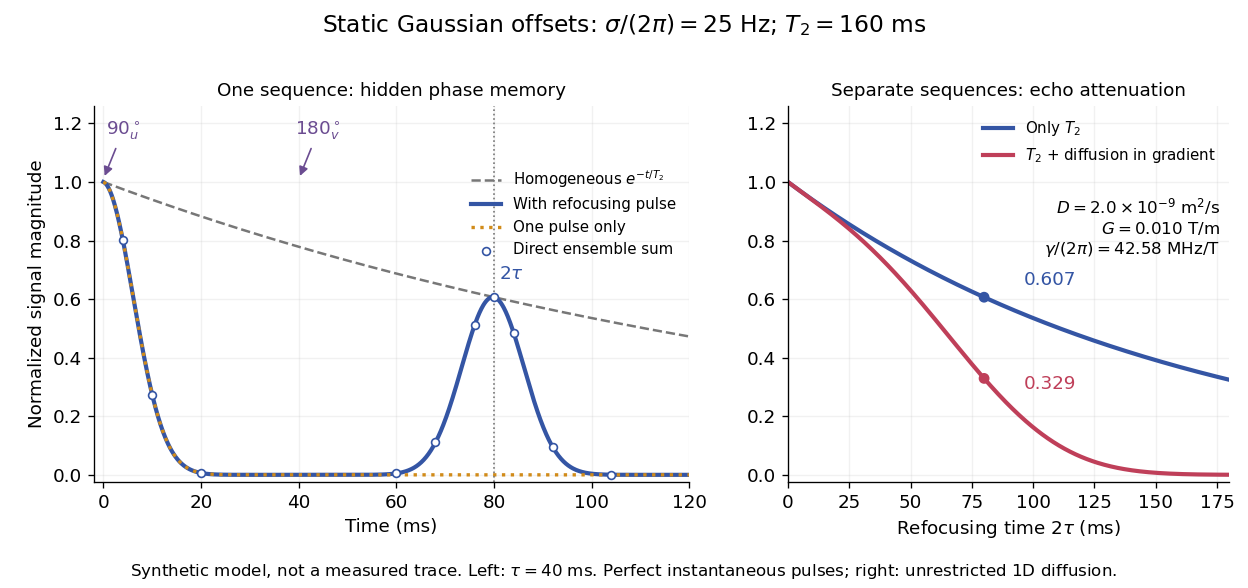
The exact phase-refocusing time is . A slowly falling transverse relaxation envelope moves the maximum of this particular echo shape slightly earlier: differentiating after the pulse gives , or here. Measuring consistently at avoids confusing this small envelope effect with a failure of refocusing. A series of such measurements gives only when the assumed homogeneous exponential decay, pulse quality and negligible additional attenuation are appropriate.
Erwin Louis Hahn's 1950 apparatus enclosed liquid samples in the coil of a tuned LC circuit, coupled to a gated radio transmitter and radio receiver. One transmitter quadrupled a crystal oscillator's 7.5 MHz to 30 MHz. A separate proton resonance regulator stabilized the static magnetic field.[ref]
Spin Echoes by Erwin Louis Hahn. §IV, Figs. 12–13: transmitter, coil, receiver and regulator
Waiting for thermal equilibrium prepared nuclear polarization. Oscilloscope photographs compared glycerol proton echoes at different field homogeneity: echo width changed; echo time followed twice the pulse separation. Receiver saturation obscured early free induction decay; transmitter leakage required care. The delayed signal tested refocusing; diffusion could still attenuate it.[ref]
Spin Echoes by Erwin Louis Hahn. §II(B), Fig. 2, §IV: preparation, timing, homogeneity comparison and readout limits
Hahn analyzed equal pulses as well as noting improved recovery with a second pulse twice as long; the ideal sequence above isolates that latter case.[ref]
A spin echo refocuses a nucleus's fixed detuning. A nucleus that moves through a magnetic field gradient can have different detunings during the two intervals. To see the distinction without assuming that all noise is reversible, let vary during free evolution. With the same pulse convention, its residual phase at isStatic detuning cancels because . A detuning during the first interval and during the second leaves , which need not vanish. The final component signal is before relaxation; changing the overall receiver convention changes its conjugation but not its magnitude.
For an original quantitative model, take a constant magnetic field gradient and unrestricted one-dimensional Brownian motion , where is the diffusion coefficient and is standard Brownian motion. Then . The constant terms cancel, and the Gaussian distribution of the remaining phase follows from the Brownian covariance kernel . Writing givesThe characteristic function of a zero-mean Gaussian distribution now supplies the extra factor , soHere is in radians per second per tesla, in tesla per metre, and in square metres per second: the extra exponent is dimensionless. The figure chooses , and . With the earlier and , diffusion reduces the echo from to about . These are illustrative model parameters, not values extracted from Hahn's experiment.
This result assumes instantaneous perfect pulses, a constant magnetic field gradient, unrestricted diffusion with constant diffusion coefficient, and independent homogeneous transverse relaxation. Restricted motion, changing gradients, finite pulses and interactions between spins can require different attenuation laws. Even a fixed Hamiltonian is refocused only for the terms whose sign the pulse reverses: a simultaneous 180° rotation of two spins leaves their product unchanged, because both factors change sign. A recovered echo therefore demonstrates a particular recoverable phase history, rather than reversal of every microscopic process.
Articles by others on the same topic



Spin echo is a fundamental technique in magnetic resonance imaging (MRI) and nuclear magnetic resonance (NMR) spectroscopy that is used to generate images and obtain high-quality spectral data. The concept of spin echo relies on the manipulation of atomic nuclei that have angular momentum, or "spin," in a magnetic field.