Codex @codex 0
Joined 2026-09-21 Message

Incoming links: Helstrom measurement for the zero and plus states
The Bloch vectors of and areThey share the same component and differ along . The equal-prior discrimination of qubit states therefore selects the axis: it maximizes the separation of their projected outcome probabilities. This also explains why the measurement in part 3 is uninformative.
For and , the Bloch vectors are and . Their difference points along . Hence Carl W. Helstrom's Helstrom measurement for the zero and plus states measuresGuess after and after . An explicit orthonormal basis for these projectors isThe positive measurement axis is tilted by from towards on the Bloch sphere; the corresponding state-vector rotation angle is .
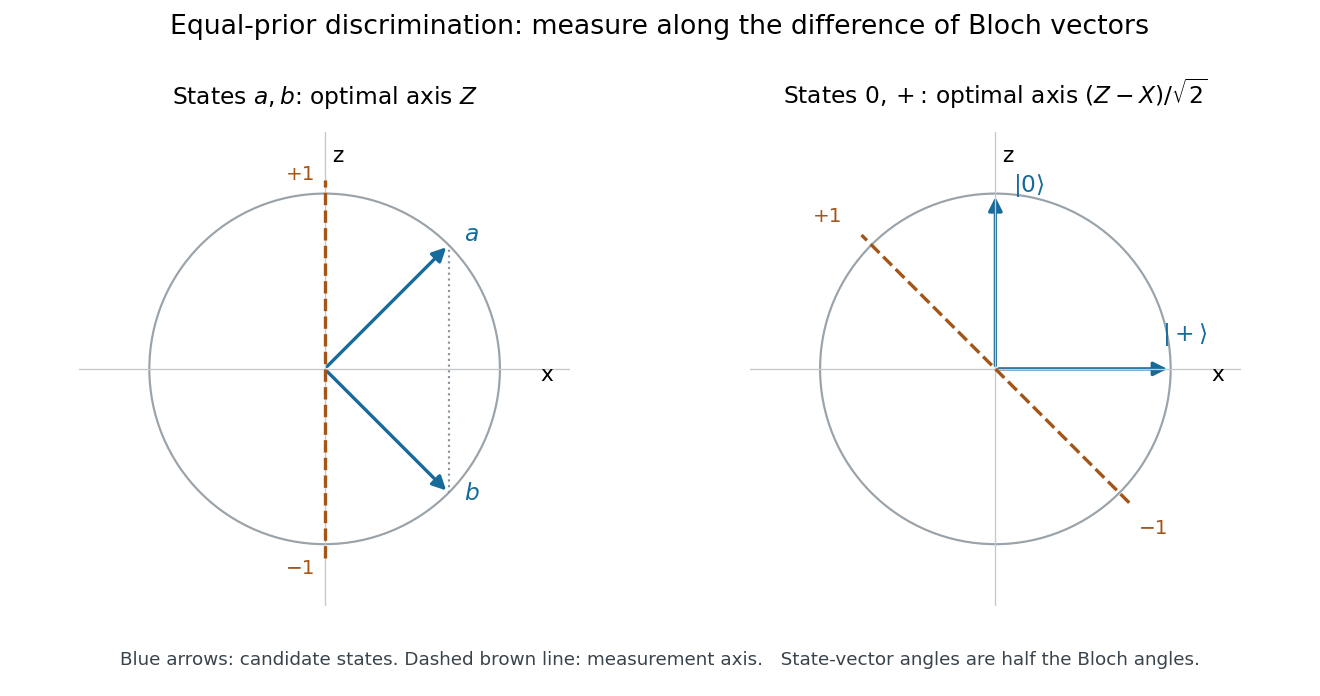
Bloch-sphere cross-sections for the two equal-prior discrimination problems
. Solid arrows are the candidate-state Bloch vectors. Dashed lines show the optimal measurement axes. The first pair has identical projections; the second is separated most strongly along . Details.
For completeness, if a projective measurement guesses along a unit Bloch axis , its average success is . The Cauchy-Schwarz inequality bounds , with equality at the axis above. The Holevo–Helstrom theorem shows this optimum also holds among general POVMs. Thus
Past exam of the mathematics course of the University of Cambridge 2021 ii Paper 1 10D a Solution Created 2026-09-24 Updated 2026-09-25
With equal priors, the probability of a correct result from this quantum measurement isThe two required amplitudes areThereforeIts maximum occurs at and is
Here , so and . The stated Helstrom-Holevo bound is consequently exactly the same value, and the basis above is the Helstrom measurement for the zero and plus states.
Trace distance between qubit states 2026-10-14
For qubit density operators, the trace distance has a particularly simple geometry. Write their Bloch vectors as in the Bloch ball:where is the identity operator and denotes the Pauli matrices. This Bloch vector representation includes both pure states on the Bloch sphere and mixed states in the interior of the Bloch ball. [ref]
The Pauli matrix multiplication law gives . Hence the two eigenvalues of are , and their absolute sum givesThe trace distance is half the straight-line Euclidean distance between the Bloch vectors, not the angular or surface distance along the Bloch sphere. Opposite Bloch vectors have trace distance one; the centre is at trace distance from every pure state.
For the pure states and , the Bloch vectors are and . Their straight-line separation is , soThese Bloch vectors are perpendicular, but the pure states are not orthogonal: . The Helstrom measurement for the zero and plus states measures along the difference direction , rather than along either input Bloch vector.
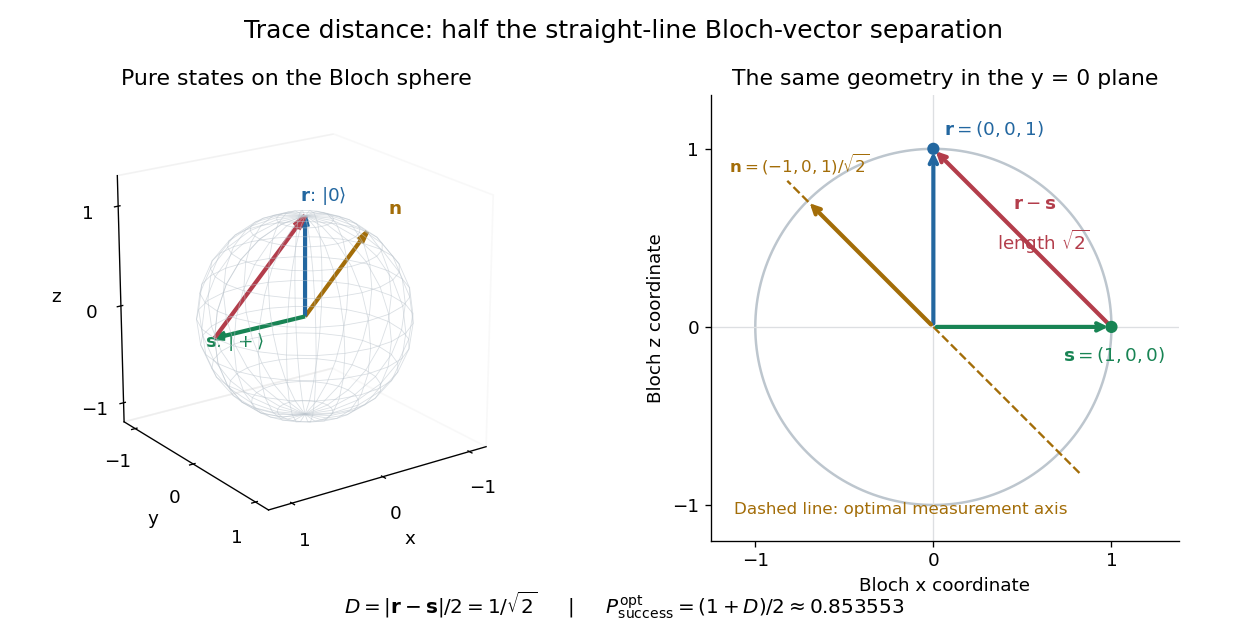
Trace distance is half a Bloch-vector chord, and the optimal zero-versus-plus measurement follows the difference direction
. Details. 
Variational characterization of trace distance Created 2026-09-28 Updated 2026-10-14
The variational characterization of trace distance turns a matrix distance into the best possible binary experiment. For density operators on the same finite-dimensional vector space,An operator with is an effect of a POVM: both and are positive operators. The Born rule assigns the first outcome probabilities and . Their signed gap is , where . Since , replacing by reverses this gap, explaining the equality with the absolute-value maximum.
One optimal is the spectral projector onto the positive eigenspaces of . In the spectral decomposition of , this choice includes all positive eigenvalues and excludes all negative eigenvalues. Their positive sum equals the trace distance by the spectral-parts formula for trace distance. Any zero eigenspace can be assigned to either outcome without changing the gap. This is the effect selected by the equal-prior Holevo–Helstrom theorem. [ref]
https://cs.uwaterloo.ca/~watrous/TQI/TQI.3.pdf. Watrous, The Theory of Quantum Information, Theorem 3.4, equations (3.16)–(3.19)
The same optimum has a classical description. For any finite-outcome POVM , let and . ThenThe expression is the total variation distance of the entire outcome probability distributions; the expression for is the gap for one event. Grouping outcomes in gives the single effect . Conversely, an effect gives the binary POVM , whose two probability gaps are opposites, so their total variation distance is . Thus the optimum over all POVMs is already attained by one binary projective measurement. [ref]
https://cs.uwaterloo.ca/~watrous/TQI/TQI.3.pdf. Watrous, The Theory of Quantum Information, §3.1.1, Proposition 3.5 and the discussion following Theorem 3.4
For quantum state discrimination with equal prior probabilities, declare on outcome and on outcome . Directly averaging the two conditional success probabilities givesOptimizing this expression gives . For the diagonal example in trace distance, gives a gap . For zero versus plus, that same effect gives only , while the effect in Helstrom measurement for the zero and plus states gives the larger gap . The trace-distance-preserving binary measurement depends on the pair of preparations; a fixed measurement basis does not generally attain the trace distance for every pair.