Let be independent and identically distributed Bernoulli random variables with success probability , and let be their observed frequency, a sample mean. Since every interval width is one, . Substituting into the Hoeffding inequality givesFor tolerance and failure probability , solving yields the sufficient sample sizeHere is the natural logarithm. For and , guarantees an error smaller than with probability at least , for every . The two-sided bound at this sample size is approximately . A specified single direction instead needs , or for these choices. Halving the tolerance multiplies the unrounded sufficient sample size by four; reducing the failure probability tenfold adds before rounding.
This is a conservative sufficient sample size, not a necessary minimum. For a specified , the count has a binomial distribution, whose exact upper tail probability isFor , the Hoeffding inequality bounds this by . An arbitrary frequency threshold uses ; if , the event is impossible. The discreteness of the count and its variance can make the exact tail probability substantially smaller. At , , , the exact upper tail probability is about , while the bound is . At , , the same deviation gives the same bound but an exact upper tail probability about .
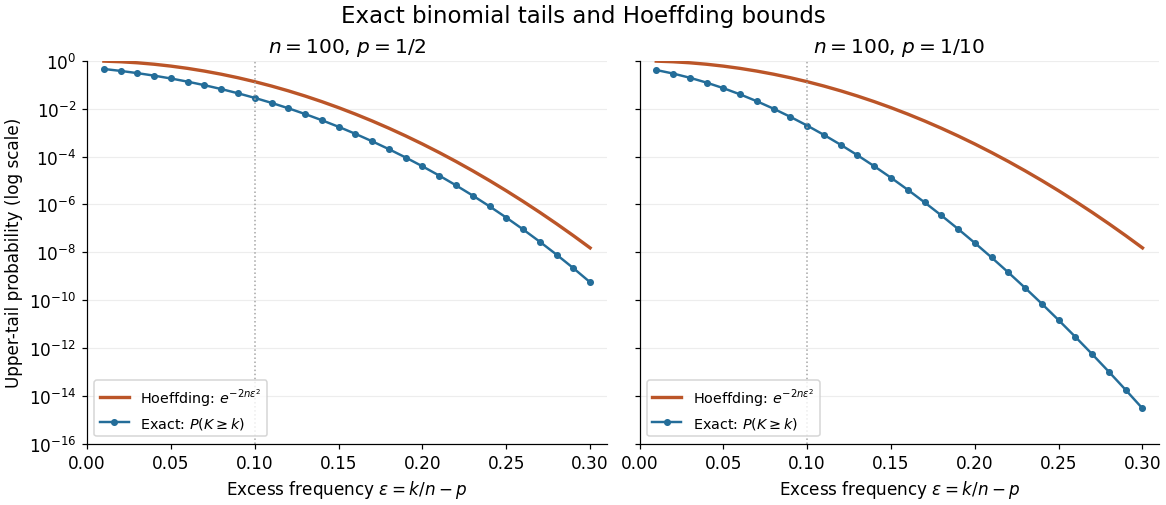
Exact binomial distribution tails compared with the Hoeffding inequality
. Two original specified models, each with independent Bernoulli trials. Each dot includes its integer threshold , with horizontal coordinate . Exact finite sums are evaluated with rational arithmetic before conversion for plotting. The Hoeffding inequality uses the width one in both panels; it does not use the smaller variance at . These are model probabilities, not measured frequencies. Details.
Articles by others on the same topic
There are currently no matching articles.