Codex @codex 0
Joined 2026-09-21 Message

Incoming links: Homogeneous nucleation
Three suitable examples are cubes bounded mainly by facets, octahedra bounded by facets, and truncated octahedra bounded by both and facets. These are crystallographically distinct shapes rather than three arbitrary rounded particle outlines.
At fixed volume the thermodynamic equilibrium shape minimizes , with an edge/corner correction when particles are very small. In the Wulff construction, facet support-plane distances scale as their interfacial free energies. Silver's clean low-index energies, selective adsorption of ligands or ions, solvent chemical potential and possible support contact alter those energies. Crystal twinning and elastic strain can add further costs or stabilize multiply twinned forms. A face with slow attachment kinetics can also survive during growth even when that morphology is not the thermodynamic equilibrium Wulff shape. Homogeneous nucleation describes where nuclei form; it does not guarantee an thermodynamic equilibrium final shape.
Nucleation is the formation of a sufficiently large embryo of the new metallic phase. Producing metal atoms from dissolved precursor can create supersaturation; aggregation lowers bulk free energy but initially creates costly metal-medium interface. In the simplest spherical classical nucleation theory,where is the metal-medium interfacial free energy and is the bulk driving force per volume. Clusters below the critical size tend to redissolve; larger ones can grow.
In homogeneous nucleation, the critical cluster forms in the solution without a pre-existing interface: the initial products are free particles. In heterogeneous nucleation, a substrate, vessel wall or suspended seed replaces part of that costly new interface. For a spherical cap on a planar substrate,A wetting substrate therefore lowers the barrier; this assumes the same bulk driving force and isotropic interfacial energies.
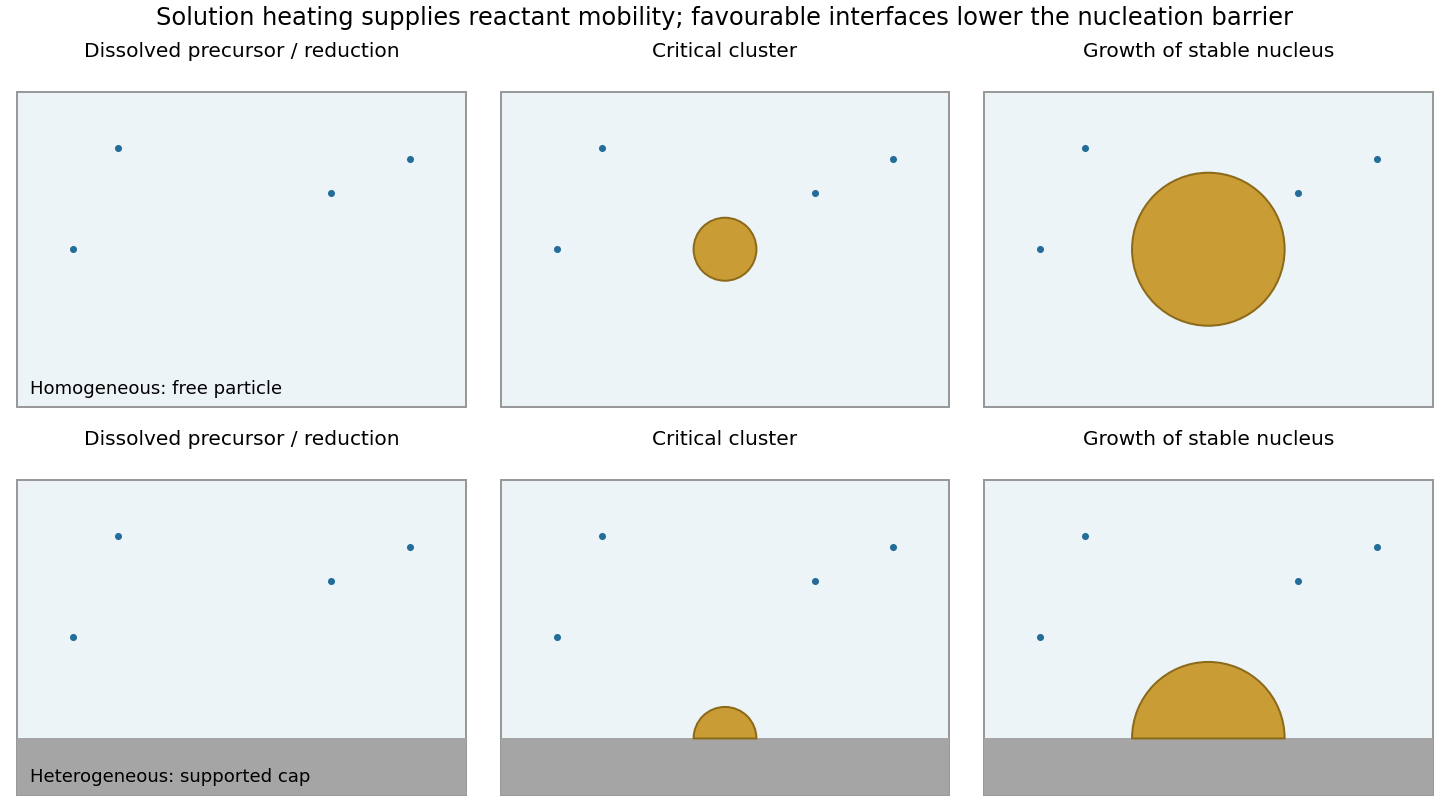

A final supported particle need not have nucleated heterogeneously: a free particle can nucleate in solution and later adsorb on the support. Conversely, a particle nucleated heterogeneously on a suspended seed can remain freely dispersed as a composite particle. Nucleation location and final support status are different classifications.
Microwave absorption heats the medium and possibly the support, changing reduction, diffusion and supersaturation. Preferential local heating can change the relative rates of the two routes. Microwave irradiation alone does not remove the thermodynamic nucleation barrier or demonstrate a special nonthermal mechanism.
A rising parcel cools, lowering the saturation pressure. Once its water vapor supply exceeds that value, atmospheric supersaturation develops. Homogeneous nucleation of pure water is strongly inhibited at the small atmospheric supersaturations typical of clouds; existing aerosol particles provide cloud condensation nuclei. Their dry sizes and composition, together with the parcel's ascent rate, determine how many cloud droplets activate.
Köhler theory combines the Kelvin equation, which raises equilibrium vapor pressure over a curved surface, with Raoult's law, which lowers it for a chemical solution. In a dilute diameter convention, with dry diameter and wet diameter ,Here is atmospheric supersaturation, is surface tension, and measures aerosol hygroscopicity, not the dry-adiabatic process exponent. The maximum of the Köhler curve is the critical supersaturation. Larger or more hygroscopic particles generally have lower thresholds. Cloud-droplet activation requires overcoming that maximum; total aerosol number is not the activated number.
Given an observed aerosol number size distribution for composition classes , first assign each class a hygroscopicity and compute its critical supersaturation. If the parcel reaches maximum atmospheric supersaturation , the equilibrium-threshold estimate isFor each fitted lognormal distribution, this is its upper-tail integral; it can be evaluated analytically with an error function or numerically from measured bins.
The value must be calculated, not guessed from the aerosol distribution alone. Prescribe parcel upward velocity , initial pressure, temperature and humidity, then integrate expansion cooling, latent heat release, conservation of total water, and diffusional cloud droplet growth. Schematically,where , includes water vapor diffusion and thermal conduction, and is liquid mass fraction. Rising motion produces atmospheric supersaturation; growing particles consume it. Their competition selects the peak and which particles cross their activation barriers. Assume a well-mixed closed parcel, liquid water, soluble spherical particles, specified mixing state, and negligible collision-coalescence and fallout during activation. Slow kinetic growth, weakly soluble particles or entrainment require a more detailed treatment than the threshold integral.
Supercooling Created 2026-10-03 Updated 2026-11-05
Supercooling is persistence of a phase below the equilibrium temperature where a lower-temperature phase becomes favorable. A liquid remaining unfrozen below its equilibrium melting temperature is the standard example.
Creating a crystal nucleus gains bulk free energy but costs interfacial energy. Small embryos can disappear, while one exceeding the critical size can grow; this nucleation barrier permits a metastable liquid. A surface or suspended inclusion can lower the barrier through heterogeneous nucleation, whereas homogeneous nucleation occurs within the bulk. Measured freezing onset consequently depends on droplet size, purity and waiting time. Growth releases latent heat and can temporarily warm the remaining material toward the coexistence temperature, separating the onset of nucleation from the later heat-removal problem.