Facing a companion and facing the source of light are different relations. The Moon keeps its near side of the Moon approximately toward Earth, while the direction to the distant Sun is nearly fixed during the idealized orbit shown below. A fixed surface patch therefore turns toward, across and away from sunlight. The far side of the Moon has day and night too; its name does not mean permanent darkness. [ref]
https://science.nasa.gov/moon/facts/. NASA: changing lunar illumination
.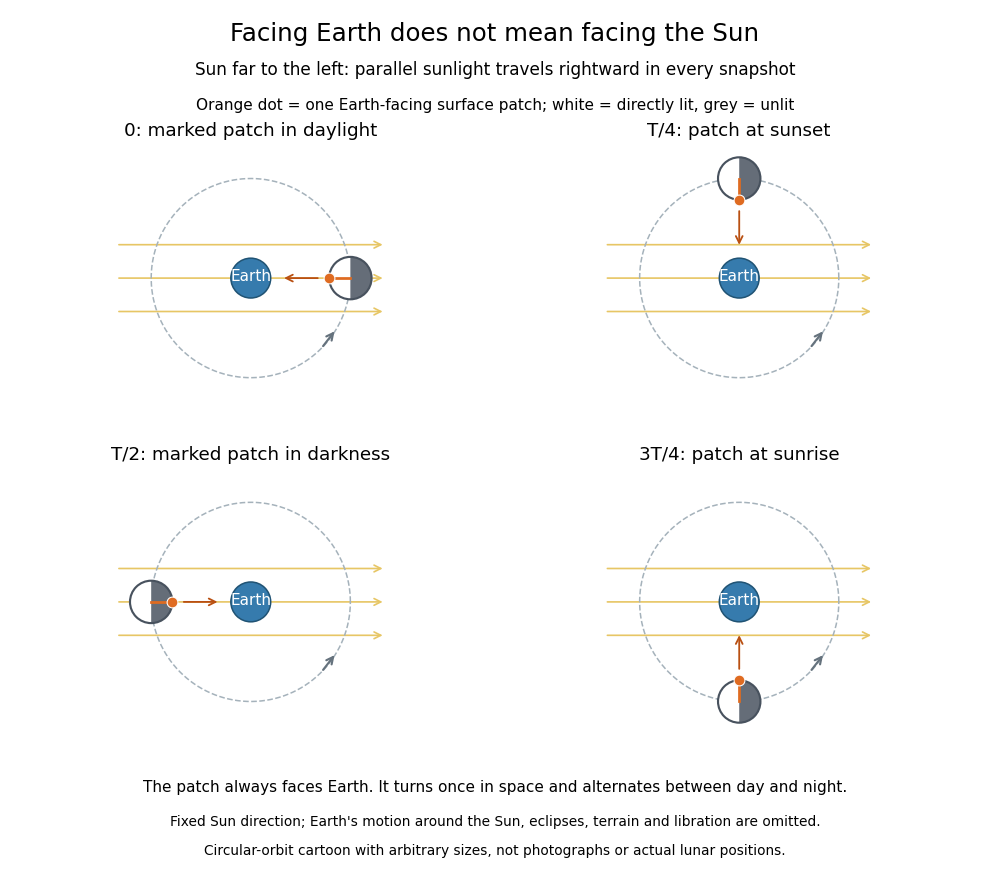

If the Sun direction has fixed angle and the marked surface patch has outward normal vector at angle , its direct illumination is proportional to . With synchronous rotation, , so the patch goes through day and night even though it always faces Earth. In reality the Earth-Moon system advances around the Sun: the lunar spin and orbital cycle relative to distant stars is about Earth days, while the lunar phase cycle has a synodic period of about Earth days. These numbers describe the actual system, not the fixed-sunlight cartoon. [ref]
https://starchild.gsfc.nasa.gov/docs/StarChild/questions/question32.html. NASA StarChild: sidereal and synodic lunar periods
.For a synchronously rotating exoplanet whose orbital companion is itself the illuminating star, the direction to the star turns with the orbit. On an ideal circular orbit, with perpendicular spin axis and no additional oscillations, this direction is fixed relative to the surface, giving persistent day and night hemispheres. Day-night heat redistribution then helps determine the nightside temperature; permanent lack of direct starlight does not imply zero temperature. Orbital eccentricity and departures from this ideal spin geometry modify that simple picture.
Articles by others on the same topic
There are currently no matching articles.