Tidal locking settles a body's spin into a sustained relation with its orbital motion through tidal forces and tidal dissipation. The simplest case is synchronous rotation, a spin-orbit resonance. On an ideal circular orbit, with spin axis perpendicular to the orbital plane, the body keeps the same face toward its companion, as the Moon approximately does toward Earth. [ref].
This article retains the broader sense of tidal locking as capture into a spin-orbit resonance; the term is also commonly used specifically for synchronous rotation. Tidally evolved rotation need not be : Mercury has a spin-orbit resonance with the Sun, turning three times in two orbital periods. The distinction matters when inferring illumination or climate from a spin period. [ref].
Tidal deformation is the change in a body's shape caused by differential gravity across it, that is, by a tidal force. The familiar two-bulge picture represents an elongated response along the companion direction, rather than a separate force pulling only the nearest surface. If spin and orbital motion differ, the forcing sweeps through the body's material. With tidal dissipation, the response is out of alignment with the instantaneous forcing, allowing a net torque. [ref].
A secular tidal torque is the torque remaining after averaging the changing tidal interaction over fast orbital and rotational motion. The misaligned tidal deformation lets the companion's gravity change the spin angular momentum; the orbit receives the opposite torque. Tidal dissipation converts mechanical energy into heat, while total angular momentum is conserved in an isolated system. Thus the spin-orbit coupling exchanges angular momentum rather than destroying it. [ref]
https://link.springer.com/article/10.1007/s11214-024-01055-4. Fuller, Guillot, Mathis and Murray (2024): tidal dissipation in giant planets
.For intuition near synchronous rotation on a circular orbit, hold mean motion and moment of inertia fixed and adopt the illustrative linear dissipative lawHere is spin angular velocity, is a marked surface direction in an inertial frame, and is a response coefficient, not a universal material constant. A faster spin is slowed and a slower prograde spin is accelerated. The solution and the associated mechanical power loss areThe orbital contribution to this power is , and the spin contribution is ; their sum becomes heat. Holding fixed is a local approximation to the coupled evolution. Actual secular tidal torque depends on the deformation response and orbital eccentricity, so this simple law does not establish which spin-orbit resonance an eccentric body captures into.
A prograde spin-orbit resonance relates mean spin angular velocity to mean motion by a ratio of small positive integers, : the body makes turns in orbital periods. Synchronous rotation is ; Mercury's spin-orbit resonance is nonsynchronous. The relevant combination of spin and orbital angles must stay bounded around a preferred orientation, not merely have a near-integer frequency ratio. For an elongated body on an eccentric orbit, the companion's gravitational torque on the permanent shape can sustain the resonance while tidal dissipation permits capture. [ref].
Synchronous rotation means one prograde turn about the body's own axis per orbital period, measured against fixed directions in an inertial frame. This spin-orbit resonance approximately describes the Moon's synchronous rotation toward Earth. [ref].
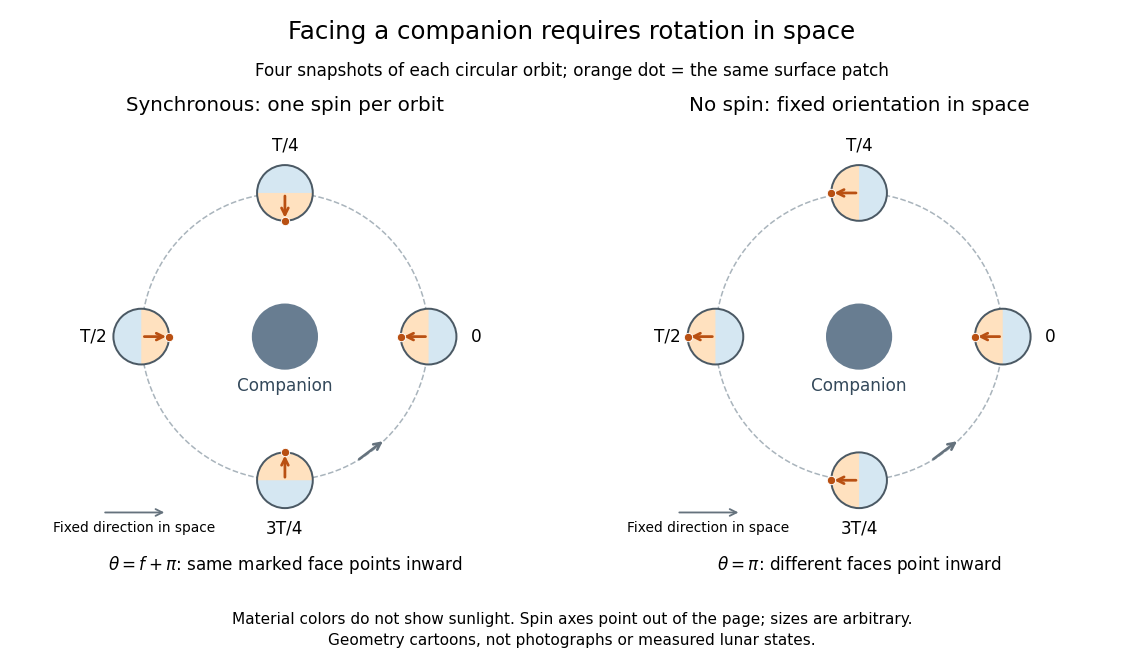
The striking geometric idea is that one turn in space can keep one face toward the companion: a fixed orientation in the frame turning with the orbit is a changing orientation in an inertial frame. This distinction helps us predict illumination: a synchronously rotating exoplanet orbiting its illuminating star can have persistent day and night hemispheres, whereas the Moon, synchronized to Earth, receives changing illumination from a different body, the Sun.
View a circular orbit along its perpendicular spin axis. Let be the orbital angle measured from a fixed direction, choosing an arbitrary zero for the circular limit of true anomaly, and let be the direction of an outward arrow painted on the body, measured from the same fixed direction. The direction from the body to its companion is . Thus an inward-facing arrow satisfiesMore generally synchronous rotation keeps constant; its particular value selects which surface direction faces the companion. Over one orbital period , both and the unwrapped increase by . This is the short geometric explanation for one turn per orbit. For a nonspinning body, instead, and the companion direction sweeps through all surface longitudes. On an eccentric orbit, mean spin does not force to stay exactly constant: true anomaly advances nonuniformly, producing the longitudinal component of libration.
Facing a companion and facing the source of light are different relations. The Moon keeps its near side of the Moon approximately toward Earth, while the direction to the distant Sun is nearly fixed during the idealized orbit shown below. A fixed surface patch therefore turns toward, across and away from sunlight. The far side of the Moon has day and night too; its name does not mean permanent darkness. [ref]
https://science.nasa.gov/moon/facts/. NASA: changing lunar illumination
.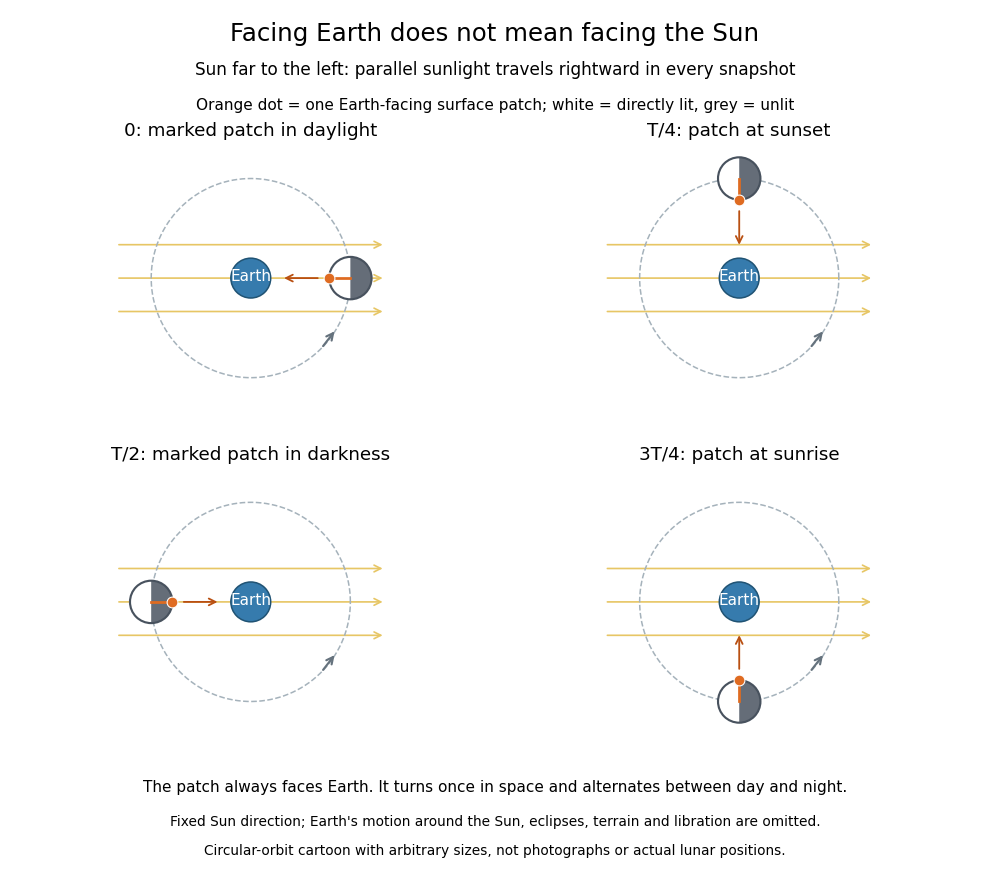
If the Sun direction has fixed angle and the marked surface patch has outward normal vector at angle , its direct illumination is proportional to . With synchronous rotation, , so the patch goes through day and night even though it always faces Earth. In reality the Earth-Moon system advances around the Sun: the lunar spin and orbital cycle relative to distant stars is about Earth days, while the lunar phase cycle has a synodic period of about Earth days. These numbers describe the actual system, not the fixed-sunlight cartoon. [ref]
https://starchild.gsfc.nasa.gov/docs/StarChild/questions/question32.html. NASA StarChild: sidereal and synodic lunar periods
.For a synchronously rotating exoplanet whose orbital companion is itself the illuminating star, the direction to the star turns with the orbit. On an ideal circular orbit, with perpendicular spin axis and no additional oscillations, this direction is fixed relative to the surface, giving persistent day and night hemispheres. Day-night heat redistribution then helps determine the nightside temperature; permanent lack of direct starlight does not imply zero temperature. Orbital eccentricity and departures from this ideal spin geometry modify that simple picture.
Articles by others on the same topic



Tidal locking is a phenomenon that occurs when an astronomical body, such as a moon or a planet, rotates on its axis in such a way that the same side always faces the body it is orbiting. This happens due to gravitational interactions between the two bodies, which create tidal forces that distort their shapes. In the case of a tidally locked moon, its orbital period around the planet matches its rotation period.