Planetary science studies planets, moons, small bodies, planetary systems, and the processes that form and evolve them.
A magnetosphere is the region around a body in which the body's magnetic interaction controls charged-particle motion and its response to the surrounding plasma. A planet with an intrinsic magnetic field can support a compressed dayside and an extended magnetotail in the solar wind. Magnetospheric currents must be distinguished from the internal field when inferring a planetary dynamo.
An induced magnetosphere is maintained by the interaction of an external magnetized plasma flow with a conducting ionosphere or atmosphere. Its currents and draped magnetic field do not establish an internal planetary dynamo. Venus is a central example; Mars combines this interaction with localized crustal fields.
A planetary magnetic field may include an intrinsic field maintained by an internal planetary dynamo, local crustal remanent magnetization, and externally driven fields associated with the solar wind. Separating these components requires spatial and temporal observations. A global internally sourced field, a localized crustal anomaly, and an induced magnetosphere are different evidence about the planet's present and past interior.
A planetary dynamo maintains an intrinsic magnetic field by motion of an electrically conducting fluid. The resistive induction equation balances stretching and transport against magnetic diffusion. A sufficiently large magnetic Reynolds number is necessary but does not ensure that the flow regenerates every required field component. Thermal or compositional convection supplies mechanical power; rotation organizes the flow through the Coriolis force, and the Lorentz force density eventually modifies the flow and limits growth. A fluid core can fail to operate a dynamo if it is stably stratified or inadequately driven.
The geodynamo is the maintenance of Earth's magnetic field by electrically conducting fluid motion in its liquid outer core. Rotation and buoyant convection organize helical flow and permit mean-field poloidal–toroidal regeneration. A scalar homogeneous alpha model explains a mechanism and a threshold but omits spherical boundaries, anisotropy, spatial variations and Lorentz force feedback. Reversals and saturation require dynamical or time-dependent transport information beyond a growing constant-coefficient kinematic mode.
A geomagnetic reversal changes the large-scale polarity of Earth's intrinsic magnetic field. Crustal remanent magnetization records past reversals. The reversal times are not a regular clock; their occurrence reflects time-dependent dynamo action rather than rigid rotation of a permanent magnet.
An asteroid is a small rocky or metallic body orbiting a star. Asteroid dynamics can involve mean-motion resonances, planetary scattering and secular perturbations. Solar-system asteroids illustrate how phase protection can prevent close encounters even when orbital paths approach a planet.
The astronomical unit is a length scale used for Solar System distances, approximately . Coarse estimates sometimes round it to . Numerical coefficients in planet formation estimates depend on which approximation is used.
Core accretion forms a planet by building a solid core through growth and accretion of solid material. A sufficiently massive core can then bind a gaseous envelope. It is distinct from direct fragmentation through gravitational instability of an astrophysical disk.
The minimum-mass solar nebula estimates a primordial gas-and-solid protoplanetary disk by spreading planetary material into annuli and restoring a solar mixture. A common idealized surface density is proportional to . This reconstruction is a model of minimum material requirements, not a unique history of the Solar System. Extrapolating it far beyond the planetary region need not give a physically consistent disk.
Accretion releases gravitational energy. Efficient radiation at an accretion shock leaves a lower-entropy cold start, while greater retained energy gives a higher-entropy hot start; intermediate outcomes are possible. Initial entropy changes a young planet's radius, luminosity and spectrum. Consequently an exoplanet direct imaging luminosity and age need not uniquely fix mass without a formation/evolution model.
A comet tail is an extended structure formed from material released by a comet. Its dust tail is shaped largely by radiation pressure, while an ion tail is shaped by the solar wind and magnetic field. The cometary dust tail is the solid-grain component.
A cometary dust tail is the extended distribution of solid grains released by a comet. Radiation pressure sorts its grains by size: high- grains are displaced rapidly in the anti-stellar direction, while larger low- grains remain closer to the projected orbit and form a more curved trail.
With uniformly distributed apsidal orientations, the phase-mixed radial probability of a Kepler orbit gives the surface probability per cometFor , this is . Multiply by the population size for a number surface density of a disk.
The innermost planet has a large metallic core and a weak but global intrinsic magnetic field. Its observed field supports an active planetary dynamo in a fluid conducting part of that core. Slow rotation does not by itself exclude dynamo action.
A planet dominated by rocky and metallic material rather than a massive H/He envelope. Earth and Mars are examples. A super-Earth is a mass category and need not be a terrestrial planet.
A giant planet with a much larger heavy-element fraction than a typical gas giant, exemplified by Uranus and Neptune. Water, ammonia and other volatile-rich materials are called “ices” in formation terminology; they need not remain ordinary frozen solids in the hot deep interior.
A large planet whose bulk mass includes a substantial hydrogen–helium envelope, as in Jupiter and Saturn. The deep envelope is fluid rather than a dilute atmosphere with a sharp solid surface. Its cooling, compression and possible electron degeneracy pressure influence the mass-radius relation.
Earth's outer core is a liquid, electrically conducting region whose buoyant motion and rotation sustain the geodynamo. Its magnetic field both responds to the flow through induction and modifies that flow through the Lorentz force. A prescribed-velocity kinematic model describes onset rather than the entire nonlinear core dynamics.
The terrestrial atmosphere has regions with opposite signs of the atmospheric lapse rate: the troposphere usually cools upward, the stratosphere warms upward through ultraviolet heating, the mesosphere cools, and the thermosphere warms. A monotone atmospheric pressure-temperature profile can approximate one such interval, but cannot describe all their transitions with one fixed branch.
The thermosphere is a high atmospheric region where absorption of energetic stellar radiation can produce an upward-rising kinetic temperature. Its very low density distinguishes kinetic temperature from a large thermal energy content.
The mesosphere lies above the stratosphere and below the thermosphere. Its typical terrestrial temperature decreases upward.
The terrestrial stratosphere lies above the troposphere and has an upward-warming region associated with ultraviolet heating by the ozone layer.
The troposphere is the lowest main layer of the terrestrial atmosphere, with weather and generally decreasing temperature with altitude. Local inversions and moist convection complicate a single lapse-rate description.
A rogue planet has no bound host star. Without stellar irradiation, its luminosity can still be supplied by internal cooling and Kelvin-Helmholtz contraction; its emitting temperature need not equal the negligible irradiation-based planetary equilibrium temperature.
A natural satellite is a naturally occurring body orbiting a planet or another nonstellar body. The Moon is Earth's natural satellite; its synchronous rotation provides a familiar example of tidal locking.
The Moon is Earth's natural satellite. Its synchronous rotation keeps approximately the same near side of the Moon facing Earth, while both the near side of the Moon and the far side of the Moon experience sunlight and darkness. See illumination of a synchronously rotating moon for the geometry. [ref].
The near side of the Moon is the hemisphere directed approximately toward Earth. Libration changes the exact visible boundary, so synchronous rotation does not mean that an observer always sees precisely the same hemisphere.
The far side of the Moon is the hemisphere directed approximately away from Earth. “Far” describes the direction to Earth; it does not describe illumination by the Sun. The far side of the Moon experiences both sunlight and darkness during the lunar phase cycle. [ref].
A lunar phase is the appearance of the sunlit portion of the Moon as seen from Earth. Outside a lunar eclipse, the distant Sun illuminates approximately one hemisphere of the Moon, but an observer sees a changing overlap of that hemisphere with the hemisphere facing Earth. The lunar phase therefore changes even though synchronous rotation keeps approximately the same near side of the Moon facing Earth. [ref].
The cycle runs through new Moon, waxing crescent, first quarter, waxing gibbous, full Moon, waning gibbous, last quarter and waning crescent. “Waxing” means that the lunar illuminated fraction is increasing; “waning” means it is decreasing. A crescent has less than half its apparent disk sunlit, and a gibbous lunar phase has more than half. First and last quarter each show half a disk: “quarter” refers to progress around the cycle, rather than a quarter of the disk being lit. [ref]
https://aa.usno.navy.mil/data/MoonFraction. US Naval Observatory: disk fractions and waxing versus waning
.An instructive circular orbit model puts Earth at the origin, the Sun far away along , and the Moon at . The sunward position , , gives new Moon; the opposite position , , gives full Moon. Counterclockwise motion gives first quarter at and last quarter at . The Sun's direction is fixed during this snapshot of the cycle. Every small globe in the orbital view is illuminated on its half; the adjacent apparent disks are separate views from Earth, rather than globes viewed from above.
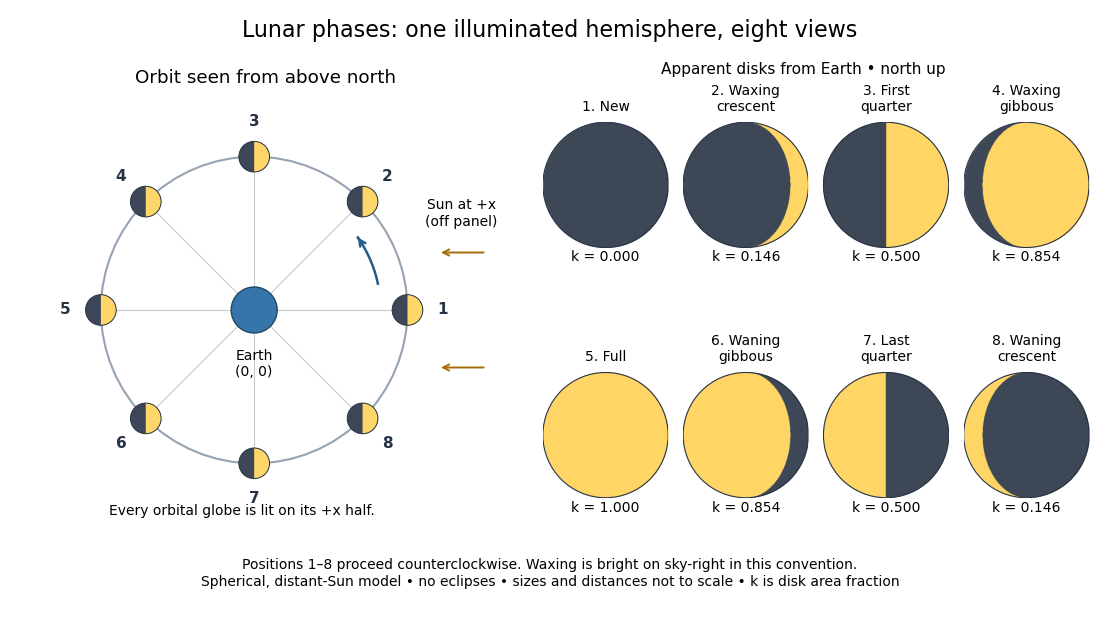
The disk views choose north up, with the upward direction perpendicular to the orbital plane. In this convention waxing lunar phases are bright on the right and waning lunar phases on the left. Local horizon orientation and viewing from different locations on Earth can rotate the apparent disk; its lit edge always points toward the projected direction of the Sun. The lunar illuminated fraction is unaffected by this rotation.
The useful angle is the phase angle , with the Sun, the Moon and the observer at Earth's center: its vertex is at the Moon. Full Moon has , quarter has , and new Moon has in the ideal model. By contrast, the elongation has its vertex at Earth. For a distant Sun, its rays are parallel, soHere is the lunar illuminated fraction: a fraction of projected disk area, not a fraction of the Moon's total surface area or its received radiant flux relative to full Moon. The phase angle and unsigned elongation each lie between and , so either alone gives the illuminated amount without distinguishing waxing from waning. The orbital direction resolves that ambiguity.
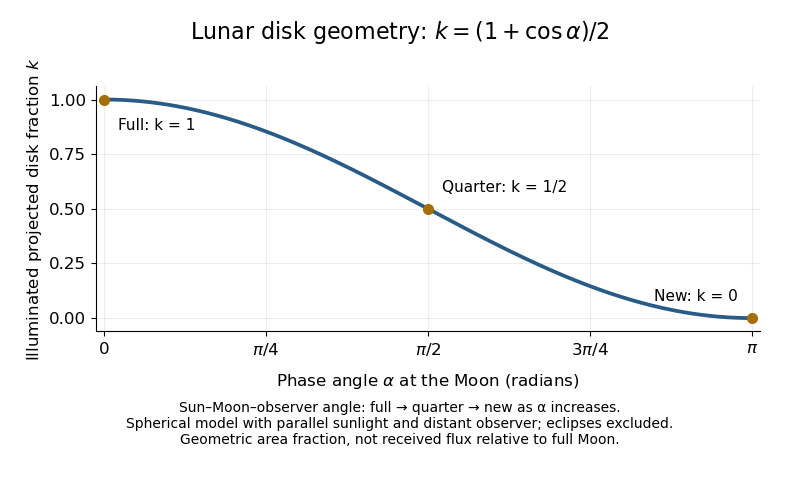


The lunar illuminated fraction has an elegant geometric derivation. Model the Moon as a sphere of unit radius and view it along the direction. Take the Sun's unit direction to be . A visible surface point above apparent disk coordinates has . Direct illumination requires the outward normal's dot product with the sunward direction to be positive. The day-night terminator therefore obeys . At a fixed , set ; the visible day-night terminator is , and the illuminated strip extends from to the right edge . Integrating its width givesThe integral is the area of half a unit circle. Thus a three-dimensional visibility problem reduces to a circle's area and a cosine. The derivation assumes parallel sunlight, a distant observer and a sphere, and ignores a lunar eclipse. Real observed brightness additionally depends on surface scattering of light and observing geometry, so does not promise half the full-Moon radiant flux.
For a worked example, elongation gives phase angle and : a crescent with of its apparent disk sunlit. At elongation , the phase angle is and : a gibbous lunar phase. At , . In each case the same occurs once while waxing and once while waning in the ideal cycle.
Ordinary lunar phases are not caused by Earth's shadow. A lunar eclipse occurs only when the Moon actually enters that shadow near full Moon. The orbital inclination of the Moon is about relative to Earth's orbital plane around the Sun; most full Moons pass above or below the shadow. This is why full Moon does not imply a lunar eclipse every month. [ref]
https://science.nasa.gov/moon/eclipses/. NASA: lunar eclipses and the Moon's roughly five-degree orbital tilt
.The phase cycle is a synodic month, about days, whereas the Moon's orbital period relative to distant stars is a sidereal month, about days. During one sidereal month, Earth advances around the Sun, so the Moon must move farther to repeat the sunward alignment. For coplanar circular orbits traversed in the same direction, subtract their mean motions: , with . HenceUsing and gives , consistent with the mean synodic month of days. After one sidereal month, the sunward direction has advanced about ; catching up takes about more days. These are mean-period estimates: orbital eccentricity and changing geometry make individual synodic months vary. [ref]
https://eclipse.gsfc.nasa.gov/SEhelp/moonorbit.html. Fred Espenak, NASA: sidereal and synodic months and varying lunations
. [ref]https://nssdc.gsfc.nasa.gov/planetary/factsheet/earthfact.html. David R. Williams, NASA: Earth's sidereal orbital period
.The lunar phase is also a practical clock for observing. Full Moon is opposite the Sun and rises roughly at sunset; first quarter is about a right angle from the Sun and is convenient in the evening, while last quarter is convenient before dawn. These are rough guides, not exact rise-time predictions for every place and season. [ref]. Historically, repeated lunar phases provided the month in lunar calendars, while half-lit disks gave Aristarchus of Samos a way to infer astronomical distances. [ref]
https://eclipse.gsfc.nasa.gov/SEhelp/moonorbit.html. Fred Espenak, NASA: lunations and lunar calendars
.The astronomical phase angle is the angle at an illuminated body between the directions to its light source and to its observer. For a lunar phase it is the Sun–Moon–observer angle at the Moon, rather than the elongation measured at Earth. A small phase angle gives a nearly full apparent disk in the spherical model.
Elongation is the apparent angular separation of a celestial body from the Sun, measured at the observer. For a lunar phase, the elongation is the Sun–Earth–Moon angle; in the distant-Sun approximation it is supplementary to the phase angle. A given unsigned elongation can occur on either side of the Sun in the sky.
The lunar illuminated fraction is the directly sunlit projected area of the apparent lunar disk divided by its total projected area. For a sphere with parallel sunlight and a distant observer, outside a lunar eclipse, it is , with phase angle at the Moon. It measures geometry rather than the fraction of full-Moon radiant flux. [ref]
https://aa.usno.navy.mil/data/MoonFraction. US Naval Observatory: definition of the illuminated disk fraction
.A sidereal month is the Moon's orbital period relative to distant stars, about days. It is shorter than the synodic month because the sunward direction changes as Earth travels around the Sun. The lunar spin period associated with synchronous rotation matches the sidereal month in the mean. [ref].
A synodic month is the synodic period of the Moon relative to the Sun, about days on average. A lunation is commonly measured from one new Moon to the next. Actual lunations vary, so the constant-speed relation derived in lunar phase is useful for understanding the mean cycle rather than predicting exact dates. [ref]
https://eclipse.gsfc.nasa.gov/SEhelp/moonorbit.html. Fred Espenak, NASA: the synodic month and lunation
.Aristarchus of Samos used the half-lit Moon to estimate the relative distances of the Sun and Moon. In the spherical illumination model a half-lit disk means phase angle , so the Sun–Moon–Earth triangle is right-angled at the Moon. Keeping the Sun at a finite distance, let and be the distances from Earth to the Moon and Sun. Then elongation at Earth givesThe elongation attributed to Aristarchus of Samos gives a ratio about , consistent with his conclusion that the Sun was between and times farther away. The example shows how lunar phase geometry becomes a distance measurement, but the ratio is extremely sensitive to an angle close to . Unlike the distant-Sun approximation, this finite triangle has elongation slightly less than at half illumination. [ref]
https://doi.org/10.5802/crphys.246. Siebren van der Werf and Tjeerd van Albada, An explanation for Aristarchus' measurement of the sun's distance, 2025
.A lunar eclipse occurs when Earth blocks some or all of the direct sunlight reaching the Moon. It requires alignment near full Moon; the orbital inclination usually carries the Moon clear of Earth's shadow. Ordinary lunar phases instead arise from viewing different amounts of the sunlit hemisphere. [ref].
Libration is the apparent rocking of a body as seen by an observer. For the Moon, longitudinal libration arises because orbital eccentricity makes its orbital angular speed vary while its spin is much more uniform: the direction to Earth advances ahead of, then falls behind, the mean facing direction. The Moon's tilted geometry also causes latitudinal libration; small actual rotational oscillations provide further corrections. Thus lunar synchronous rotation holds in the mean, rather than requiring exact instantaneous alignment. [ref]. [ref].
Planetary system dynamics studies the orbital evolution of planets, planetesimals, and dust under gravity, radiation, collisions, and dissipative forces.
Orbit crossing occurs when two geometrical orbital paths intersect. It permits collisions or close encounters when bodies also reach the intersection at compatible times; crossing alone does not imply a collision. For nearly circular coplanar nested orbits, a useful local test follows by differentiating their radial positions at fixed longitude.
For a cold coplanar disk with complex eccentricity , the first-order radial shape is . Infinitesimally neighboring orbits first cross when . Under secular forcing by a distant outer planet, , and , so the secular phase gradient gives . The finite-neighbor version requires the accumulated phase difference to remain small when replacing a difference by a derivative.
Isotropic stellar mass loss changes the central gravitational parameter while preserving the central direction of the force, provided the escaping material causes no recoil or drag on the orbiting body. The relative equation is . Specific angular momentum remains exactly constant; specific orbital energy obeys . Orbital expansion is adiabatic only when the mass-loss law varies slowly on the orbital period.
Time averaging over a Kepler orbit gives , as follows from and . Consequently slow isotropic stellar mass loss preserves the secular orbital eccentricity. Conserved specific angular momentum then gives , so pericentre, apocentre and semimajor axis expand inversely with the remaining gravitational parameter.
The signed instantaneous contribution of apsidal precession to azimuthal motion during isotropic stellar mass loss is . Its maximum absolute magnitude is small when , where near a circular orbit and as . The low-orbital eccentricity coordinate singularity can be avoided by evolving the eccentricity vector.
For isotropic stellar mass loss the eccentricity vector obeys . With true anomaly and , this gives and . The osculating pericentre satisfies , hence cannot decrease during mass loss and is instantaneously stationary at pericentre. The vector form is nonsingular at a circular orbit.
Anisotropic thermal radiation produces recoil that changes the semi-major axis of a rotating solid body. Finite thermal inertia provides the temperature lag. Large bodies have small acceleration per unit mass, while very small bodies become nearly isothermal. The Yarkovsky effect can supply bodies to dynamical escape regions.
Drift driven by the Yarkovsky effect can carry a body out of a belt or into an unstable orbital region. A useful two-limit removal law is , with slow escape at both large and small diameters.
A population supplied at differential number rate and surviving externally for a size-independent time has . Its differential number slope changes by the negative of the removal-time exponent, unless the belt is already removal-dominated, in which case it reflects the fragment injection spectrum.
For , the ratio has its minimum at . Removal beats collisions somewhere exactly when , provided the relevant diameters are present. This criterion uses the collision-only cascade as a reference.
The law for positive has a minimum at with value . This size differs from the minimum of the ratio of removal and collision times.
A passing star perturbs a planetary or cometary system through its differential Newtonian gravitational field. A distant encounter is predominantly tidal; a sufficiently close one can substantially change specific orbital energy and angular momentum, eject a comet, or shift its periapsis into or out of the planetary region.
Planetary migration changes a planet's orbital semimajor axis through torques from a disc or exchanges of energy and angular momentum with other bodies, often followed by tidal dissipation. Short-period giant planets, eccentric progenitors, resonant architectures, and stellar obliquity provide complementary constraints rather than one unique migration diagnostic.
For a fixed mass on a Keplerian circular orbit, has derivative . The torque on the satellite is minus the torque on the disk. This gives the displayed drift law. In the density-slope satellite torque model, .
The stellar obliquity is the angle between a star's spin and a planet's orbital angular momentum. The Rossiter-McLaughlin effect constrains the angle between the sky projections of those two axes, rather than a component of . If the orbital and stellar-spin inclinations to the line of sight are and , then ; alone generally does not determine . Large misalignments constrain formation and planetary migration, but can also reflect a tilted birth disc.
A transiting body hides different velocity regions of a rotating stellar disc and causes an anomalous measured Doppler shift. Its time dependence constrains the sky-projected spin-orbit angle, which is not generally the full stellar obliquity.
Tidal locking settles a body's spin into a sustained relation with its orbital motion through tidal forces and tidal dissipation. The simplest case is synchronous rotation, a spin-orbit resonance. On an ideal circular orbit, with spin axis perpendicular to the orbital plane, the body keeps the same face toward its companion, as the Moon approximately does toward Earth. [ref].
This article retains the broader sense of tidal locking as capture into a spin-orbit resonance; the term is also commonly used specifically for synchronous rotation. Tidally evolved rotation need not be : Mercury has a spin-orbit resonance with the Sun, turning three times in two orbital periods. The distinction matters when inferring illumination or climate from a spin period. [ref].
Tidal deformation is the change in a body's shape caused by differential gravity across it, that is, by a tidal force. The familiar two-bulge picture represents an elongated response along the companion direction, rather than a separate force pulling only the nearest surface. If spin and orbital motion differ, the forcing sweeps through the body's material. With tidal dissipation, the response is out of alignment with the instantaneous forcing, allowing a net torque. [ref].
A secular tidal torque is the torque remaining after averaging the changing tidal interaction over fast orbital and rotational motion. The misaligned tidal deformation lets the companion's gravity change the spin angular momentum; the orbit receives the opposite torque. Tidal dissipation converts mechanical energy into heat, while total angular momentum is conserved in an isolated system. Thus the spin-orbit coupling exchanges angular momentum rather than destroying it. [ref]
https://link.springer.com/article/10.1007/s11214-024-01055-4. Fuller, Guillot, Mathis and Murray (2024): tidal dissipation in giant planets
.For intuition near synchronous rotation on a circular orbit, hold mean motion and moment of inertia fixed and adopt the illustrative linear dissipative lawHere is spin angular velocity, is a marked surface direction in an inertial frame, and is a response coefficient, not a universal material constant. A faster spin is slowed and a slower prograde spin is accelerated. The solution and the associated mechanical power loss areThe orbital contribution to this power is , and the spin contribution is ; their sum becomes heat. Holding fixed is a local approximation to the coupled evolution. Actual secular tidal torque depends on the deformation response and orbital eccentricity, so this simple law does not establish which spin-orbit resonance an eccentric body captures into.
A prograde spin-orbit resonance relates mean spin angular velocity to mean motion by a ratio of small positive integers, : the body makes turns in orbital periods. Synchronous rotation is ; Mercury's spin-orbit resonance is nonsynchronous. The relevant combination of spin and orbital angles must stay bounded around a preferred orientation, not merely have a near-integer frequency ratio. For an elongated body on an eccentric orbit, the companion's gravitational torque on the permanent shape can sustain the resonance while tidal dissipation permits capture. [ref].
Synchronous rotation means one prograde turn about the body's own axis per orbital period, measured against fixed directions in an inertial frame. This spin-orbit resonance approximately describes the Moon's synchronous rotation toward Earth. [ref].
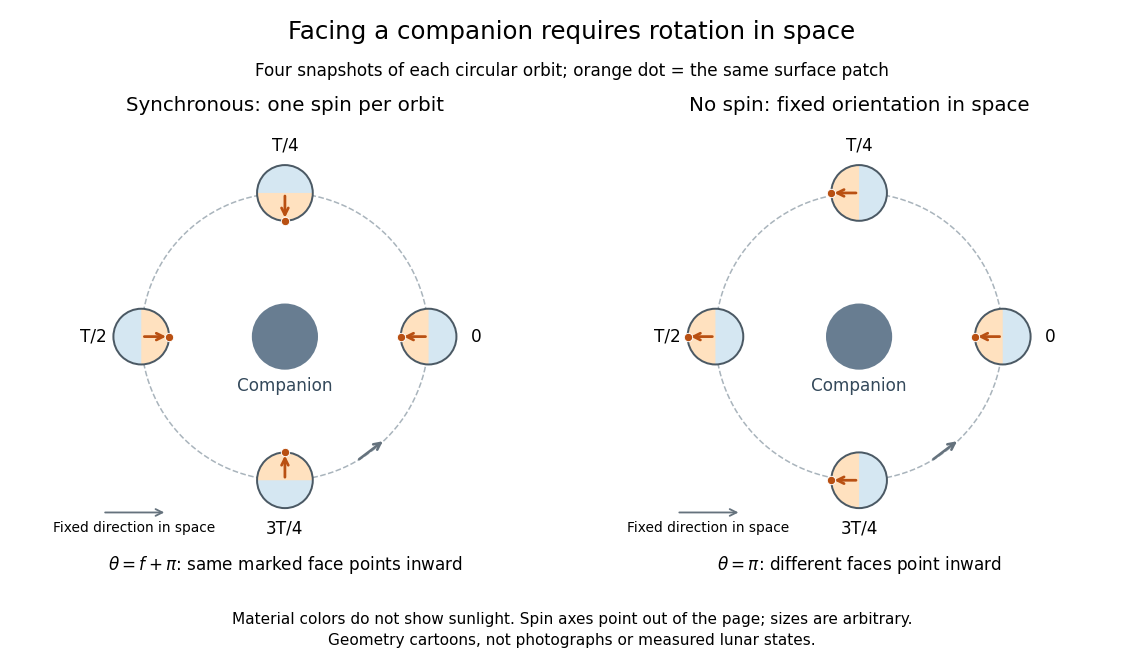

The striking geometric idea is that one turn in space can keep one face toward the companion: a fixed orientation in the frame turning with the orbit is a changing orientation in an inertial frame. This distinction helps us predict illumination: a synchronously rotating exoplanet orbiting its illuminating star can have persistent day and night hemispheres, whereas the Moon, synchronized to Earth, receives changing illumination from a different body, the Sun.
View a circular orbit along its perpendicular spin axis. Let be the orbital angle measured from a fixed direction, choosing an arbitrary zero for the circular limit of true anomaly, and let be the direction of an outward arrow painted on the body, measured from the same fixed direction. The direction from the body to its companion is . Thus an inward-facing arrow satisfiesMore generally synchronous rotation keeps constant; its particular value selects which surface direction faces the companion. Over one orbital period , both and the unwrapped increase by . This is the short geometric explanation for one turn per orbit. For a nonspinning body, instead, and the companion direction sweeps through all surface longitudes. On an eccentric orbit, mean spin does not force to stay exactly constant: true anomaly advances nonuniformly, producing the longitudinal component of libration.
Facing a companion and facing the source of light are different relations. The Moon keeps its near side of the Moon approximately toward Earth, while the direction to the distant Sun is nearly fixed during the idealized orbit shown below. A fixed surface patch therefore turns toward, across and away from sunlight. The far side of the Moon has day and night too; its name does not mean permanent darkness. [ref]
https://science.nasa.gov/moon/facts/. NASA: changing lunar illumination
.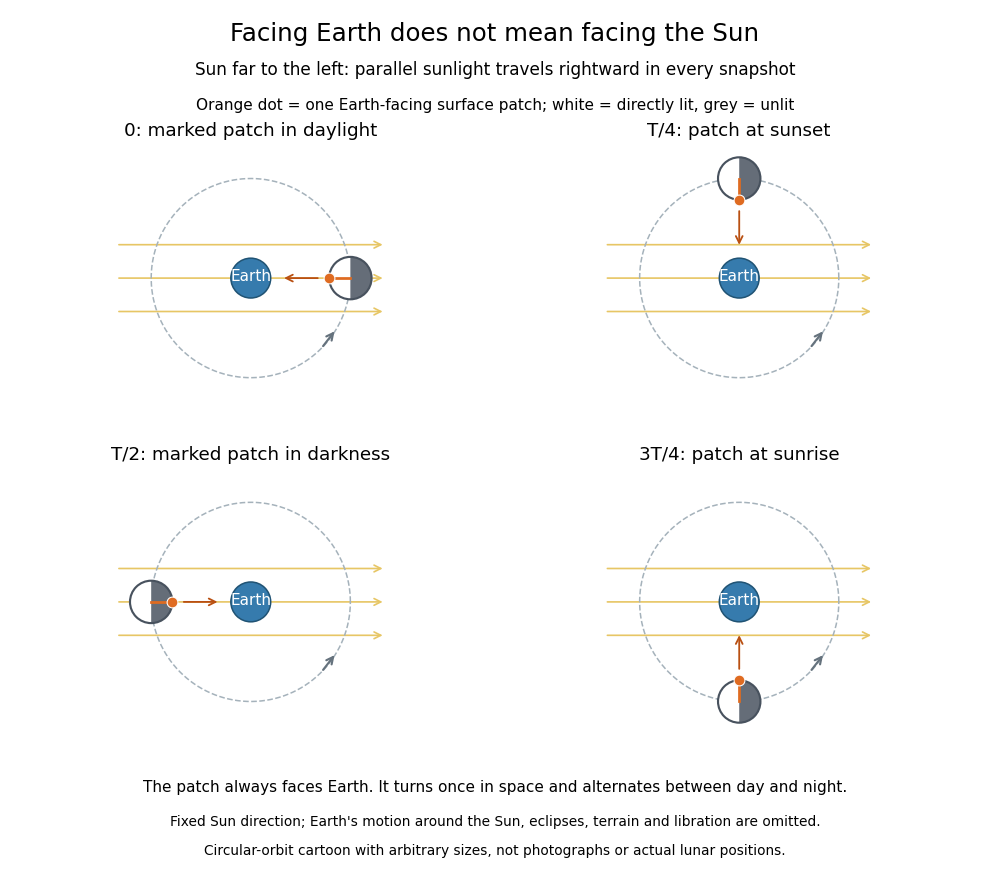

If the Sun direction has fixed angle and the marked surface patch has outward normal vector at angle , its direct illumination is proportional to . With synchronous rotation, , so the patch goes through day and night even though it always faces Earth. In reality the Earth-Moon system advances around the Sun: the lunar spin and orbital cycle relative to distant stars is about Earth days, while the lunar phase cycle has a synodic period of about Earth days. These numbers describe the actual system, not the fixed-sunlight cartoon. [ref]
https://starchild.gsfc.nasa.gov/docs/StarChild/questions/question32.html. NASA StarChild: sidereal and synodic lunar periods
.For a synchronously rotating exoplanet whose orbital companion is itself the illuminating star, the direction to the star turns with the orbit. On an ideal circular orbit, with perpendicular spin axis and no additional oscillations, this direction is fixed relative to the surface, giving persistent day and night hemispheres. Day-night heat redistribution then helps determine the nightside temperature; permanent lack of direct starlight does not imply zero temperature. Orbital eccentricity and departures from this ideal spin geometry modify that simple picture.
Tidal heating converts mechanical energy of tidal deformation into internal heat through tidal dissipation. Sustained orbital eccentricity or a spin axis tilted relative to the orbital plane's perpendicular can maintain changing tidal deformation and heat an exoplanet interior. Thus synchronous rotation alone does not eliminate tidal heating.
Tidal dissipation converts mechanical energy associated with a time-varying tidal deformation into heat. It can reduce orbital eccentricity, drive synchronous rotation, and contribute deep planetary heating. A circular orbit with exact synchronous rotation, perpendicular spin axis and no additional forcing has a static tidal deformation in the body's frame and need not sustain substantial tidal heating.
An astronomical conjunction occurs when two orbiting bodies have the same apparent longitude as viewed from their primary or from an observer.
For two uniform angular motions with , an inner exoplanet transit at zero and next outer exoplanet transit at , the next conjunction solves . Hence its longitude modulo isFor an eccentric outer body this is only an approximation. Let be its line-of-sight anomalies and . Exact true alignment instead requires . The correction follows directly from uniform mean anomaly and nonuniform true anomaly.
Keplerian shear is differential orbital motion caused by : neighboring material at smaller semi-major axis advances in longitude relative to material farther out.
Phase mixing disperses an initially localized ensemble because its members have slightly different orbital frequencies, causing their phases to spread with time.
A planetesimal is a solid body in a young or evolved planetary system whose collisions and gravitational interactions help build or erode larger bodies.
For an impactor number density per size , relative speed , and collision cross-section , the differential collision rate of one target is .
The specific impact energy is an impactor's kinetic energy divided by the target mass. For equal-density spherical bodies,
A binary planetesimal is a gravitationally bound pair of planetesimals. Its internal two-body problem and its centre of mass orbit respond differently to external forces, including gas drag.
For linear gas drag with aerodynamic stopping times , masses , total mass , and relative velocity , defineIf is the gas velocity relative to the centre of mass, the relative drag acceleration is . The first term dissipates internal specific orbital energy; the second is a differential headwind that vanishes for equal aerodynamic stopping times.
For a weakly perturbed circular binary planetesimal, the constant differential headwind does zero work averaged over the unperturbed orbit. Orbit-averaged drag work givesWith constant aerodynamic stopping times, . This averaging assumes drag is slow compared with the orbital period and does not appreciably distort the circular orbit within one period.
For a nearly circular stellar orbit of radius in gas moving at times the local circular speed, the averaged tangential gas drag on the centre of mass is . Orbit-averaged drag work givesIf and aerodynamic stopping time scales as , , then . Internal contraction can outpace stellar migration. Tightly gas-coupled drift requires solving radial and azimuthal motion together instead of this weak-drag approximation.
For a small body with orbital elements relative to a planet on a circular orbit of semi-major axis , the Tisserand parameter is approximatelyIt is derived from the Jacobi constant and is approximately conserved across separated weak encounters in the circular restricted three-body problem.
For bound planet-crossing Kepler orbits, , with the planet radius taken as one. At fixed , is maximized by and . For this gives . This form remains regular at . It is an invariant-based accessibility bound, not a guarantee that a scattering history attains it; for it gives no positive universal pericentre floor.
In units where a circular planet has orbital radius and speed one, the particle's relative speed outside a close encounter satisfies , to leading order in the planet-to-star mass ratio. This follows from the vis-viva equation and at the encounter radius. A short conservative encounter changes the direction of this relative velocity while preserving its magnitude.
The disturbing function is the perturbing part of the gravitational potential used to derive the evolution of orbital elements in celestial mechanics.
For a particle far inside a planet's stellar orbit, the planet-centred disturbing function is . Expanding the first term cancels its dipole against the indirect disturbing function. Dropping the spatially constant monopole leaves , where is the angle between the two offset vectors. The omitted instantaneous terms are . The gradient of the retained expression is the leading differential stellar tidal acceleration.
For two circular Kepler orbits with mutual inclination , independently average the stellar quadrupole disturbing function over both mean anomalies. A circular ring with unit normal has . Contracting the two ring tensors gives , proving the displayed exact angular factor. For small orbital inclinations relative to a common plane, . Thus the secular angular factor is . This potential generates the slow stellar contribution to satellite nodal precession.
The Lagrange planetary equations express changes of osculating orbital elements in terms of derivatives of a disturbing function. Their small-eccentricity secular limit becomes a linear equation for complex eccentricity.
If retained Lagrange planetary equations have and , then . Thus is constant. A resonantly oscillating orbital eccentricity–semi-major axis trajectory retraces one curve rather than enclosing area in that projection.
For disturbing function , , the leading planar Lagrange planetary equations give . The derivative with respect to holds the other osculating orbital elements fixed. If one writes , its literal derivative includes ; the physical mean-longitude equation cannot be obtained by silently dropping that term. A consistent accumulated-phase parametrization uses .
For perturbing acceleration on an osculating orbital element system with fixed central parameter ,To prove it, differentiate the specific orbital energy , obtaining . Substitute , and . Here is the true anomaly; a normal perturbing acceleration does no instantaneous work.
The direct disturbing function is the gravitational potential of the perturbing body evaluated at the disturbed body. In heliocentric coordinates it is proportional to the inverse separation of the two bodies.
The indirect disturbing function accounts for the acceleration of a non-inertial origin, such as a star-centered coordinate frame accelerated by a perturbing planet.
The D'Alembert characteristic constrains each disturbing-function harmonic so that the integer coefficients of its angular arguments sum to zero, with corresponding parity and eccentricity-inclination order restrictions imposed by rotational symmetry.
A Laplace coefficient is the Fourier coefficientIt packages the radial dependence of a disturbing-function expansion.
A short-period orbital perturbation is driven by rapidly varying orbital-angle combinations and usually averages to zero over many conjunctions away from resonance.
A resonant orbital perturbation has a slowly varying angular argument because a nearly integer relation between orbital frequencies prevents successive conjunction effects from averaging away.
A secular perturbation survives averaging over fast orbital phases and drives slow precession and exchange of eccentricity or inclination.
For a quantity on a periodic Kepler orbit, its orbit average is . Equal increments of true anomaly are not equal increments of time. Eccentric anomaly gives the weight , which yields . Slow orbital perturbations can be averaged using elements held fixed over a single orbital period.
Articles were limited to the first 100 out of 211 total.
Articles by others on the same topic
There are currently no matching articles.