Why add the daughter four-momenta? Consider a selected combination of final particles withUsing the Minkowski metric, its scalar square isIn the combination's center-of-momentum frame, its total momentum vanishes and its total energy is . Therefore , givingLorentz transformations preserve this scalar square, so the reconstructed invariant mass does not depend on the combination's laboratory motion. It includes relative kinetic energy and need not equal the sum of the daughter rest masses. A random pair has an invariant mass too; that number does not itself establish a common parent.
For two daughters, expanding the square and substituting each energy–momentum relation givesHere and are masses, not energies. Reporting in and momenta in is equivalent to calculating numerically with and in . Setting in natural units suppresses these conversion factors; it does not change the measured quantity.
Alvarez's lecture illustrates invariant mass searches with combinations and contrasts resonance lifetimes near with the much longer lived states the chambers originally targeted. These resonances decayed before producing a resolvable parent track.[ref]
Recent Developments in Particle Physics by Luis Walter Alvarez. UCRL-18696, printed pp. 46–47, Figs. 15–17: effective-mass histograms and short lifetimes
Operationally, choose a reaction hypothesis, require an acceptable bubble-chamber kinematic fitting result, and form specified daughter combinations. Accumulate their invariant masses in a histogram across events. A particle resonance is inferred from the ensemble's dynamics; its short-lived parent is not directly photographed. Daughter tracks can be visible even when the production and decay positions of the parent cannot be separated. Wrong combinations create background, and several combinations from one event are statistically correlated.
Take two stipulated oppositely charged daughters with equal rest mass and exactly opposite momenta of magnitude . Their total momentum is zero, soThis is a constructed event, not an identification of a historical particle. Boosting both four-momenta by along the first daughter's direction gives total energy and total momentum . Substitution recovers the same invariant mass, although the laboratory energy has increased.
The following independent simulation stipulates 700 signal combinations from a Cauchy distribution centered at with scale , truncated to , plus 2400 background combinations whose density decreases linearly across that interval. Each combination is converted to a back-to-back two-daughter event with . Independent isotropic directions are chosen, each Cartesian momentum component receives normal distribution noise with standard deviation , and invariant mass is reconstructed from the perturbed momenta. All inputs and counts are invented. No historical experimental points or fitted historical parameters appear.
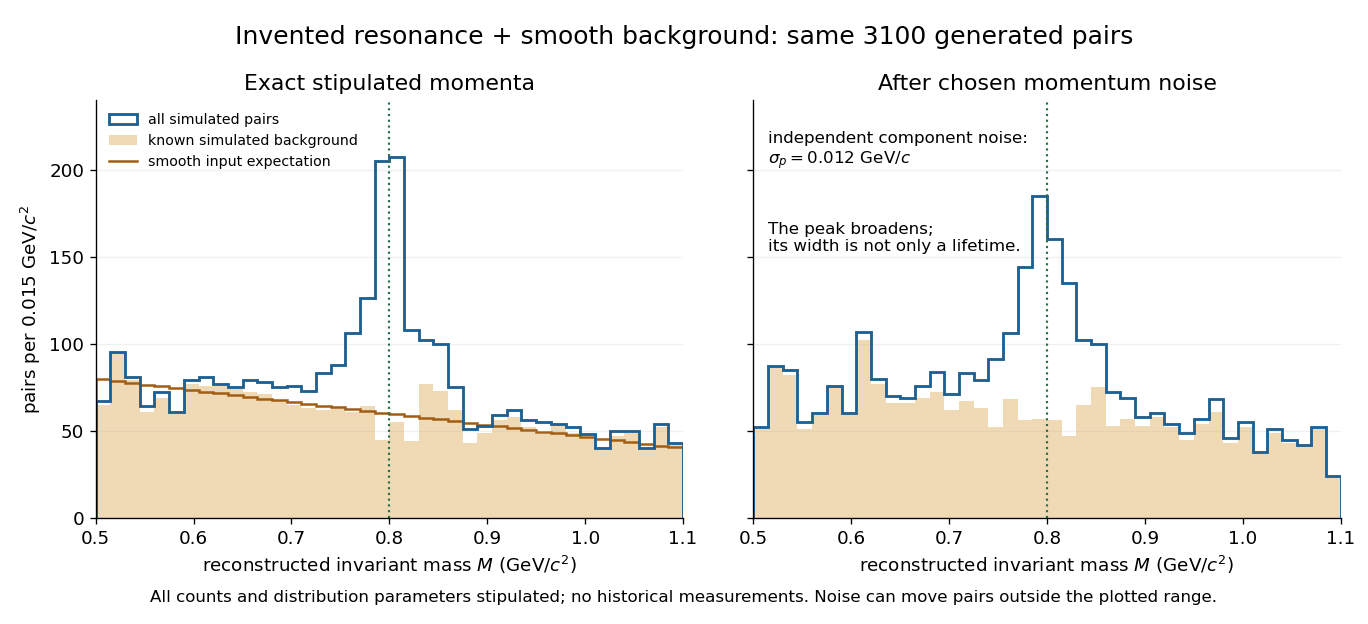
A stipulated resonance component produces an excess above a smooth simulated invariant-mass background
. Original simulation of two-daughter events, with invented counts, a truncated Cauchy signal and a linearly falling background. The two panels share the same generated events. The right panel adds chosen momentum noise before reconstructing invariant mass; this is not an experimental discovery plot. Details.
The simulation separates a stipulated physical distribution from measurement broadening. Its Cauchy distribution is only a convenient resonance-shaped input, not a complete quantum scattering model. Spatial resolution, magnetic field calibration, Multiple Coulomb scattering, stopping power and incorrect daughter identities all propagate into the measured invariant mass. Instrumental broadening must be understood before interpreting an observed width as a lifetime.
Selection also changes the shape. A momentum threshold can remove low-invariant mass pairs; a fit that fixes the candidate parent's mass would artificially concentrate that same mass and cannot supply an independent search distribution. Compare accepted simulated events with the input distribution, vary justified selection criteria, and check neighboring invariant mass intervals. A peak supported only by one untested selection is weaker evidence than a structure that survives calibration and background checks. The smooth background in the figure is a stipulated control component, not a claim that every physical background is smooth.
Articles by others on the same topic
There are currently no matching articles.