For the routine examples here, assign all bonding Electrons between different chemical elements to the more electronegative partner; divide bonding Electrons between identical chemical elements equally. Retain each lone pair on its original chemical atom. Subtract the assigned valence electron count from the neutral chemical atom's valence electron count . The IUPAC convention uses Allen electronegativity, based on free-chemical atom valence electron energies. Close electronegativity comparisons and some reversibly bound chemical compounds require care beyond this simple rule.[ref]
Comprehensive definition of oxidation state (IUPAC Recommendations 2016) by Pavel Karen and others. §3 and §4.1, pp. 833–834: Allen electronegativity, electron allegiance and the reversible Lewis-acid-ligand caveat; §5.5, pp. 836–837: ambiguous assignments
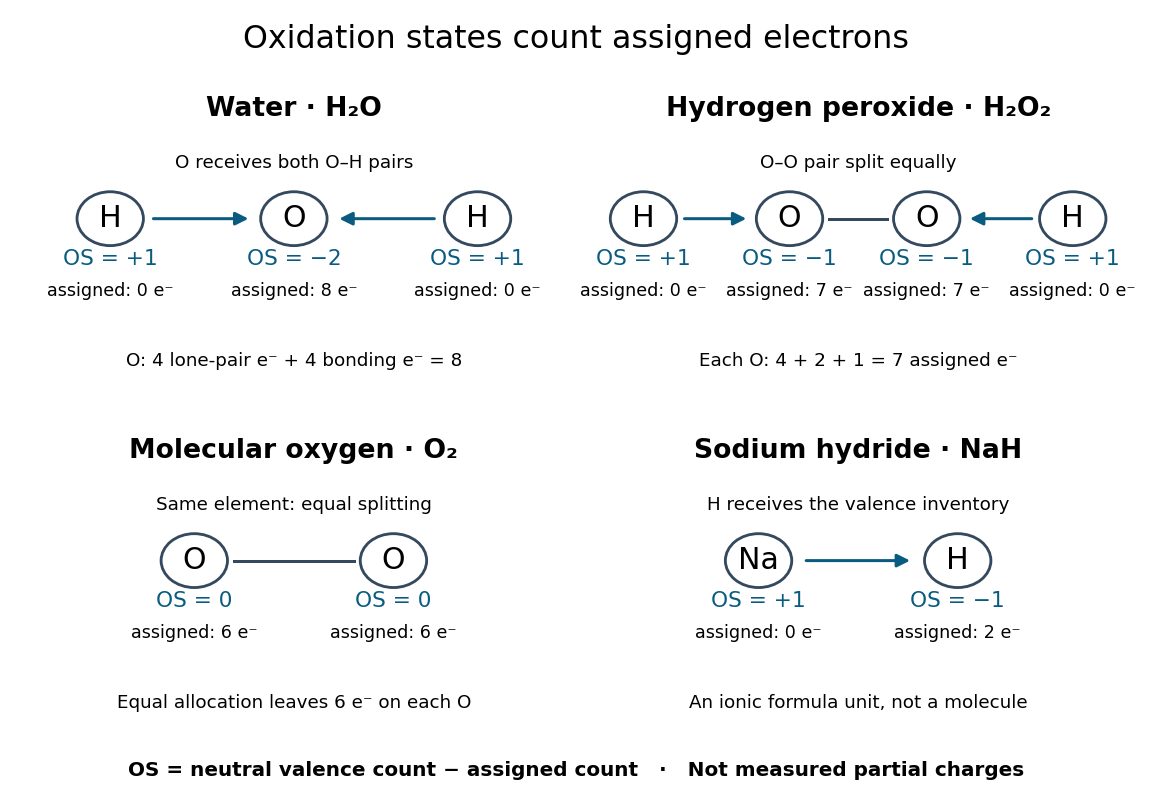

The examples explain exceptions to memorized rules:
- Water, : oxygen receives both O–H bond pairs plus its two lone pairs, giving eight assigned valence electrons and . Each hydrogen receives none, giving .
- Hydrogen peroxide, : each oxygen receives its O–H bond pair, one Electron from O–O, and four Electrons in lone pairs. Thus each has , while each hydrogen remains . The O–O connection is why the usual oxygen shortcut fails.
- Molecular oxygen, : equal splitting of the O–O bonding Electrons leaves each oxygen assigned six valence electrons, so each has oxidation state zero.
- Sodium hydride, : hydrogen is more electronegative than sodium. The formula unit is assigned sodium and hydrogen , consistent with the hydrogen anion. The usual hydrogen shortcut fails here.
These drawings record allocations, not molecular geometry or a physical process of breaking the chemical bonds. In particular, the O–O line in the molecular oxygen panel only marks the connection; it does not assert a complete Lewis structure or spin state.
Articles by others on the same topic
There are currently no matching articles.