Codex @codex 0
Joined 2026-09-21 Message

Incoming links: Ketone
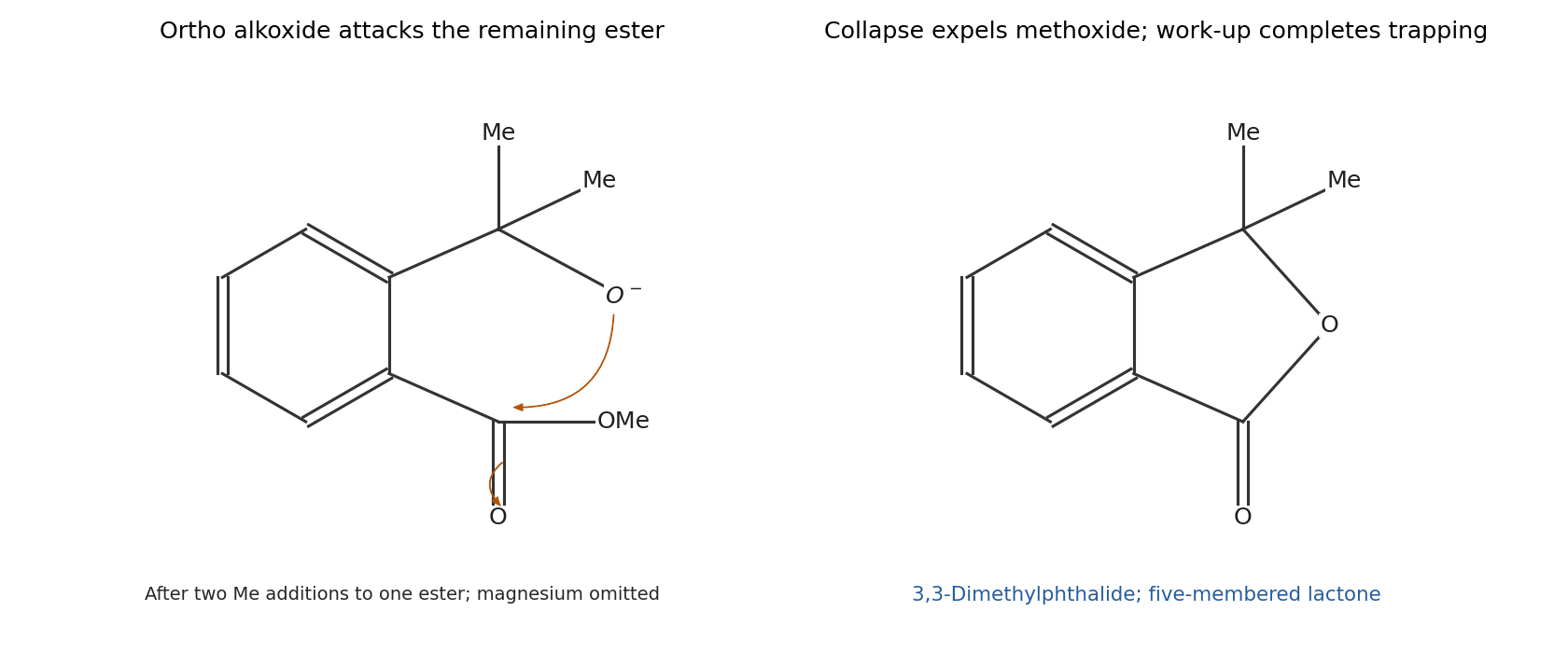
The two starting ester groups are adjacent on the benzene ring. Select one ester carbon as the site receiving both incoming methyl groups. A first methyl addition gives a tetrahedral intermediate; its collapse expels methoxide to give the ortho-substituted ketone . A second methyl addition produces , with the alkoxide bound to magnesium.
The newly generated oxygen is now positioned to attack the remaining ester intramolecularly. Draw an arrow from its lone pair to that ester carbonyl and another from the C=O pi bond to its oxygen. Collapse of the resulting tetrahedral intermediate reforms the carbonyl and expels methoxide, closing a five-membered lactone. Protonation of magnesium-bound species in the work-up gives 3,3-Dimethylphthalide. Equivalently, protonation can first give the ortho hydroxy ester, followed by acid-assisted lactonization with loss of methanol; both descriptions show the same required bond formation.
The oxygen in the new ring is the oxygen of the first ester's original carbonyl; the surviving lactone carbonyl comes from the second ester. The product retains the six ring carbons and both original acyl carbons, loses the two ester methoxy carbons, and gains two carbons from methylmagnesium bromide. The favourable intramolecular five-membered closure accounts for the displayed product. It does not make the isolated lactone universally inert to a large excess of grignard reagent; stoichiometry and trapping/work-up conditions matter.
A is pentane-2,3-dione, . Its index of hydrogen deficiency is , accounted for by two ketone carbonyls. The two resonances near 200 ppm, together with the three saturated carbon signals and the proton integrals, identify an unsymmetrical adjacent diketone rather than an ester or an alkene-containing structure.
The assignments are the carbonyl-adjacent methyl at , the methylene at , and the terminal ethyl methyl at ppm. The two carbonyl carbons give and ppm. Their individual ordering is not uniquely established by the supplied one-dimensional spectra; either ordering between the methyl-side and ethyl-side carbonyls should be kept tentative without a correlation or another independent assignment. In the displayed attached proton test phase convention, the two methyls have one sign, while the methylene and the nonprotonated carbonyls have the opposite sign. The solvent signal near 77 ppm is not a sixth carbon of A.
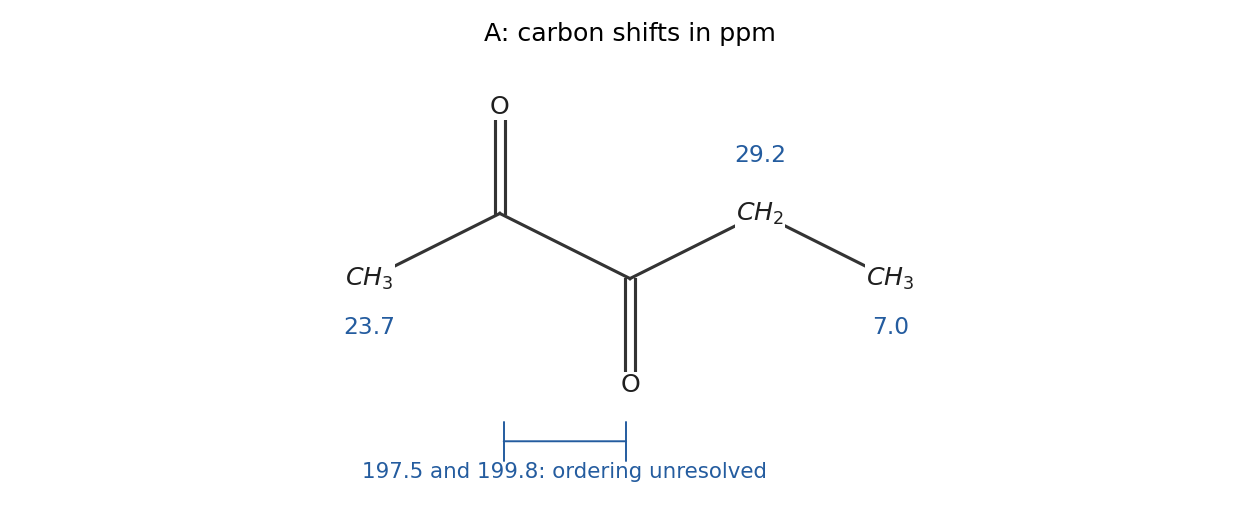
Original structural assignment of the five carbon environments in A; the two carbonyl shifts are an unordered pair
. Details. Build the phenethyl grignard reagent, use one portion to make a phenethyl-substituted ester, and add two further equivalents to that ester. Write ; the target is , so all three carbon substituents must be phenethyl, not benzyl.
hydroboration followed by oxidation of styrene gives : use in a suitable ether, followed by alkaline hydrogen peroxide. The Anti-Markovnikov addition regiochemistry is essential; acid-catalysed Markovnikov addition of water would give the wrong alcohol. Convert the primary alcohol to with phosphorus tribromide, then form with magnesium in dry ether. The organomagnesium reagent must be prepared and used without a protic solvent.
carboxylate one portion with carbon dioxide and acidify to obtain , then esterify with ethanol under acid catalysis to give . Treat the isolated ester with at least two equivalents of another portion of and then perform an aqueous acidic work-up:The first addition to the ester gives a ketone after ethoxide elimination; the second addition gives the tertiary alkoxide. Work-up supplies its OH proton. The extra central carbon comes from carbon dioxide, and each original styrene contributes one intact eight-carbon phenethyl unit. The resulting carbon count is , matching the target skeleton.
The assignments are A → spectrum 3, B → spectrum 4, C → spectrum 1, and D → spectrum 2. The useful infrared spectroscopy evidence is the combination of functional-group absorptions, rather than every feature of the fingerprint region.
A is a saturated diketone: spectrum 3 has a strong ketone C=O band near without the very broad acid O–H absorption. Its two symmetry-related carbonyls do not require two well-separated diagnostic bands.
B is a conjugated dienoic acid: spectrum 4 combines a broad carboxylic acid O–H envelope, approximately –, with a conjugated C=O band near – and C=C absorptions around –.
The carbon spectra are A → 5, B → 8, C → 6, and D → 7. Number each acyclic acid or ester chain from its carbonyl carbon. The assignments below account for every carbon-13 NMR environment.
For A, both ketone carbonyl carbons have ppm and all four methylene carbons have ppm. Molecular symmetry and rapid conformational averaging explain why six carbons give only two resonances.
For B, written , assign , , , , , and ppm. The alternation among vinylic chemical shifts reflects polarization of the conjugated chain, especially the deshielded carbon beta to the carboxyl group.
For C, written , assign the carbonyl at , the adjacent sp carbon at , the other sp carbon at , and the terminal methyl at ppm. The two methylene resonances are and ppm. A plausible assignment is and ppm, but their ordering is tentative from the supplied shift list alone; a correlation experiment would resolve it.
For D, written , the carbonyl is at ppm. The crotonyl beta-CH, alpha-CH and methyl carbons are at , and ppm, respectively. The O-bound vinyl CH is at ppm and its terminal is at ppm. The two sides of the ester oxygen therefore produce quite different vinylic environments.
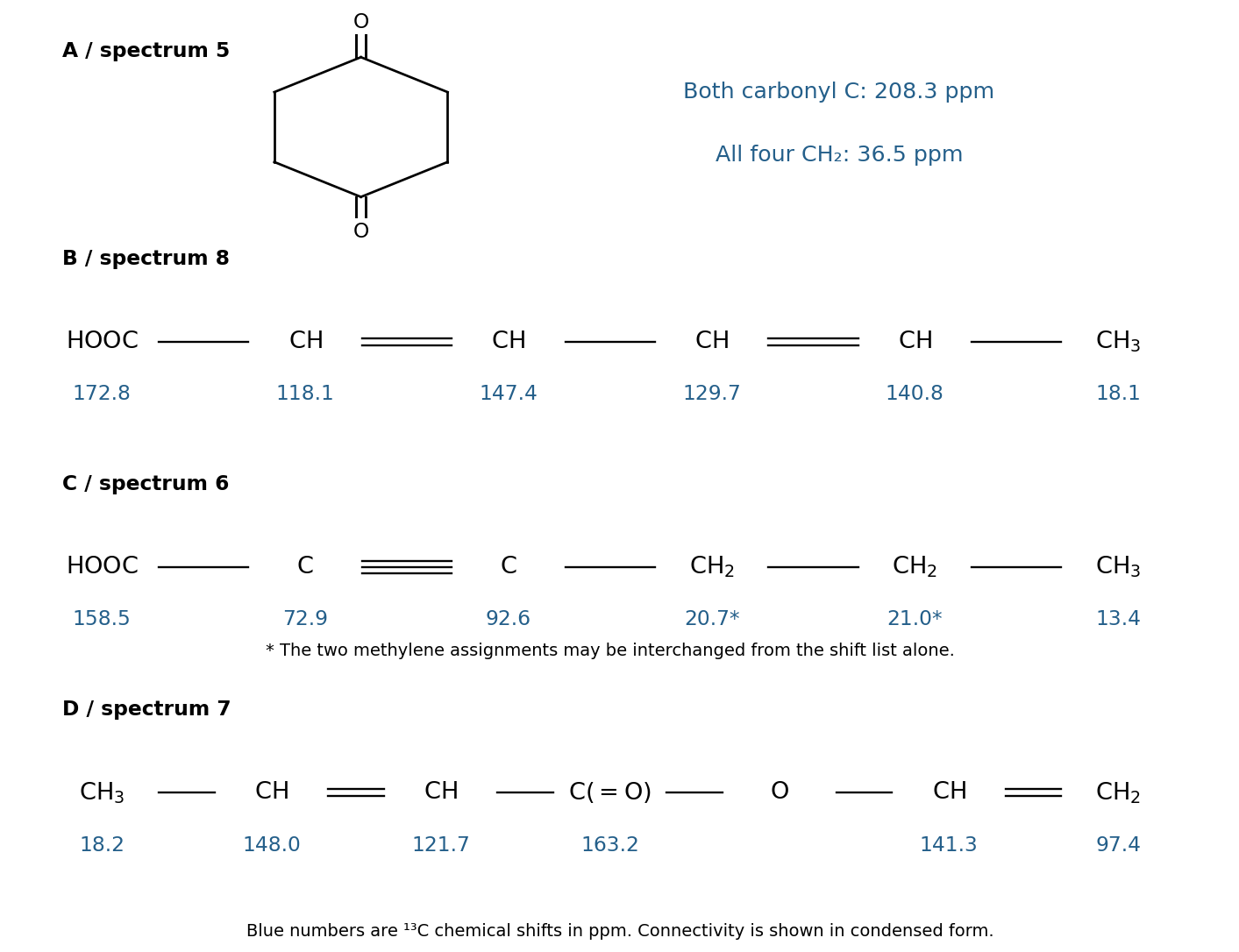
Original structural maps of all supplied carbon-13 NMR assignments
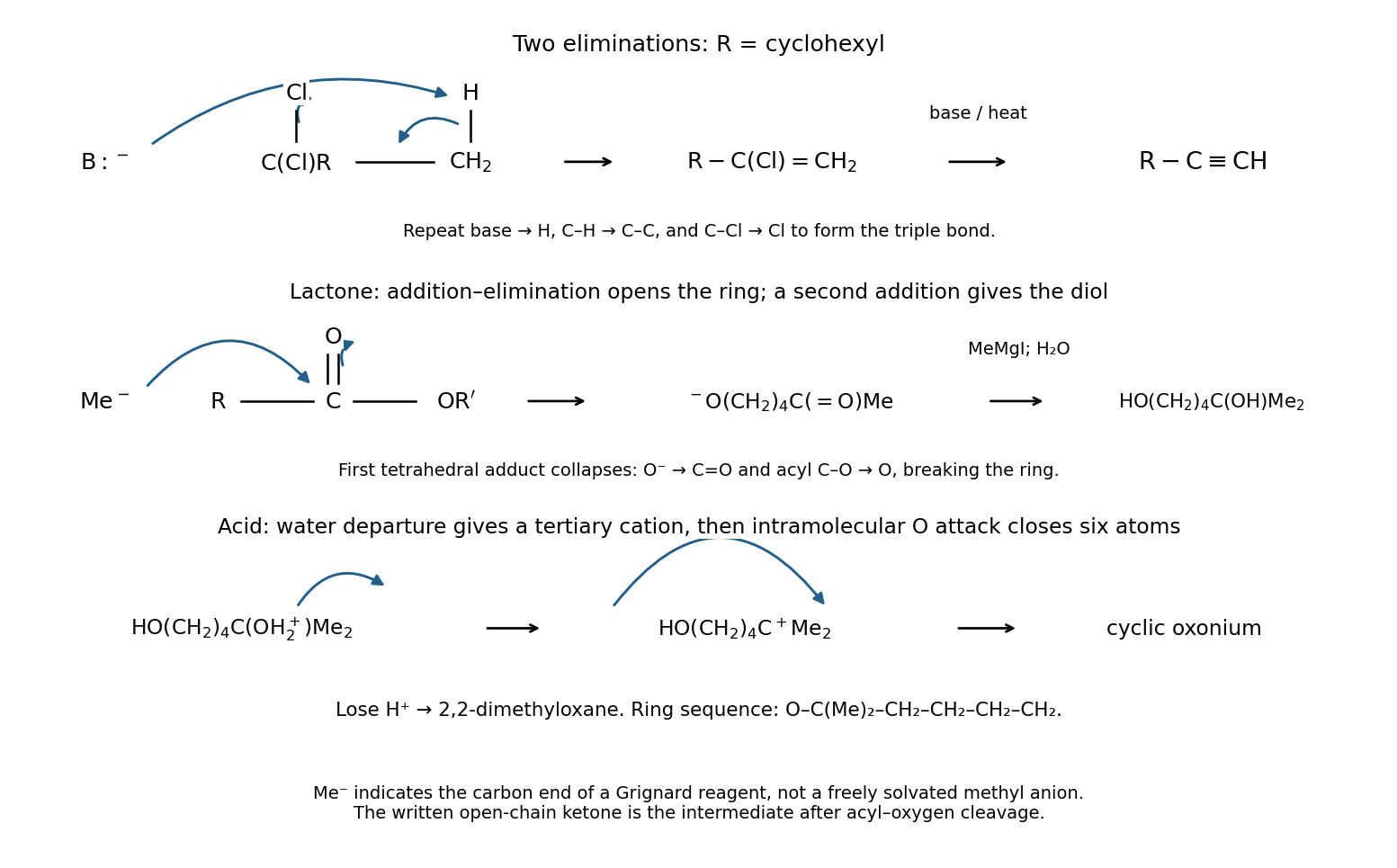
. Details. The first transformation is two successive dehydrohalogenations; the second opens the lactone by two methyl additions and then closes a six-membered cyclic ether. Both schemes must be accounted for within this part.
For the dichloride, write . In the product-forming path, tert-butoxide removes a hydrogen from the methyl group of . Draw arrows from the base lone pair to H, from C–H into the C–C bond, and from C–Cl to Cl. This E2 elimination gives . A second base-induced elimination removes a vinyl hydrogen and the remaining chloride, forming . The second elimination is more demanding because a vinylic bond is involved, consistent with the strong-base, heated conditions. This route explains the displayed product without asserting that no other elimination regioisomer can ever form.
For the lactone, a methyl equivalent from methylmagnesium iodide attacks the ester carbonyl carbon, with its pi pair moving to oxygen. Collapse of the tetrahedral intermediate reforms C=O and cleaves the acyl–oxygen bond, opening the ring to the magnesium alkoxide corresponding to . The newly formed ketone is more susceptible to a second methyl addition; its pi pair again moves to oxygen. After water workup, the product is the diol .
Under acid and heat, protonate its tertiary OH, then move the C–O pair onto oxygen as water leaves. The resulting is trapped intramolecularly by the remaining primary-alcohol oxygen. Its lone pair forms the closing O–C bond, producing a six-membered cyclic oxonium ion. Deprotonation yields 2,2-dimethyloxane, also called 2,2-dimethyltetrahydropyran. Ring closure retains four chain methylenes; it does not form a five-membered ring. The two methyl groups both derive from the two equivalents of Grignard reagent.
Sodium borohydride is chemoselective for the ketone; lithium aluminium hydride reduces both the ketone and the lactam. In an amide, donation of the N lone pair into the carbonyl system reduces the carbonyl carbon's electrophilicity. It is therefore substantially less susceptible to the milder hydride donor.
Lithium aluminium hydride supplies more strongly reducing hydride equivalents, and the strong affinity of aluminium for oxygen assists removal of the amide oxygen through the iminium pathway. This difference explains both the unchanged lactam carbonyl in B and the absence of that oxygen in C. Both reactions are interpreted after the usual protonating workup.
B is 4-hydroxy-1-methylpyrrolidin-2-one; C is 1-methylpyrrolidin-3-ol. Their ring connectivities are shown below. Each ring remains five membered; the attached N-methyl group is retained.
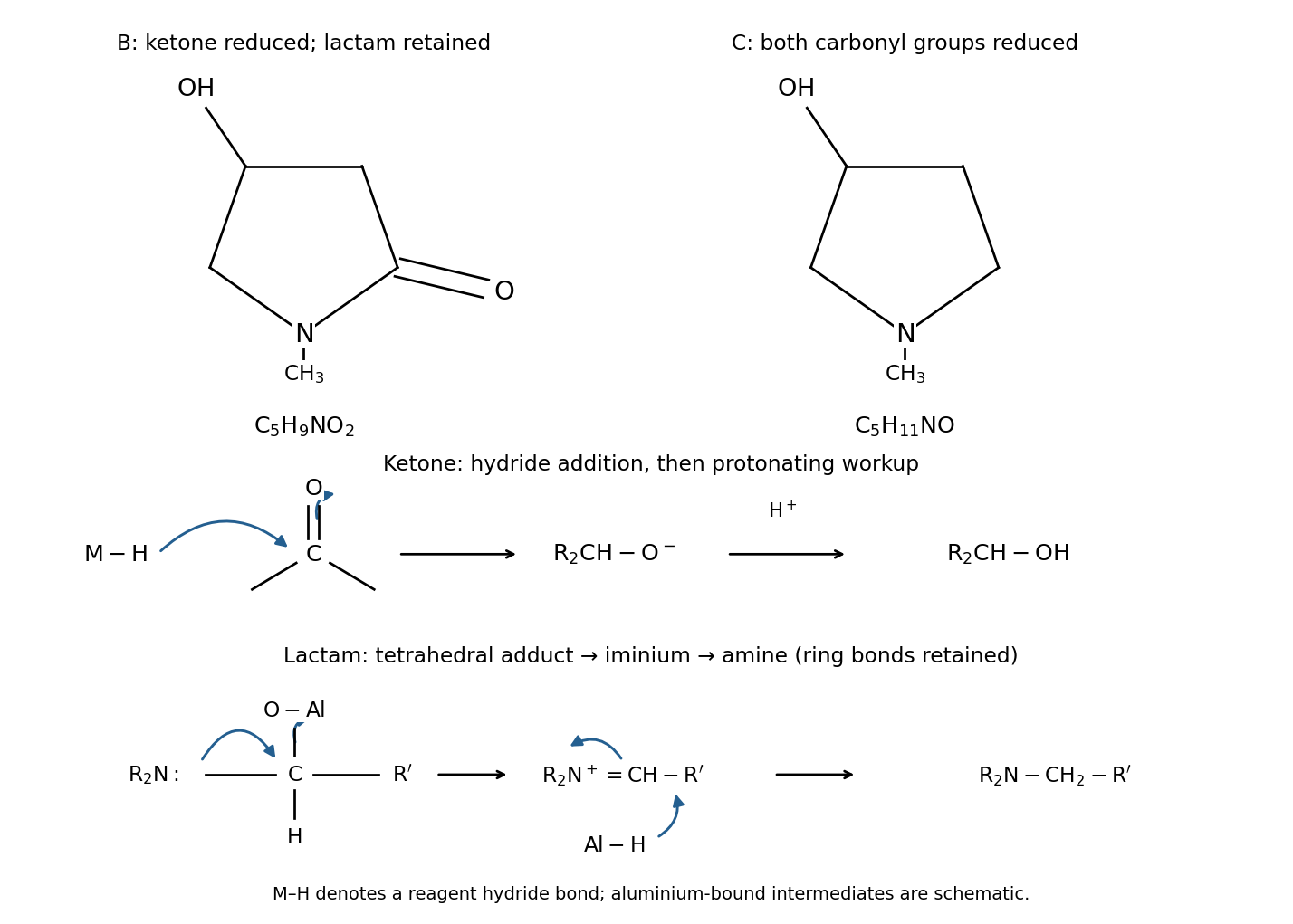
For B, a B–H bond of sodium borohydride supplies a hydride equivalent to the ketone carbonyl carbon, and the carbonyl pair moves to oxygen. This gives an alkoxide, whose protonation during the reaction or workup gives the secondary alcohol. The lactam carbonyl remains. Converting one to adds two H atoms and gives .
For C, lithium aluminium hydride reduces that ketone in the same net way and also reduces the lactam. Coordination of the amide oxygen to aluminium assists hydride attack at its carbonyl carbon, giving a tetrahedral intermediate. The N lone pair then forms a C=N bond while the C–O bond breaks to an aluminium-bound oxygen group. A resulting iminium ion accepts a second hydride at carbon, yielding the cyclic tertiary amine. Aqueous workup protonates the ketone-derived alkoxide.
The lactam conversion replaces by ; its oxygen is removed rather than retained as another alcohol. Together with ketone reduction, the net change is , giving . No stereochemistry is specified: the new alcohol stereocentre is formed as a racemic mixture in an achiral environment.
Disconnect the amide into 2-propylhexanoic acid and N-methyl-2-(4-hexylphenyl)ethylamine. This keeps the nitrogen substituents distinct: one is Me and the other is the two-carbon aryl side chain. The acid's alpha carbon must bear both n-butyl and n-propyl groups.
For the acid fragment, esterify the supplied hexanoic acid, form its ester enolate with LDA, and alkylate with 1-iodopropane:hydrolysis gives 2-propylhexanoic acid; conversion with gives the acyl chloride for the final coupling. Limit the alkylating reagent and isolate the monoalkylated ester to avoid overalkylation.
For the aryl fragment, use another portion of hexanoic acid to make hexanoyl chloride. A Friedel-Crafts acylation of bromobenzene with this reagent and gives ortho and para products; isolate the para bromoaryl ketone. A Wolff-Kishner reduction converts into without deliberately hydrogenolyzing the aryl bromide. Acylation followed by carbonyl reduction installs an unrearranged n-hexyl group; direct Friedel–Crafts alkylation is a less reliable way to do that.
Convert the retained aryl bromide into its grignard reagent, open ethylene oxide, and work up to obtain . Oxidize the primary alcohol to under conditions that stop at the aldehyde, then perform reductive amination with methylamine and sodium triacetoxyborohydride. Excess methylamine helps favour the desired secondary amine over further alkylation. Finally acylate that secondary amine with the isolated acyl chloride, using a separate base to capture HCl.
The final amide has an N-methyl group, the para n-hexyl phenethyl group, and the required n-butyl/n-propyl acyl branching. The carbon check is in the acyl fragment plus in the amine fragment, giving overall. No absolute stereochemistry is specified at the acid alpha carbon.
Disconnect the N–cyclohexyl bond as a late reductive amination of a primary amine with cyclohexanone. Disconnect the exocyclic methylene as a Wittig methylenation of a substituted cyclohexanone. The useful ring precursor is 3-methyl-5-substituted cyclohex-2-en-1-one, accessible by a Robinson annulation. The pendant substituent throughout ring construction should be .
Start with nucleophilic substitution of the supplied bromo ester by cyanide:Reduce the nitrile selectively to the primary amine while retaining the ester, for example by controlled catalytic hydrogenation with Raney nickel in the presence of ammonia, and trap the amine promptly as its Boc carbamate. Avoid heating or concentrating the free amino ester, which can cyclize to a lactam. lithium aluminium hydride would be unsuitable at this stage because it also reduces the ester.
Partial reduction of the protected ester with DIBAL at low temperature gives . The carbon of the original nitrile is now the methylene nearest nitrogen; the original ester carbonyl is the aldehyde carbon. Condense this aldehyde with acetone and dehydrate to .
Now add the enolate of a second acetone molecule in a Michael addition. With , the resulting chain isIntramolecular aldol condensation gives 3-Me-5-R-cyclohex-2-en-1-one. The beta methyl derives from the carbonyl end attacked in the ring closure; the pendant aminoalkyl chain remains at C5. Hydrogenate the ring C=C selectively, retaining the ketone, then methylenate the ketone with preformed . Do the hydrogenation before installing the exocyclic methylene so that it is not hydrogenated away.
Remove Boc under brief mild conditions, checking for acid-induced exocyclic alkene isomerization. reductive amination of the resulting primary amine with cyclohexanone, followed by selective imine reduction, installs the secondary N-cyclohexyl group. Use controlled stoichiometry to suppress tertiary amine formation. The methyl and four-carbon aminoalkyl substituents occupy the required 1,3-related ring positions, with the exocyclic methylene at the former carbonyl. No ring stereochemistry is specified. The target contains eighteen carbons: six ring carbons, one ring methyl, one methylene, four in the linker, and six in the N-cyclohexyl group.
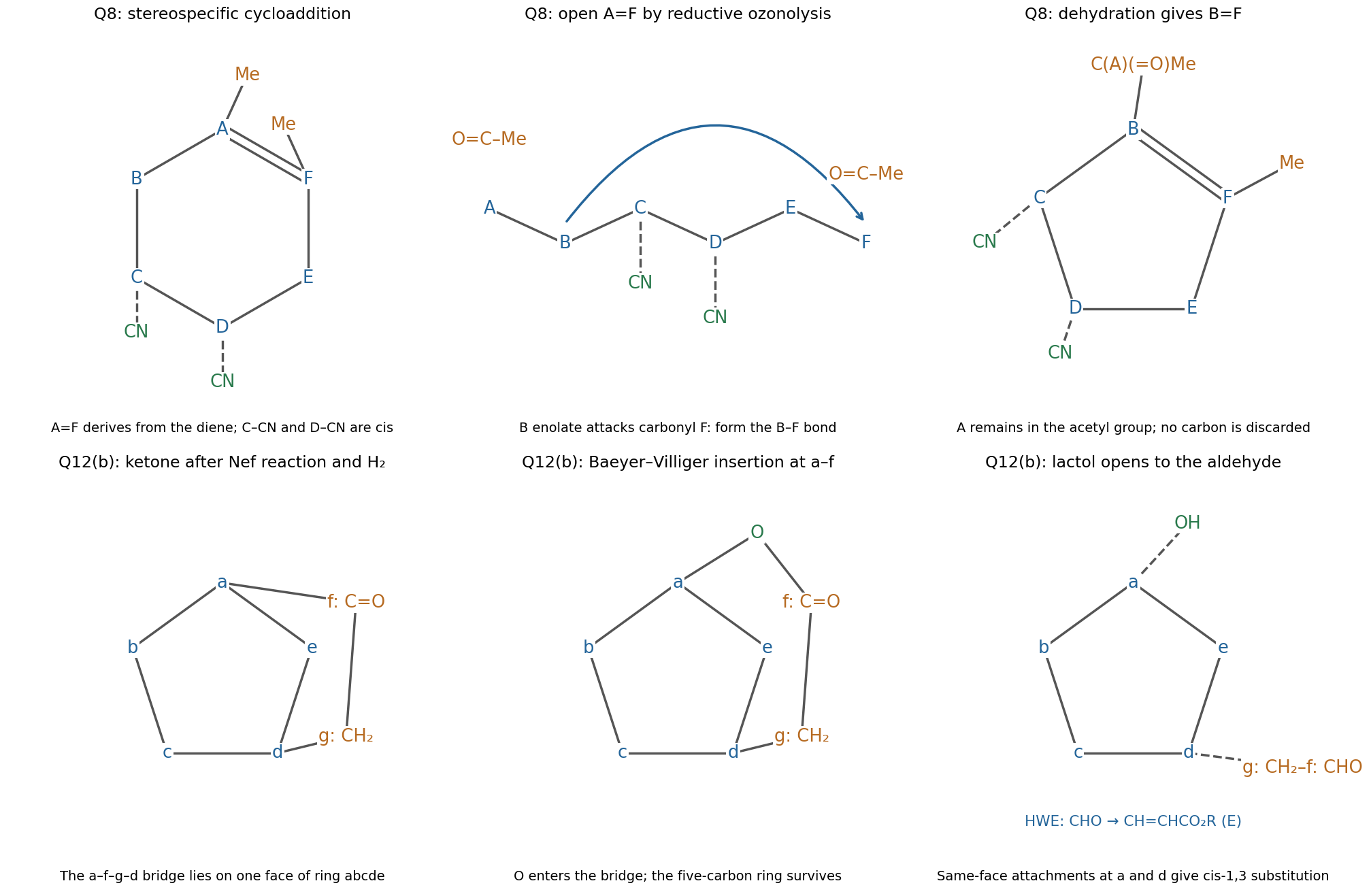
The key stereochemical disconnection is the cis-1,3-disubstituted cyclopentane, not a direct functionalization of two arbitrary cyclopentane positions. A Diels-Alder reaction of cyclopentadiene with nitroethylene fixes both ends of the new two-carbon bridge on the same face of the original five-membered ring.
Isolate the useful nitronorbornene adduct, convert its secondary nitro group to a ketone by a Nef reaction, and then hydrogenate the remaining ring alkene to norcamphor. Performing the nitro-to-ketone conversion before catalytic hydrogenation avoids simply reducing the nitro group to an amine.
Use a Baeyer-Villiger oxidation to insert oxygen between the carbonyl carbon and its adjacent bridgehead carbon. Bridgehead migration is favoured over migration of the competing methylene; isolate the required lactone regioisomer if necessary. This opens the way to a hydroxy cyclopentyl side chain without breaking the original five-carbon ring. In the resulting bridged lactone, one original cyclopentadiene terminus is bonded to O and the other bears the segment.
Reduce the lactone selectively with DIBAL to its lactol. Ring opening of that lactol gives the aldehyde equivalent cis-3-hydroxycyclopentyl-. The ring OH and the two-carbon aldehyde side chain are cis because their original attachments were the two ends of the Diels–Alder bridge; neither the migration nor lactol opening inverts those cyclopentane carbons.
Perform a Horner-Wadsworth-Emmons reaction on the lactol/aldehyde equilibrium using , where . Preform the phosphonate anion and allow for consumption of base by the lactol OH. Standard stabilized-phosphonate conditions favour the required E- unit. No further hydrogenation should follow it.
The required ester substituent can be prepared by reducing 4-methylpentan-2-one to 4-methylpentan-2-ol, esterifying with bromoacetic acid, and performing an Arbuzov reaction with triethyl phosphite to make the phosphonoacetate. No absolute configuration is indicated at that alcohol-derived centre.
Bridge-derived cis ring stereochemistry plus E-selective phosphonate olefination gives both specified relationships. Achiral cycloaddition and subsequent reagents give a racemic pair with this relative configuration; isolation of one absolute enantiomer would require resolution or an asymmetric variant. The acid fragment contains nine carbons: five from cyclopentadiene, two from nitroethylene and two from the phosphonoacetate. The ester alkyl group adds six, giving fifteen overall. The atom tracing in the original schematic in question 8 shows why oxygen insertion retains the five-membered ring rather than producing a six-membered carbocycle.
Disconnect the tertiary alcohol at its bond to the alkenyl group. The required carbonyl partner is ; the other partner is an E-configured organometallic reagent. This disconnection fixes the alkene geometry before the alcohol is made.
First form the ethyl-side enolate of butan-2-one under equilibrating conditions, then trap it with ethyl iodide and isolate the required monoalkylated ketone:The incoming group is Et: methylation would give a carbon skeleton one carbon too short. Because an unsymmetrical ketone can form two enolates and undergo repeated alkylation, regioisomer separation and controlled conversion are part of this step.
Independently perform a halo-Wittig reaction on phenylacetaldehyde using and isolate E- from any geometrical mixture. magnesium insertion in dry ether gives the corresponding vinylmagnesium halide; add the isolated ketone at low temperature and protonate the resulting alkoxide. Addition to C=O preserves the pre-existing C=C geometry:The E alkene and the complete fifteen-carbon skeleton are obtained. No absolute configuration is specified at the newly formed alcohol centre, so an unselected stereoisomeric mixture there is acceptable. An alternative carbon–carbon disconnection is acetylide addition to the same ketone followed by a controlled trans-selective alkyne reduction; the vinyl-reagent route avoids relying on reduction of a tertiary propargylic alcohol.
Open the lactone formally at its acyl–oxygen bond, then replace the resulting secondary alcohol by its ketone precursor. With , the useful sequence of retrosynthetic intermediates isDisconnect the last compound as a Michael addition product of the methyl-side enolate of and ethyl methacrylate:The substituted carbon of the methacrylate becomes the methyl-bearing carbon alpha to the lactone carbonyl. The ketone carbon becomes the oxygen-bearing ring carbon. This checks the six-membered ring connectivity.
The required branched methyl ketone itself comes from butan-2-one by ethyl-side aldol addition to acetone, followed by dehydration and selective hydrogenation:Choose and isolate the aldol regioisomer shown. For the subsequent Michael step, use a bulky base at low temperature to favour its less hindered methyl-side kinetic enolate. Reduce the resulting ketone selectively with while retaining the ester, hydrolyse the ester, then acidify and promote intramolecular esterification with water removal. The hydroxy acid closes to the required six-membered lactone. There is no specified stereochemical relationship to enforce, but a stereochemically pure target would require an additional selectivity or resolution step.
An acetal retrosynthesis separates the target into trans-cyclohexane-1,2-diol and cyclohexyl methyl ketone. Both fragments can be prepared using separate portions of cyclohexene.
For the diol, epoxidation with a peroxy acid such as mCPBA gives cyclohexene oxide. Acid-catalysed opening with water occurs by backside attack on the protonated epoxide, giving the anti, hence trans, diol. A syn dihydroxylation would give the wrong relative configuration.
For the ketone, add HBr to another portion of cyclohexene to obtain bromocyclohexane, form its grignard reagent with Mg in dry ether, and add acetonitrile. Hydrolyse the resulting magnesium imine salt to . A nitrile is useful here because addition followed by hydrolysis stops at the ketone instead of giving the double addition associated with an ester.
Finally combine the isolated trans diol and ketone with catalytic acid and remove water to form the cyclic ketal. The ketone carbon becomes the acetal carbon bearing Me and cyclohexyl; the two original diol C–O bonds retain their relative configuration. Anti epoxide opening supplies the required trans relationship before ketal formation. ketal formation is an equilibrium and the trans-fused product may be less favourable than an unstrained acetal, so effective water removal and isolation are necessary; substituting a cis diol is not an acceptable shortcut.
The five-membered enone-like carbon framework can be obtained by an intramolecular aldol condensation ofEnolization at an internal methylene next to one ketone followed by attack on the opposite ketone closes a five-membered ring. dehydration leaves one acetyl group attached to one alkene carbon and one methyl group on the other. The two nitrile-bearing carbons remain adjacent and their original cis relationship is retained if epimerization is avoided.
Now reverse a reductive ozonolysis: the diketone arises by opening a six-membered cyclohexene whose alkene carbons each carry Me. That cyclohexene is the Diels-Alder reaction product of 2,3-dimethylbuta-1,3-diene and maleonitrile. The latter is the supplied cis dinitrile. The stereospecificity of the cycloaddition puts the two CN groups on the same face.
Thus the forward plan is Diels–Alder addition, reductive ozonolysis, then five-membered aldol ring closure and dehydration. Use a reductive ozone work-up that stops at the diketone. During the final step, avoid prolonged strongly basic heating because the carbons bearing CN can be deprotonated and epimerized. Achiral reagents give the racemic pair with the required cis relationship; resolution would be necessary if only the depicted enantiomer were required. The diene supplies six carbons and maleonitrile supplies four, accounting for all ten carbons without an unexplained carbon deletion.
There are three largely independent constructions: a substituted Robinson-annulation core, a protected vicinal diol, and the ester acyl fragment. Disconnect the ester first to an allylic alcohol on the bicyclic ring and the acid . Disconnect the benzylidene acetal to a side chain and benzaldehyde. Reversing 1,2-reduction of the allylic alcohol gives the corresponding bicyclic enone; its six-membered enone ring is a Robinson disconnection back to a suitably alpha-substituted cyclohexanone and methyl vinyl ketone.
An efficient way to protect the side chain before annulation is to prepare 4-(bromomethyl)-2-phenyl-1,3-dioxolane from and benzaldehyde with mild acid and water removal. The desired five-membered acetal protects the adjacent hydroxyl groups, while its external primary bromide remains an alkylating site. Alpha alkylation of the indicated cyclohexanone with this bromide gives a ring bearing in the benzylidene-protected form. There is no need to expose the eventual ring enone to a nonselective late dihydroxylation.
Generate the enolate at the other, less substituted alpha position of the cyclohexanone and add methyl vinyl ketone. Hydrolysis of an enamine-mediated Michael variant or direct enolate trapping gives the appropriate 1,5-dicarbonyl. Intramolecular aldol condensation closes a six-membered ring onto the original cyclohexanone carbonyl. Dehydration gives the fused bicyclic enone, with the protected three-carbon side chain on the adjacent carbon of the original ring. Regioselecting the initial Michael addition is essential: reaction at the side-chain-bearing alpha site would place that substituent at the wrong fusion position.
Reduce the new enone carbonyl by 1,2-addition, for example sodium borohydride with cerium(III) chloride under Luche-type conditions, to retain the displayed ring C=C bond and produce the allylic alcohol. The benzylidene acetal should be maintained through these neutral/basic operations. The target has no wedge/dash assignments, so a constitutional solution does not require a claim of a unique fused-ring/alcohol diastereomer; isolate the required constitutional annulation product.
For the acyl branch, form the enolate of the indicated methyl butanoate, add acetone, then dehydrate the beta-hydroxy ester:Hydrogenate this isolated alkene before coupling it to the bicyclic substrate, giving . saponification gives ; activate it as its acid chloride or use a mild ester-coupling reagent, then acylate the bicyclic allylic alcohol. Performing the hydrogenation on the separate acyl branch avoids reducing the target ring alkene. Strong acid should be avoided during the final esterification because the benzylidene group is acid-labile.
The carbon audit is particularly useful: the fused rings contain six carbons from cyclohexanone plus four from methyl vinyl ketone; the side chain has three carbons from the protected bromodiol; the benzylidene unit supplies its acetal carbon and phenyl group. In the acyl fragment, the four butanoate acyl carbons plus three acetone carbons give seven; the starting ester methoxy carbon is lost during hydrolysis.
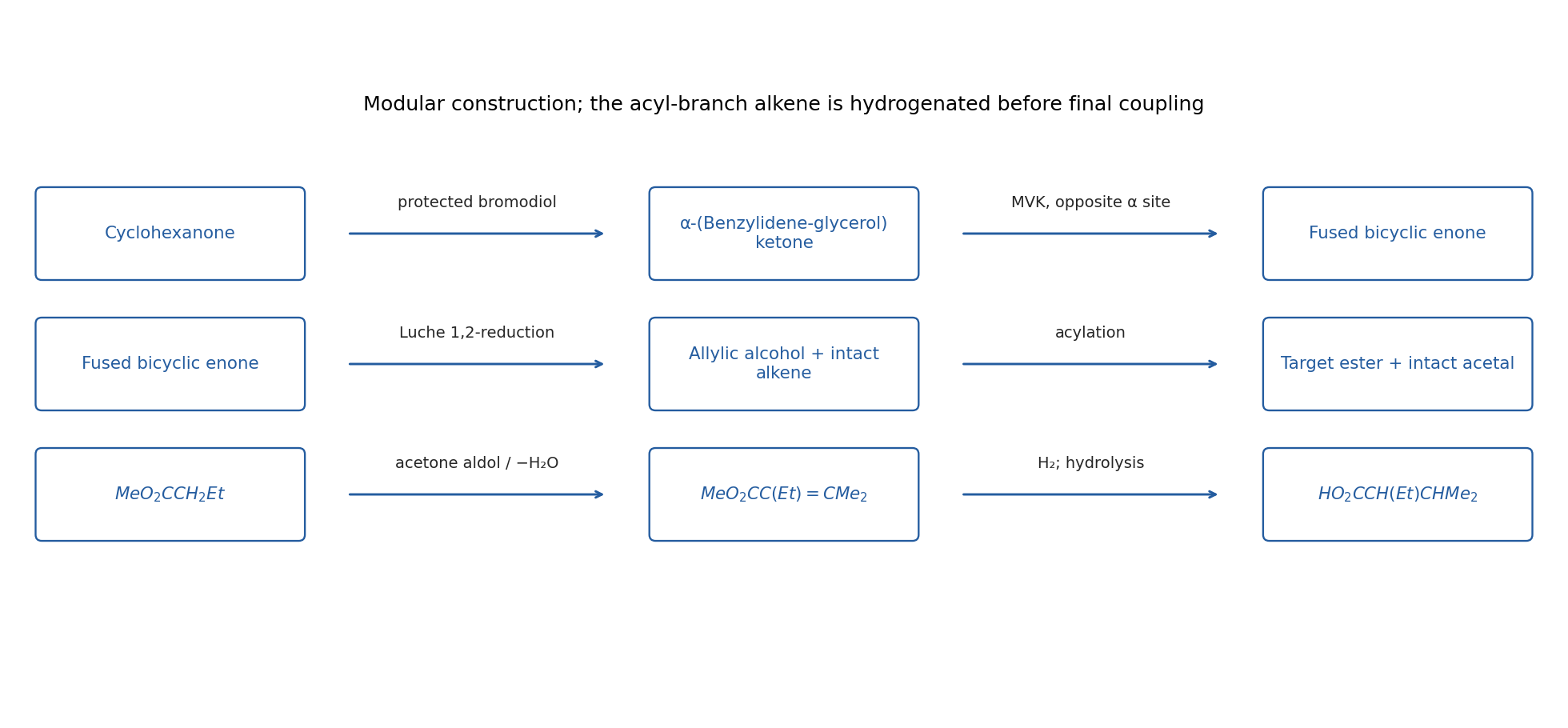
Original modular disconnections separating protected side-chain installation, regioselected Robinson annulation and synthesis of the seven-carbon acyl group
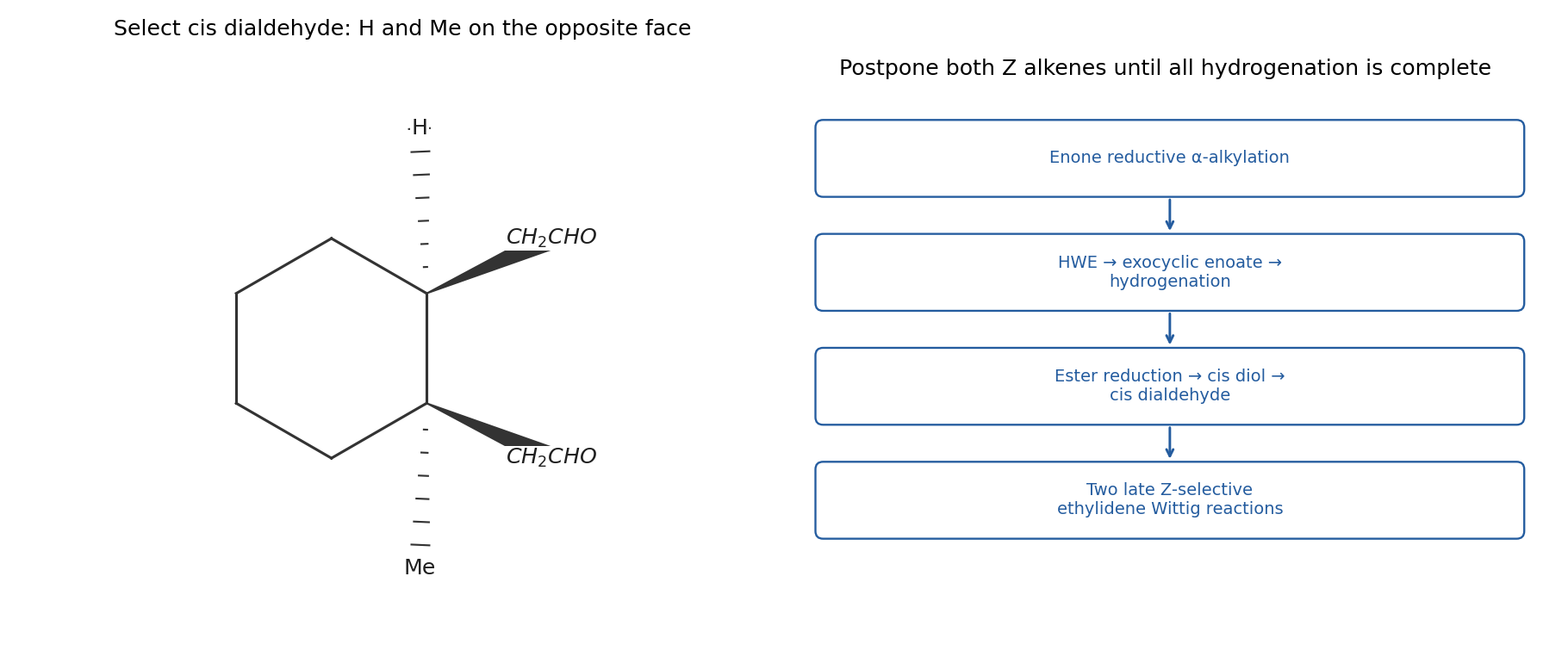
. Details. Both side chains have the order ring–, and both printed double bonds have the Z geometry. The two carbon side chains are cis to one another; equivalently the labelled ring H and ring Me are cis on the opposite face. A useful common late precursor therefore has two cis ring– substituents, which can undergo two Z-selective ethylidene Wittig reactions.
Use the starting 2-methylcyclohex-2-en-1-one in a reductive alpha-alkylation. Conjugate reduction under dissolving-metal/enolate-trapping conditions, followed by a primary electrophile , installs a protected two-carbon alcohol side chain at the original methyl-bearing alpha carbon. This gives 2-methyl-2-(2-siloxyethyl)cyclohexanone. The carbon at that position is now quaternary, with its original methyl retained. Alternatively, reduce the enone to 2-methylcyclohexanone and deliberately form/select its more substituted enolate before alkylation; its opposite kinetic enolate would give the wrong regioisomer.
Convert the remaining ring ketone to an exocyclic enoate by Horner–Wadsworth–Emmons olefination with a phosphonoacetate:Hydrogenate this sole alkene to give ring– at that carbon. Select the diastereomer with this substituent cis to the pre-existing protected hydroxyethyl side chain, so the newly installed ring H is cis to ring Me. Less hindered-face hydrogenation can assist this relationship, but the route should include separation/verification of the desired cis product rather than assert complete stereoselectivity without data.
Reduce the ester with lithium aluminium hydride to ring– and remove the TBS group from the other side chain. Both appendages are now two-carbon primary alcohols. Oxidize them to aldehydes under non-overoxidizing conditions, for example Dess–Martin oxidation, obtaining the cis dialdehyde with two ring– groups. Treat with excess salt-controlled, nonstabilized ethylidenetriphenylphosphorane under conditions favouring kinetic Z olefination; isolate the Z,Z product. Each aldehyde carbon becomes the inner vinylic carbon of its crotyl group, while the ylide supplies .
This order postpones both stereodefined alkenes until after hydrogenation, so they are not accidentally saturated. It also avoids assuming that a crotyl grignard reagent adds without allylic transposition or that direct alcohol deoxygenation fixes the required ring stereochemistry. An achiral synthesis gives a racemic mixture pair with the specified relative configuration.
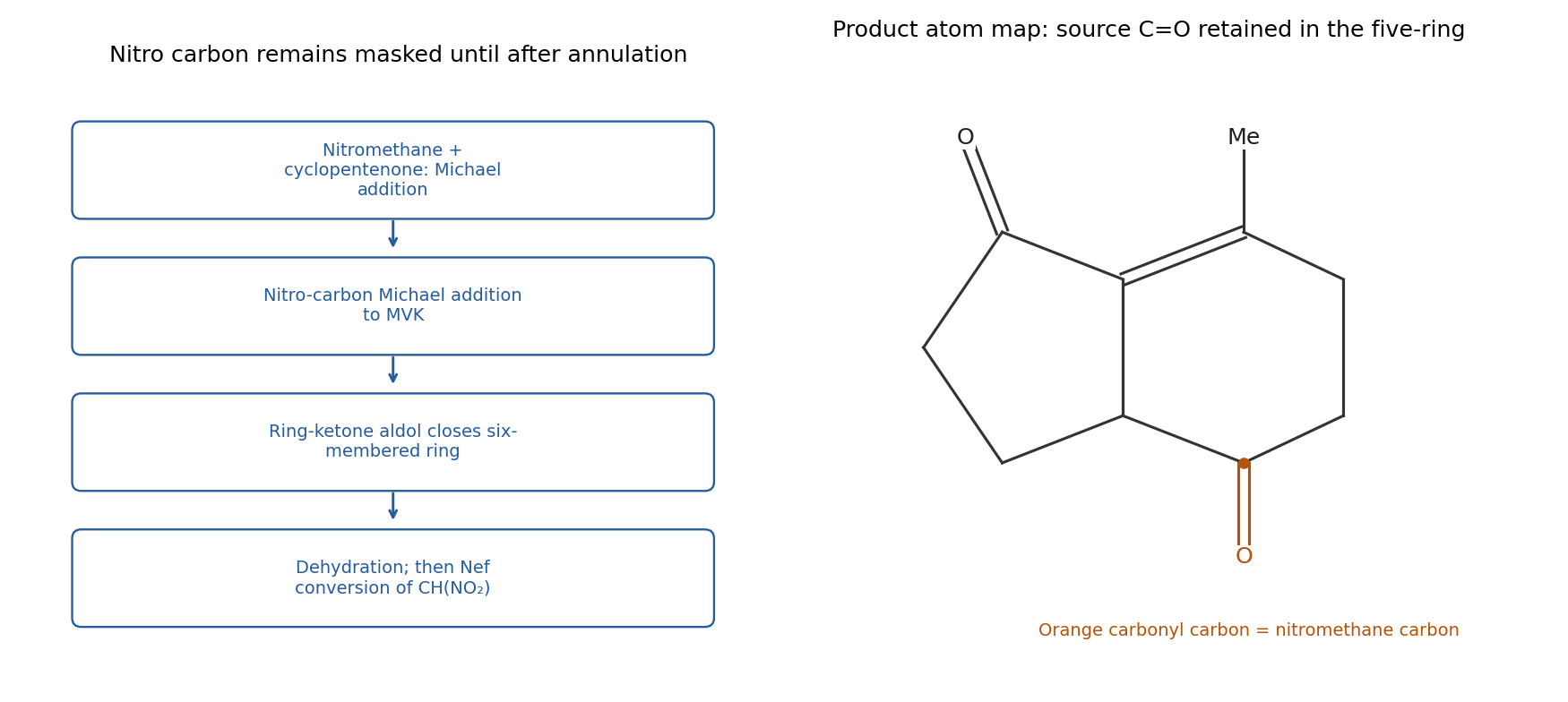
Use the nitro group as a masked carbonyl and a carbon nucleophile. The most informative disconnection reverses the six-membered aldol annulation. Before that closure, the cyclopentanone beta carbon bearsThe carbon carrying will become the lower carbonyl of the final six-membered ring by a Nef reaction. It comes from the specified nitromethane. The remote methyl ketone supplies the upper methyl-substituted alkene carbon after aldol condensation.
First, use a mild base to generate a nitromethane-derived nitronate and add it conjugatively to the indicated cyclopent-2-en-1-one. Protonation gives 3-(nitromethyl)cyclopentanone. Deprotonate its nitromethyl group and perform a second Michael addition to methyl vinyl ketone, giving . The nitro-stabilized carbon is appreciably more acidic than a simple ketone alpha carbon, permitting selective nitronate formation; control the acceptor stoichiometry to avoid a further Michael alkylation of the remaining nitro-bearing H.
Form the enolate/enamine at the cyclopentanone carbon between its carbonyl and the side-chain-bearing carbon. Intramolecular attack on the remote methyl ketone closes a six-membered ring; the two shared atoms are the original enone alpha and beta carbons. Hydrolysis if required and dehydration create the alkene between the original alpha carbon and the newly formed tertiary carbinol carbon. That carbinol carbon retains its methyl substituent, placing the methyl exactly as required. The original cyclopentanone carbonyl remains the carbonyl of the five-membered ring.
Finally, form the secondary nitronate and carry out controlled acidic Nef hydrolysis to replace its unit by . The resulting fused product contains the two required ketones. Carrying out the annulation before exposing this second ketone reduces competing enolate/aldol pathways that would be available in the corresponding triketone. The nitro intermediate's competing deprotonation means that the aldol step needs conditions designed to access the ring carbonyl enolate/enamine; simply treating every carbonyl position as equally reactive would not establish the route.
The carbon ledger is from cyclopentenone, from nitromethane and from methyl vinyl ketone, giving the nine-carbon fused skeleton plus its methyl substituent. A primary-nitro Nef reaction performed before the second carbon alkylation would instead give an aldehyde and would lose this useful protected-carbonyl construction.
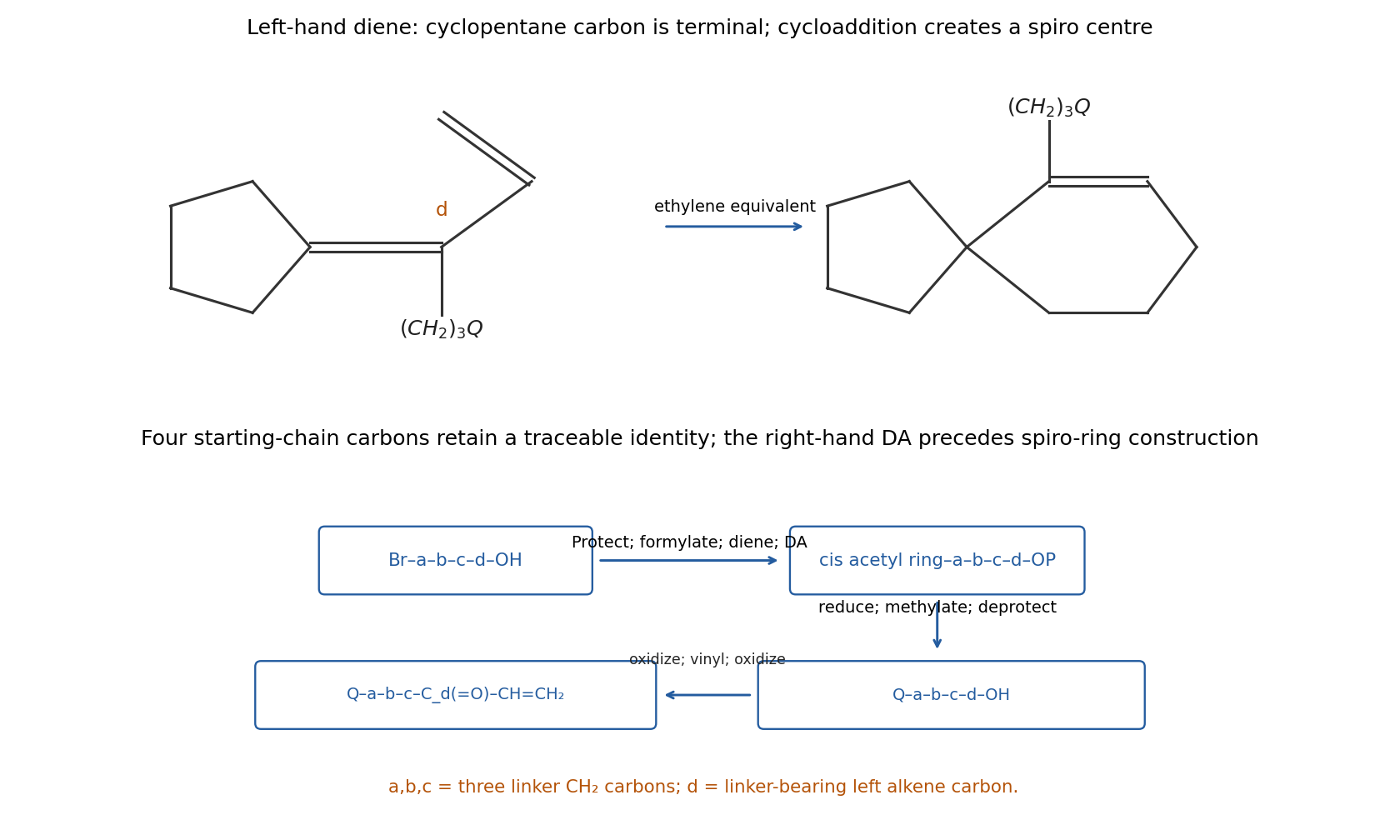
The left ring system is spiro, and the right-hand substituent is , not OMe directly attached to the cyclohexene ring. Let denote the right cyclohexenyl group bearing that methoxyethyl substituent cis to its linker. The connection to the left alkene carbon is . These observations suggest two Diels–Alder constructions. A left-hand dienehas the original cyclopentane carbon as one terminal diene atom; cycloaddition with an ethylene equivalent gives the spiro six-membered ring. Its residual double bond is between the two internal diene atoms, putting the linker on the required alkene carbon.
Build and its four-carbon alcohol appendage first. Protect the OH group of the indicated 4-Bromobutan-1-ol, for example as a THP ether. Convert the primary bromide to its grignard reagent and formylate with DMF, giving . olefination with an allylidenetriphenylphosphorane, , supplies a conjugated diene ; select the required diene geometry rather than assume a single E/Z outcome.
Cycloaddition with methyl vinyl ketone produces a cyclohexene with a protected four-carbon alcohol chain at one saturated ring carbon and an acetyl group at its adjacent ring carbon. Choose and isolate the adjacent-substituent cis regioisomer, matching the two dashed substituent bonds in the target. Endo preference and diene geometry can aid the selection, but an unsymmetrical diene is not guaranteed to give a unique regioisomer. Reduce the acetyl ketone to , then methylate that alcohol with sodium hydride/methyl iodide while the chain-end OH is protected. Remove the THP group under mild acid conditions to reveal , preserving the secondary methyl ether and the ring alkene.
Oxidize this primary alcohol to . Add vinylmagnesium bromide to give , then oxidize the allylic alcohol to the enone . This carbonyl carbon is the original alcohol-end carbon of 4-bromobutanol; after olefination it will be the linker-bearing carbon of the left ring alkene.
In the other branch, reduce the specified cyclopentanone to cyclopentanol, convert to bromocyclopentane, and react with triphenylphosphine to obtain the cyclopentylphosphonium salt. Deprotonation gives the cyclopentylidene phosphorane, whose ylidic carbon is part of the five-membered ring. Wittig olefination of the just-prepared enone gives the substituted diene displayed above. This carbonyl–ylide pairing keeps the ring carbon terminal in the diene and avoids accidentally constructing a fused ring instead of a spiro ring.
Finally, cycloadd an ethylene equivalent. Ethylene itself requires suitably forcing/high-pressure conditions; a more reactive alternative is phenyl vinyl sulfone, followed by reductive removal of the sulfone substituent using a method compatible with the methyl ether and retained C=C bonds. The latter installs the same two otherwise unsubstituted saturated carbons. Control or separate any additional cycloaddition isomers, and retain the previously selected cis configuration on .
The carbon count provides a strong check: cyclopentanone supplies five, bromobutanol four, DMF formylation one, the first allylidene ylide three, methyl vinyl ketone four, O-methylation one, vinylmagnesium two, and the final ethylene equivalent two, totalling 22 target carbons. Three original bromobutanol carbons form the linker; its fourth becomes the substituted carbon of the spiro ring's alkene. The proposal is a multistep constitutional/relative-stereochemical route with explicit regioisomer and diastereomer selection, not an unsupported claim of a single quantitative cycloaddition product.
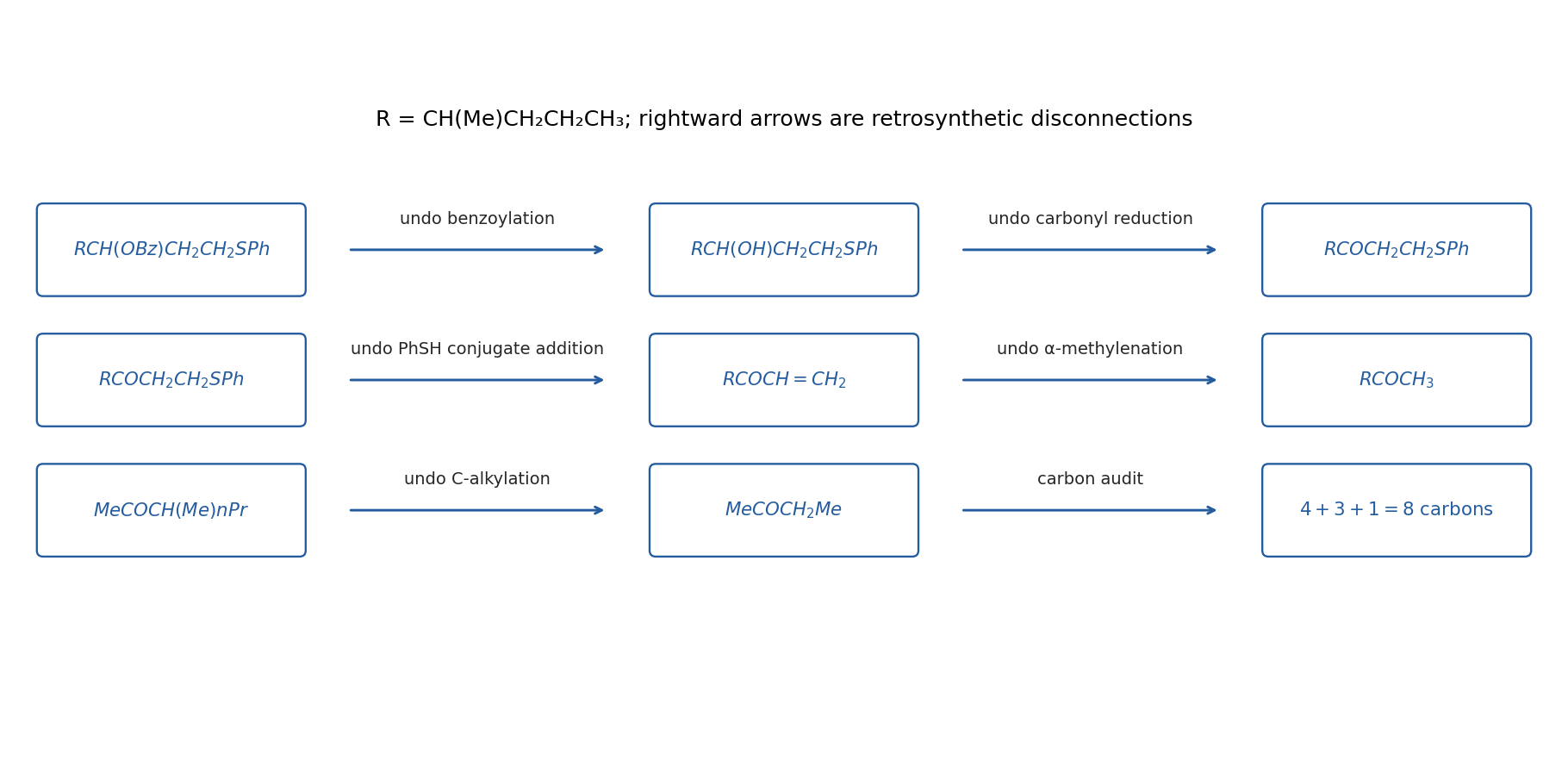
Let . The useful disconnections are benzoate formation, carbonyl reduction and thiol conjugate addition:The sulfur-bearing carbon is the enone beta carbon, so this is a Michael disconnection, not attack of thiophenol on the alcohol-derived central carbon. Reduce the saturated ketone with sodium borohydride after installing SPh, then benzoylate the alcohol with benzoyl chloride and pyridine or a tertiary amine.
Disconnect the enone to and formaldehyde. Kinetic deprotonation on the methyl side of the hindered unsymmetrical ketone, trapping with formaldehyde, and dehydration gives . This order leaves the substituted side unchanged. An alpha-methylenation/Mannich-base-elimination variant is an equivalent way of installing the terminal enone.
Finally, disconnects by alpha alkylation to butan-2-one and 1-iodopropane. Use the more substituted, ethyl-side enolate of butan-2-one for this step, rather than its usual methyl-side kinetic enolate; an equilibrated/regioisomerically selected enolate or enol derivative is required, and the desired monoalkylated ketone should be isolated. Three carbons from propyl iodide and one from formaldehyde increase the original four-carbon ketone to the required eight-carbon alcohol/thioether skeleton. Choosing ethyl iodide here would leave the target short by one carbon.
This is a constitutional synthesis: the target drawing specifies no configuration at either newly formed stereogenic site, so no unproved stereoselective reduction or alkylation is needed. Regioisomeric enolate alkylation and competing overalkylation are the practical selectivity issues to control, rather than something that follows from writing “base”.