
Muon storage-ring time-dilation experiment Created 2026-10-18 Updated 2026-10-31
Accelerator-produced muons circulating in a magnetic storage ring allow a direct comparison between their measured laboratory mean lifetime and times the rest lifetime. The 1977 experiment at measured positive- and negative-muon lifetimes near , consistent with time dilation. This is a controlled complement to atmospheric survival measurements, with different systematic effects.[ref]
Measurements of relativistic time dilatation for positive and negative muons in a circular orbit by J. Bailey and others. 1977 abstract, Lorentz factor, lifetimes and comparison with the lifetime at rest
Past exam of the physics course of the year 1 of the natural sciences course of the University of Cambridge 2019 Section B 9 Solution Created 2026-10-18 Updated 2026-10-20
Experimental evidence. Tests of special relativity check linked predictions about light propagation, clocks and four-momentum. Several independent kinds of experiment support those predictions.
- In the Michelson-Morley experiment, light follows perpendicular paths in an interferometer. Rotating the apparatus would change their round-trip travel-time difference in a classical stationary-aether model. The expected orientation-dependent interference fringe shift was absent at the predicted scale, consistent with isotropy of the round-trip speed of light in special relativity. This experiment alone does not distinguish special relativity from every alternative theory.[ref]On the Relative Motion of the Earth and the Luminiferous Ether by Albert Abraham Michelson and Edward W. Morley. 1887 report, apparatus and predicted versus observed orientation-dependent fringe shifts
- The Fizeau experiment compares light propagation with and against flowing water using an interference fringe displacement. Neglecting optical dispersion, the velocity-addition formula predicts
The Hypotheses Relating to the Luminous Aether by Hippolyte Fizeau. 1851 report, counter-propagating beams, reversing water flow and resulting fringe displacements
- A controlled muon storage-ring time-dilation experiment measured circulating muons at . Its measured mean lifetimes were about , compared with about at rest, consistent with . This tests time dilation with accelerator-selected particles.[ref]Measurements of relativistic time dilatation for positive and negative muons in a circular orbit by J. Bailey and others. 1977 abstract, Lorentz factor and positive- and negative-muon lifetimes
Atmospheric muons and the two frame descriptions. Atmospheric cosmic rays create unstable particles whose decay chains produce muons. A stopped-muon experiment measures the time between a stopping signal and the subsequent decay electron, obtaining the proper mean lifetime . The associated light-travel distance is only , yet substantial numbers of energetic atmospheric muons reach detectors after travelling several kilometres.
For an ideal selected cohort produced height above a detector and moving downward at constant speed , the flight time in the terrestrial frame is . Time dilation predicts a laboratory mean lifetime , hence survival fractionWithout time dilation, the predicted exponent would be and the surviving population much smaller. Altitude comparisons constitute a cosmic-ray muon time-dilation experiment: select comparable momenta or energies and account for detector acceptance, atmospheric energy loss and backgrounds before interpreting the count ratio.
For illustration, not as a claimed measurement, take and . Then , the laboratory flight time is , and the predicted surviving fraction is about . Omitting time dilation would give only about on the same idealized constant-speed model.
In the muon rest frame, its decay still follows . The atmosphere and ground move upward. Their separation, measured simultaneously in that frame, is shortened by length contraction:The same survival fraction follows. The terrestrial description uses a longer-lived moving particle; the muon-frame description uses a shorter atmospheric flight path. They describe the same production and detection events. This consistency illustrates both time dilation and length contraction, while the survival measurement is not two independent experimental tests merely because it can be described in two frames.
Energy-momentum invariant. For a particle with rest mass ,Since , substitution and cancellation of giveThis relativistic energy-momentum relation reduces to when .
Laboratory beam energies. If both final muons are at rest in the laboratory, their total momentum is zero and their total energy is . Four-momentum conservation therefore requires equal and opposite incoming momenta. Because the electron and Positron have equal rest masses, they then have equal total energies:Subtract each particle's own rest energy:Using the usual handbook rest energies gives approximately for each beam. These are the ideal kinematic threshold values. Just above threshold, the pair has small, equal and opposite momenta in this laboratory frame.
Positron momentum. Apply the relativistic energy-momentum relation to and use its stipulated negative- direction:The electron has the opposite momentum, with .
Boost to the electron rest frame. The electron's velocity is . Thus moves in the positive- direction, and its Lorentz factor satisfiesThe positron has the same laboratory total energy as the electron, so . The supplied Lorentz transformation then givesAs a sign check, the same boost gives , as required for the electron rest frame.
Three experimental tests probe different consequences of special relativity. The Michelson-Morley experiment compares light round trips along perpendicular interferometer arms while changing the apparatus orientation. Its small observed orientation-dependent fringe shift contradicts the simple stationary-aether prediction and supports orientation-independent round-trip light speed. It does not, alone, exclude every alternative theory.[ref]
On the Relative Motion of the Earth and the Luminiferous Ether by Albert Abraham Michelson and Edward W. Morley. 1887 apparatus and fringe-shift comparison
In the muon storage-ring time-dilation experiment, fast circulating muons live longer in laboratory time than muons at rest. Measuring decay counts versus elapsed laboratory time and independently determining the beam Lorentz factor tests . Circular motion includes acceleration, so this also tests the applicability of accumulated proper time along the stored trajectory.[ref]
Measurements of relativistic time dilatation for positive and negative muons in a circular orbit by J. Bailey and others. storage-ring lifetime measurements and comparison with the relativistic factor
Bertozzi's electron speed-energy experiment measures electron time of flight and deposited kinetic energy independently. An electrostatic accelerator and a linear accelerator increase the energy while the measured speed approaches the light-speed limit. Calorimetry checks that the additional beam energy is real, rather than inferring it only from an assumed voltage-to-speed relation. The result supports relativistic rather than extending to arbitrarily large speeds.[ref]
Speed and Kinetic Energy of Relativistic Electrons by William Bertozzi. 1964 abstract: time-of-flight measurements over 0.5–15 MeV and independent calorimetry
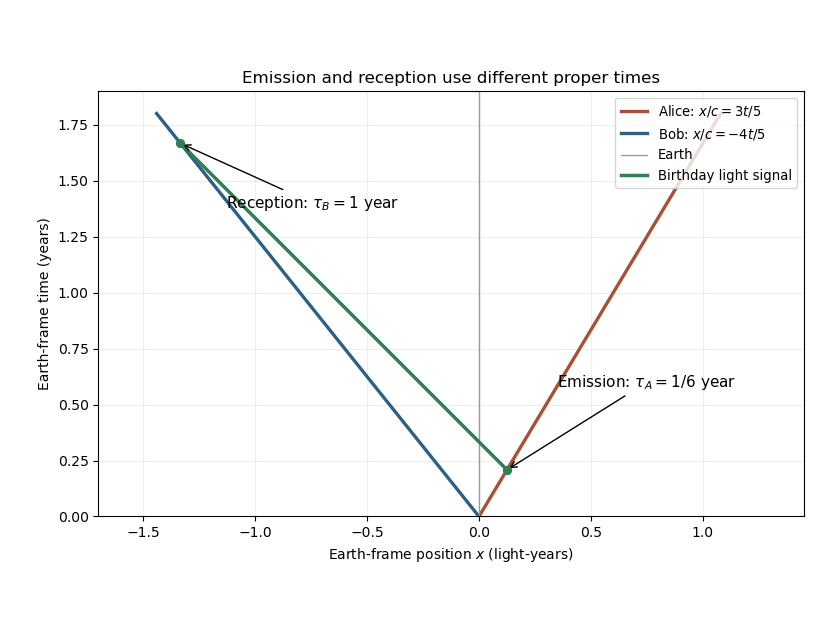
For the two ships, set launch time to zero and measure Earth time in years. Their Lorentz factors are and . Bob's thirtieth birthday occurs after one year of his proper time, so its Earth coordinates areIf Alice sends at Earth time , her position is . The left-going light signal obeys . Intersection with Bob givesAlice's elapsed proper time is thereforeShe sends two months after her twenty-ninth birthday. This compares the emission and reception events; the captains' clocks need only be synchronized at launch, not kept numerically synchronized afterward.

Twin paradox clock experiments 2026-10-14
The 1972 paper Around-the-World Atomic Clocks: Observed Relativistic Time Gains by J. C. Hafele and others reports four cesium-beam atomic clocks flown around the world in October 1971, eastward and westward. Their readings were compared with the U.S. Naval Observatory reference time scale before and after travel. An electronic time-interval counter resolved differences to the nearest nanosecond; intercomparisons among the flying clocks continued during travel. The final ensemble results were eastward and westward; the quoted spreads are standard deviations. These are corrected clock offsets, not raw readings or aircraft travel times. Four clocks allowed identification of individual rate changes through patterns in their mutual differences. The authors also report magnetic shielding and laboratory orientation checks. Their analysis could not detect a disturbance common to every flying clock, and the small ensemble limits statistical conclusions. This is a concrete reunited-clock experiment with apparatus, readout and drift controls.[ref]
Around-the-World Atomic Clocks: Observed Relativistic Time Gains by J. C. Hafele and others. pp. 168–170: Table 1, electronic counter, correlated rate-change analysis, magnetic shielding and common environmental effects
The companion paper Around-the-World Atomic Clocks: Predicted Relativistic Time Gains by J. C. Hafele and others computes eastward and westward from the recorded flight paths. These are predictions, with flight-data uncertainty estimates. Both time dilation from motion and gravitational time dilation matter: aircraft clocks at altitude experience a different gravitational potential, while the rotating Earth means a ground clock is not the inertial home clock of our simple model. Eastward and westward motion change the aircraft's velocity relative to an approximately nonrotating inertial frame, not merely its speed relative to the ground. The measured agreement therefore tests combined special relativity and general relativity; the westward gain does not contradict the maximum-proper time result for fixed endpoints in Minkowski spacetime.[ref]
A complementary microscopic test is Measurements of relativistic time dilatation for positive and negative muons in a circular orbit by J. Bailey and others. The authors measured muon decay lifetimes in a storage ring at Lorentz factor : for positive muons and for negative muons. The reported positive-muon lifetime agrees with the independently measured lifetime at rest and special relativity to a fractional error of at 95% confidence. This is a decay-lifetime readout under continuous centripetal acceleration, rather than a reunion of portable clocks. It supports the clock hypothesis for this physical process and regime; the inspected abstract does not establish universal immunity of every clock mechanism to acceleration. [ref]