An atomic clock uses an atomic transition as a frequency reference for an oscillator; counting its calibrated cycles realizes a time interval. In a passive beam implementation, the chemical atoms are repeatedly prepared, interrogated and detected, while feedback control corrects the continuously running oscillator. The Ramsey separated oscillatory fields experiment explains how internal quantum phase becomes a measurable population signal.
The SI second fixes the unperturbed ground state hyperfine structure transition frequency of caesium-133 to exactly . This is a defining value for the ideal transition, rather than a guarantee that an operating apparatus has no shifts.[ref]
SI base unit: second (s) by Bureau International des Poids et Mesures. SI base unit: second (s), defining paragraph and equivalent duration in periods of the unperturbed caesium-133 ground-state hyperfine transition
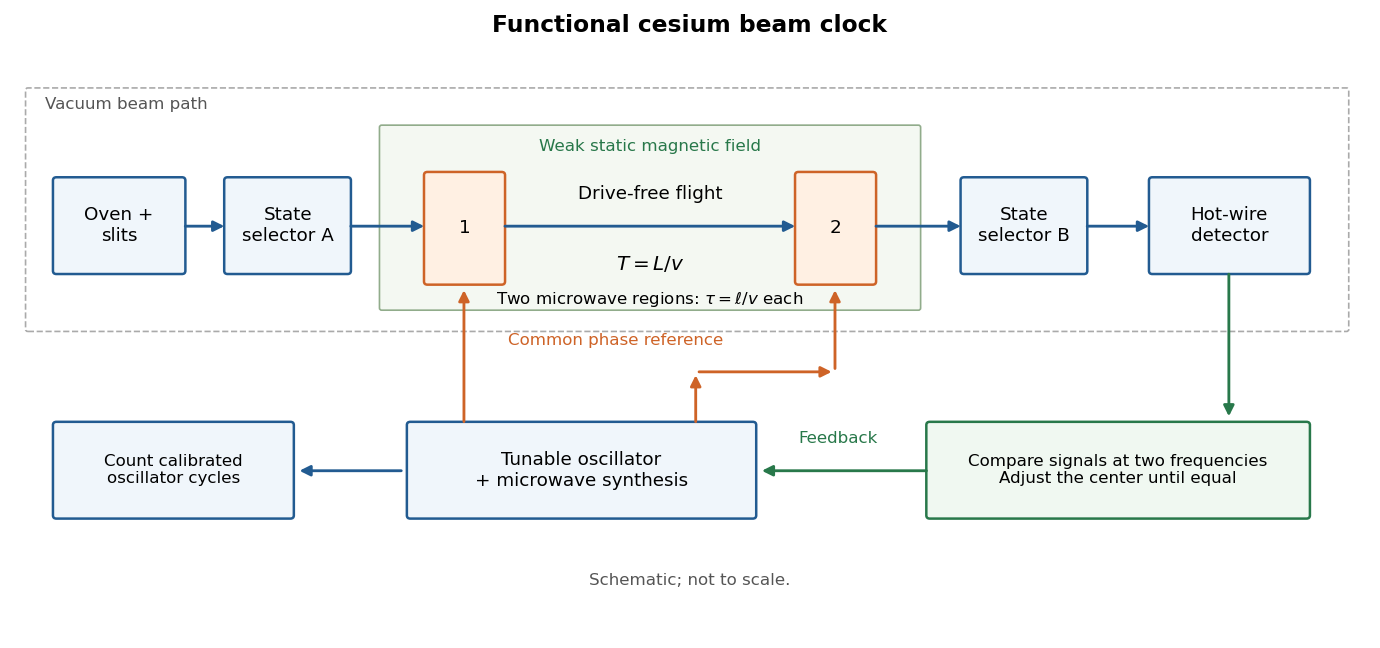
An oven supplies a collimated caesium beam. State-selecting magnets precede and follow two coherent microwave interaction regions; a weak static magnetic field separates sublevels. The clock transition connects and . Transferred atoms reach a heated ionizing collector. A detector scan identifies the resonance before locking.[ref]
The Physical Basis of Atomic Frequency Standards by A. S. Risley. April 1971 edition, §5.3, pp. 36–38, Fig. 7
Here labels the total angular momentum and its projection. The selected pair is a two-level system inside a larger set of atomic energy levels; treating every oven atom as a prepared qubit would overstate the preparation. A measured detector signal may be modeled as , with background and gain . Background subtraction and stable transmission are necessary before interpreting the signal as a transition probability. The velocity-averaged Ramsey line provides one explicit ideal example; its chosen dimensions are not historical specifications.
A peak has zero slope at its center, so a single peak-height reading does not tell feedback control which way to tune. Instead sample the two sides at ordinary frequencies , where is a chosen modulation offset, and subtract:For an even signal around the true center , write . A Taylor expansion gives . On the descending side of a positive central peak , so the update has restoring sign for and is locally stable in this ideal discrete update when . A detector dip requires the opposite sign. These conditions follow from linearizing the update, not from assuming any particular electronics.
For the ideal signal , choose . Then . With and , a center error of gives exact . The sign directs the update toward lower frequency. Constant background cancels, but background drift between samples or asymmetric neighboring spectral lines can bias the zero. An initial scan matters because other fringes can also supply zeros.
A narrow fringe makes the center easier to resolve statistically; it does not certify an unbiased frequency. For example, with ideal pulses and a second-pulse oscillation phase offset , the finite-pulse Ramsey transition probability approachesThis sign uses exactly the Rabi detuning convention and pulse Hamiltonian operator above, with the second pulse replacing by . The factor converts angular frequency to ordinary frequency. For the original example, rad and give a shift of about . For finite pulses or distributed flight times, use the full signal and its atomic clock frequency lock rather than inserting an unweighted mean .
NIST-7 used optical pumping and fluorescence. Controls included field-sensitive transitions, independent beam-speed measurements, microwave power stabilization, and beam reversal for cavity quantum phase errors.[ref]
Primary Atomic Frequency Standards at NIST by D. B. Sullivan and others. §2.2, pp. 50–52: optical readout and frequency-shift controls
The connection to special relativity is quantitative. A freely moving emitter's proper time advances more slowly than laboratory time by . With first-order propagation effects removed in the ideal comparison, its internal laboratory frequency is thereforeCorrecting an ensemble signal requires the effective velocity weights of preparation, interrogation and detection, not simply the oven's mean speed. Additional shifts from Zeeman splitting, unwanted light, collisions and cavity fields likewise require separate evaluation; feedback control locks to the observed line, including any uncorrected bias. Comparing clocks at different gravitational potentials additionally requires gravitational time dilation. The moving-clock experiments in twin paradox clock experiments compare calibrated clock readings along different world lines; the beam atoms' internal motion is part of the clock mechanism's own correction.
Articles by others on the same topic

An atomic clock is a highly precise timekeeping device that uses the vibrations of atoms to measure time. Unlike traditional clocks that rely on mechanical or quartz oscillations, atomic clocks use the natural frequencies of atoms, typically cesium or rubidium. ### Key Features of Atomic Clocks: 1. **Atomic Transitions**: Atomic clocks work by measuring microwave radiation emitted or absorbed by atoms transitioning between energy levels.


A similar model was used in the Hafele-Keating experiment to test special relativity on two planes flying in opposite directions. Miniaturization was key.
Contains a disposable tube with 6g of Caesium. You boil it, so when it runs out, you change the tube, 40k USD. Their tube is made by Agilent Technologies, so a replacement since that opened in 1999, and the original machine is from the 60s.
Detection is done with an electron multiplier.
youtu.be/eOti3kKWX-c?t=1166 They compare it with their 100 dollar GPS disciplined oscillator, since GPS satellites have atomic clocks in them.