A moving-coil galvanometer has a winding that rotates about an axis, a restoring spring, and a pointer or optical readout. In the radial-field construction, a cylindrical iron core and shaped magnetic poles keep the magnetic field approximately in the coil's plane as it turns. The resulting moving-coil galvanometer torque is nearly independent of the deflection angle; the spring then converts electric current into a proportional settled deflection. [ref]
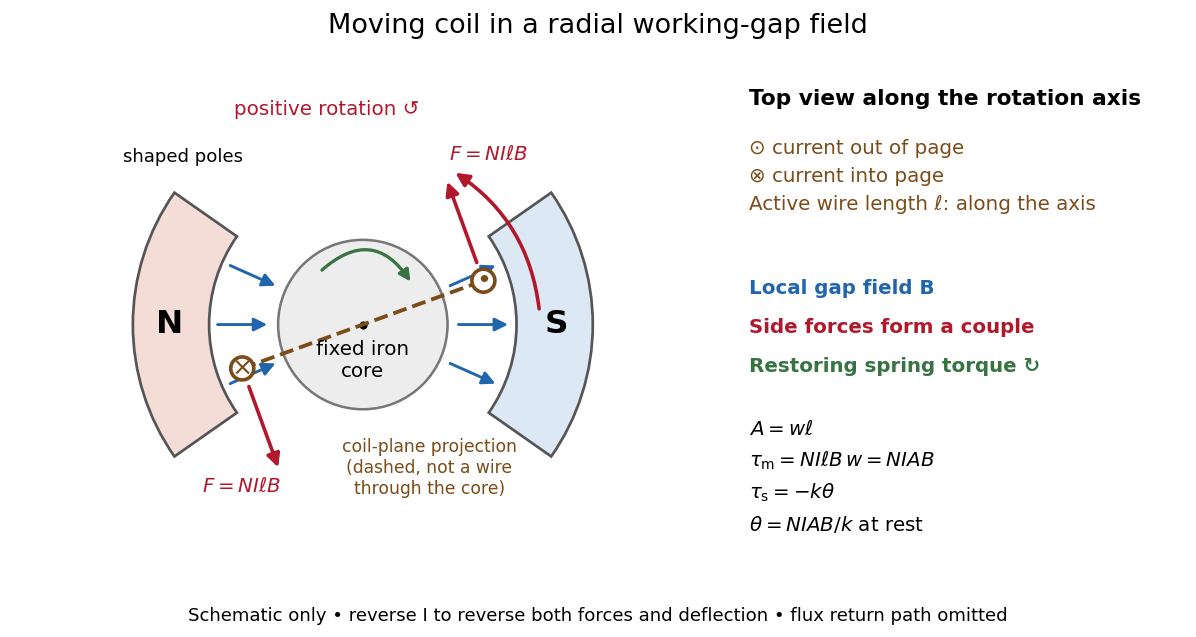
Figure 1.
Radial gap field and the force couple on a moving coil
. Original top-view schematic: the active wire lengths run perpendicular to the page. Dots indicate outward conventional current, crosses inward conventional current. Blue arrows show the local magnetic field; red arrows show the magnetic force on a current-carrying wire. Their force couple turns the coil counterclockwise for the illustrated positive electric current; the spring supplies the opposite torque. Only the working gaps are shown, not the complete magnetic field lines. Source. Details.

Articles by others on the same topic (NaN)

There are currently no matching articles.