Dividing two extensive quantities with the same replication factor produces an intensive quantity:Division by volume gives a density, such as mass density or energy density . Division by mass gives a specific quantity, such as specific internal energy or specific volume . Division by amount of substance gives a molar quantity, such as molar volume . Their units are respectively , , , and . The denominator must be stated: “per particle”, “per mole” and “per unit mass” are different normalizations.
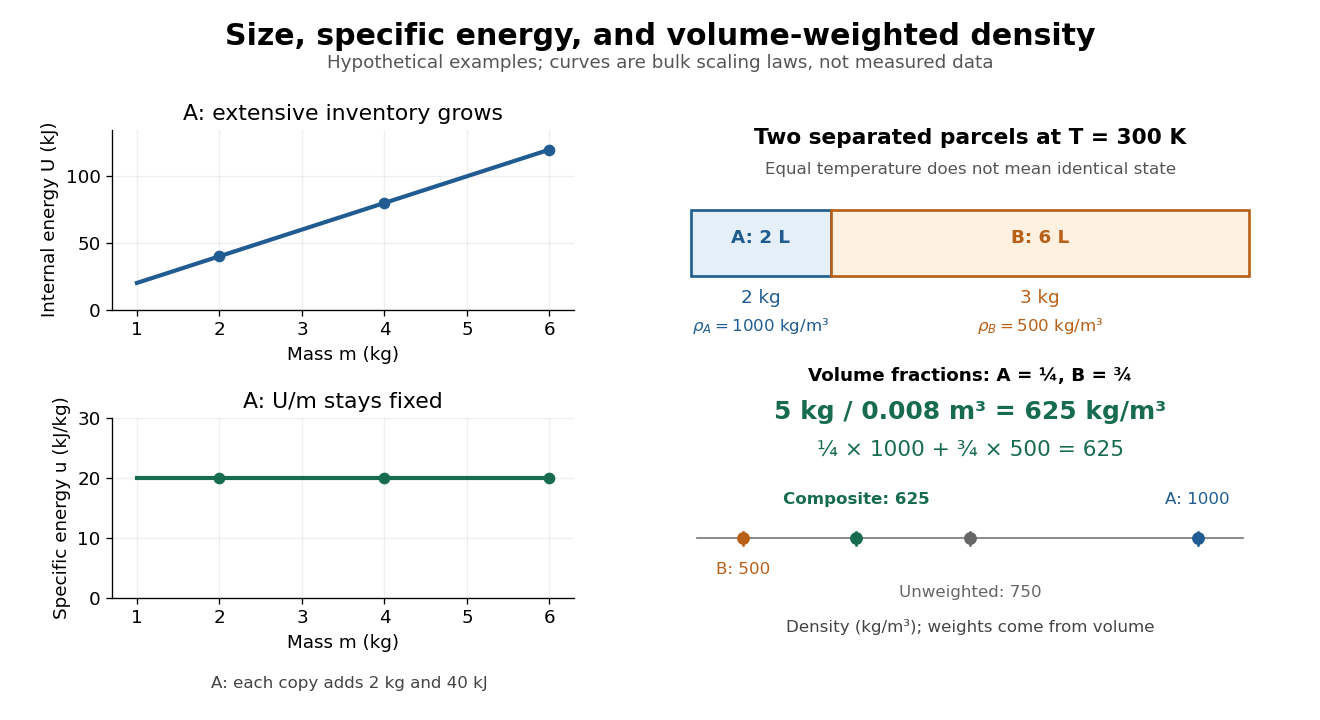
For a hypothetical uniform parcel with mass , volume and internal energy relative to a specified reference, and . Three independent copies have , and ; both ratios remain unchanged. This permits comparison of materials without confusing the amount tested with the state tested.
If and are additive but the parcels have different , their composite ratio is a weighted arithmetic mean:The denominator supplies the weights: specific internal energy uses mass weights, while mass density uses volume weights. This identity is accounting for the specified subsystems; predicting a new state after mixing also needs the relevant equation of state.

Articles by others on the same topic
There are currently no matching articles.