For identical particles, the particle exchange operator exchanges both spatial and spin labels. The symmetrization postulate requires a symmetric full state for bosons and an antisymmetric full state for fermions. A product must therefore have spatial and spin exchange eigenvalues whose product is or , respectively; a general state may be a sum of such products.
For orthonormal spatial orbitals , the combinations have opposite exchange parities. Two spin-one-half fermions combine with the antisymmetric spin-one-half singlet state , or with one of the three symmetric spin-one-half triplet states. Two particles in the same spatial orbital must be a spin singlet. This is the Pauli exclusion principle applied to complete spin orbitals, not a ban on sharing a spatial orbital with opposite spins.
A Slater determinant enforces fermionic antisymmetry for many occupied spin orbitals. Bosonic symmetrization instead uses a permanent; repeated orbital occupations are allowed. These exchange requirements apply even when particles do not interact.
A single-mode coherent state is an annihilation operator eigenstate:Its photon statistics are Poisson distribution: . For optical quadratures , , one has and . Its field mean oscillates classically while retaining vacuum fluctuations.[ref]
Topics in Quantum Mechanics by David Tong. §4.4.2, printed pp.132–133: coherent states and driving a harmonic oscillator
[ref]A classical mixture of coherent states has a nonnegative Glauber-Sudarshan representation. A nonclassical state of light cannot be represented that way. Examples are a squeezed vacuum state, with quadrature variances and , and a nonvacuum number state, with zero photon number variance. Noise below the vacuum level in one quadrature, sub-Poisson number noise, or photon antibunching can witness nonclassicality. For , ; coherent light has . Thermal light has excess noise but is a classical mixture: noncoherent does not by itself mean nonclassical.
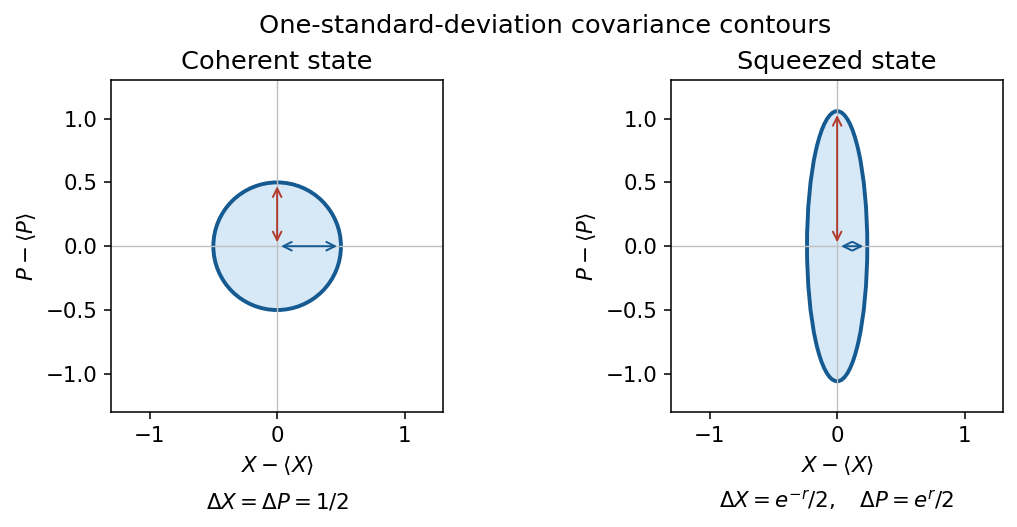
Coherent light has equal vacuum quadrature noise; squeezing reduces one variance and increases the other
. Source. Details. 
The Stark effect changes atomic energy levels in a static electric field. For , the electric-dipole interaction is for an electron, with . A nondegenerate state of definite parity has , so its leading quadratic Stark effect isThe ground state shift is negative, conventionally with positive electric polarizability.[ref]
Degenerate opposite-parity states require degenerate perturbation theory. In ideal Coulomb hydrogen, the subspace has an off-diagonal matrix element of magnitude , where is the Bohr radius. Its mixed states shift byThis Linear Stark effect in the first excited hydrogen eigenspace assumes fine-structure and Lamb splittings are negligible compared with the mixing. In an isolated parity eigenstate with such degeneracies resolved, sufficiently weak fields restore quadratic behaviour. Strong fields require further mixing and can ionize the atom.[ref]
Articles by others on the same topic
There are currently no matching articles.