Put . Angular momentum addition gives , and the spin-dot-product eigenvalue isThus the spin-three-halves pair spectrum isFor identical fermions, exchange parity of two coupled identical spins makes spin-antisymmetric and spin-symmetric. Corresponding spatial exchange symmetries make the full state antisymmetric; without a specified spatial state, none of these total-spin sectors is excluded.
Adjacent nodes of a wavefunction are separated by roughly , so a locally sinusoidal wavefunction has typical wavevector . The kinetic-energy estimate from wavefunction nodes is thereforeEquivalently, . The robust scaling is ; the precise coefficient depends on how the extent is defined and how the oscillations vary near classical turning points. For few nodes, use an order-one offset to : the nodeless ground state still has confinement energy bound from position support of order , rather than zero.
Centre the infinite square well at zero. Its ground state wavefunction is inside the well and zero outside. The momentum representation in quantum mechanics gives the wavevector amplitudeConsequently the unnormalised wavevector distribution of an infinite-well ground state isThe apparent singularities at are removable. The normalized probability density is times the boxed expression and has limit there. Translating the well changes only the Fourier transform's phase. The wavevector is continuously distributed; a box energy eigenstate is not a free momentum eigenstate.
For identical particles, the particle exchange operator exchanges both spatial and spin labels. The symmetrization postulate requires a symmetric full state for bosons and an antisymmetric full state for fermions. A product must therefore have spatial and spin exchange eigenvalues whose product is or , respectively; a general state may be a sum of such products.
For orthonormal spatial orbitals , the combinations have opposite exchange parities. Two spin-one-half fermions combine with the antisymmetric spin-one-half singlet state , or with one of the three symmetric spin-one-half triplet states. Two particles in the same spatial orbital must be a spin singlet. This is the Pauli exclusion principle applied to complete spin orbitals, not a ban on sharing a spatial orbital with opposite spins.
A Slater determinant enforces fermionic antisymmetry for many occupied spin orbitals. Bosonic symmetrization instead uses a permanent; repeated orbital occupations are allowed. These exchange requirements apply even when particles do not interact.
A single-mode coherent state is an annihilation operator eigenstate:Its photon statistics are Poisson distribution: . For optical quadratures , , one has and . Its field mean oscillates classically while retaining vacuum fluctuations.[ref]
Topics in Quantum Mechanics by David Tong. §4.4.2, printed pp.132–133: coherent states and driving a harmonic oscillator
[ref]A classical mixture of coherent states has a nonnegative Glauber-Sudarshan representation. A nonclassical state of light cannot be represented that way. Examples are a squeezed vacuum state, with quadrature variances and , and a nonvacuum number state, with zero photon number variance. Noise below the vacuum level in one quadrature, sub-Poisson number noise, or photon antibunching can witness nonclassicality. For , ; coherent light has . Thermal light has excess noise but is a classical mixture: noncoherent does not by itself mean nonclassical.
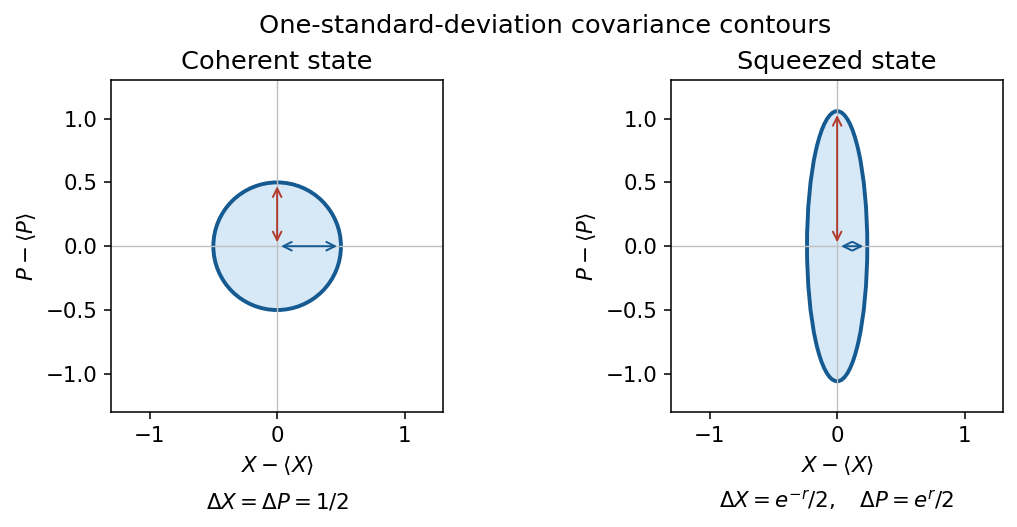
Coherent light has equal vacuum quadrature noise; squeezing reduces one variance and increases the other
. Source. Details. 
The Stark effect changes atomic energy levels in a static electric field. For , the electric-dipole interaction is for an electron, with . A nondegenerate state of definite parity has , so its leading quadratic Stark effect isThe ground state shift is negative, conventionally with positive electric polarizability.[ref]
Degenerate opposite-parity states require degenerate perturbation theory. In ideal Coulomb hydrogen, the subspace has an off-diagonal matrix element of magnitude , where is the Bohr radius. Its mixed states shift byThis Linear Stark effect in the first excited hydrogen eigenspace assumes fine-structure and Lamb splittings are negligible compared with the mixing. In an isolated parity eigenstate with such degeneracies resolved, sufficiently weak fields restore quadratic behaviour. Strong fields require further mixing and can ionize the atom.[ref]
With and oscillator length , the first two harmonic oscillator eigenfunctions and energies areThe ground state is even and nodeless; the first excited state is odd with one node of a wavefunction. Their rms widths are and . Also, gives the characteristic extent directly.
For the shaken harmonic trap, expanding about the unshifted Hamiltonian givesThe scalar term gives only a common phase and no transitions. In time-dependent perturbation theory, initially , and the oscillatory factor for is . ThusThe odd operator makes transitions to even vanish by parity. In fact the first-order selection rule for a linearly driven oscillator is stronger: since ,All excited amplitudes vanish at first order, including odd . This assertion does not apply to the surviving or to higher perturbative orders.
Put , . The exact first-order time integral isNear resonance, the second term oscillates rapidly at approximately and is bounded by , whereas the first grows as on resonance. Thus justifies the rotating-wave approximation, . At zeros of the resonant term, the omitted small contribution can dominate the residual; the approximation has no uniform relative-error bound there.
Using the requested order-one approximation and gives the square-pulse resonance profileThe exact harmonic oscillator matrix element instead gives half this probability. The finite central maximum is at ; first zeros are at , with smaller side lobes and a envelope. Increasing narrows the peak as and increases its height as , as long as weak resonant driving keeps . Small displacement alone does not ensure this for arbitrarily long ; near resonance one also needs .
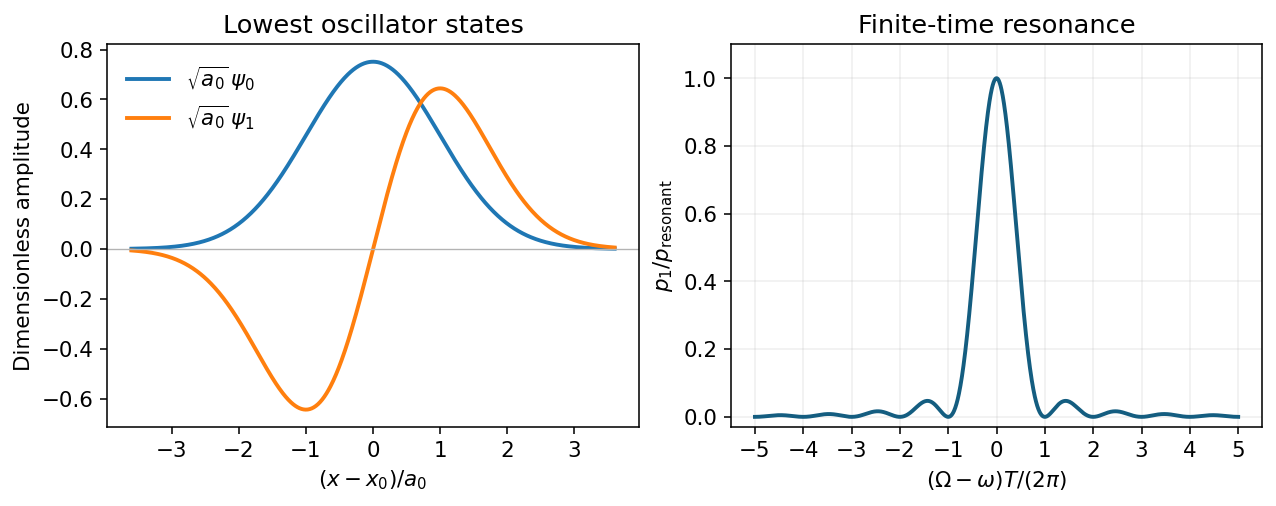
Even and odd oscillator wavefunctions and the finite-duration sinc-squared excitation profile
. Source. Details. 
Define and use radiation energy density per unit angular frequency, excluding the zero-point contribution. The Angular-frequency Einstein coefficients give rates per atom: for absorption, for stimulated emission, and for spontaneous emission. Stimulated emission adds a photon to the stimulating mode; spontaneous emission persists with no incident photons.
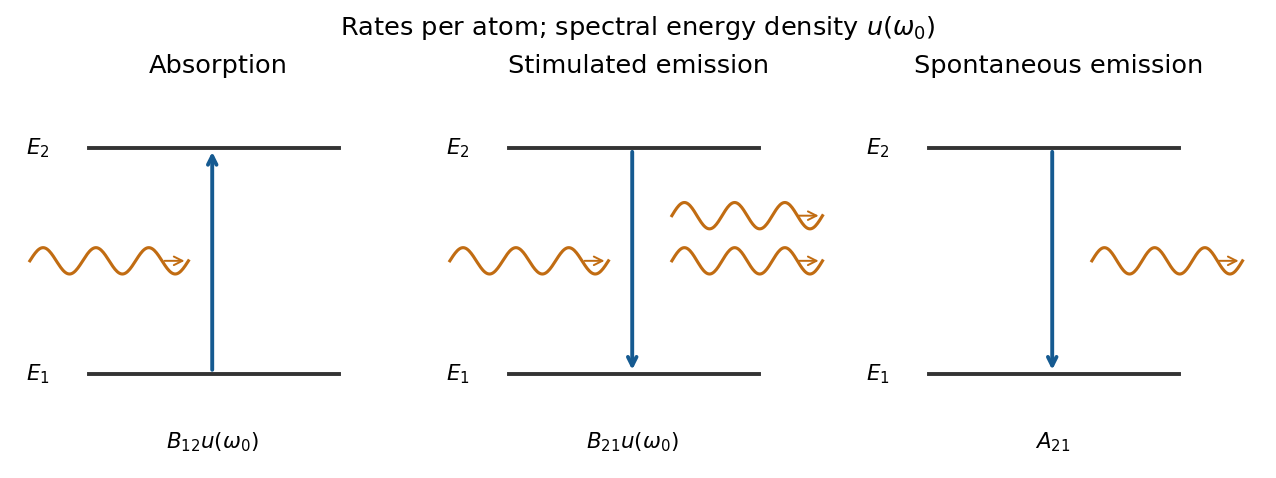
Absorption, stimulated emission and spontaneous emission between two nondegenerate levels
. Source. Details. 
In thermal equilibrium the Boltzmann distribution gives . Balancing up and down rates yieldsMatching the Planck law for every temperature fixesNo degeneracy factor is needed for these nondegenerate levels.[ref]
Topics in Quantum Mechanics by David Tong. §4.3.2, printed pp.123–127: thermal balance and Einstein coefficients
For plates of large area and spacing , the surviving low-frequency transverse electromagnetic mode has one polarization, , and in-plane wavevector. Periodic in-plane counting givesMultiplying this single-polarization two-dimensional photon density of states by and the Bose-Einstein distribution produces the thermal radiation between parallel conducting plates:The same rate balance therefore givesThese coefficients refer to the radiation polarization in their respective environments: isotropic free-space must not automatically be equated to the coefficient for a specified -polarized field.
For hydrogen, take the quantization axis along , neglect spin-orbit coupling, and assume perfect plates, a wide in-plane region and an unmodified atomic wavefunction: , with negligible surface-induced mixing or shifts. The electric-dipole selection rules for hydrogen require ; the allowed field has . Hence the polarization-selective spontaneous emission between conducting plates givesThe thin-cavity enhancement of a normal electric dipole applies: the dipole points along and couples to the enhanced mode density. For , the transition dipoles lie in the – plane and couple to none of these low-frequency modes: the electric-dipole decay rate is zero in the ideal model, so this channel's lifetime is infinite. Real finite, imperfect plates and additional decay or mixing channels limit the lifetime. The order-one orientation factor for the allowed transition does not change the requested lifetime scaling.
Articles by others on the same topic
There are currently no matching articles.