A stellar wind removes mass and carries energy and angular momentum from a star into its surroundings. Hot gas can escape through thermal pressure; radiation transfers momentum through continuum or spectral-line absorption, and radiation acting on dust can drive surrounding gas. Magnetic stresses can extract rotational energy and angular momentum. These mechanisms have different dependencies on heating, opacity, stellar luminosity and field geometry.
For a steady spherical isothermal pressure-driven model, mass conservation gives . With and constant isothermal sound speed , the radial Euler equation becomes the Parker wind equationA smooth transonic flow solution crosses at . Its inner subsonic atmosphere connects to a supersonic outflow; continuing heat input is needed to keep that expanding wind isothermal. Other boundary pressures can select a breeze rather than this escaping branch, and the mass-loss rate needs boundary/heating information. A polytropic outflow instead converts finite enthalpy into escape energy and has a different terminal budget.
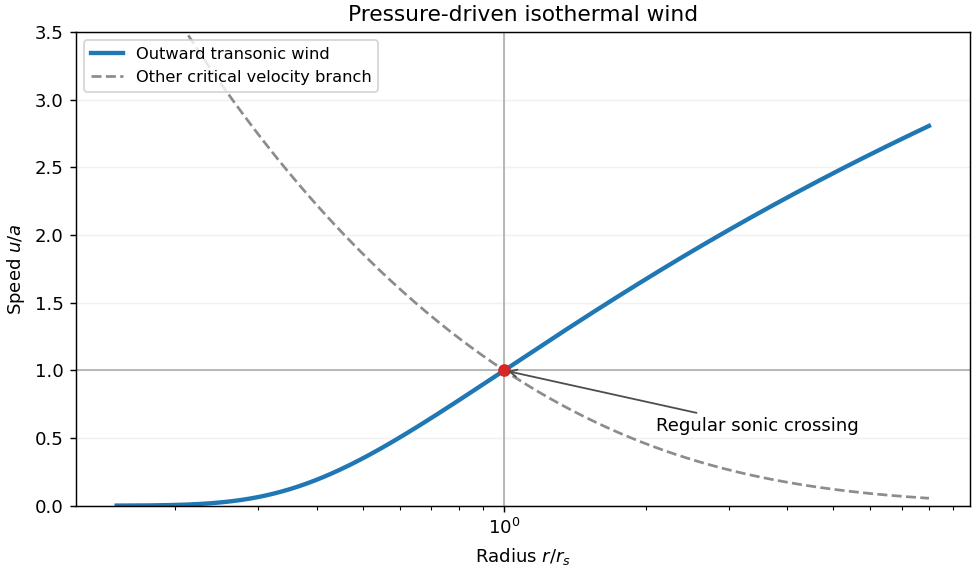

The solar wind supplies a nearby plasma example. Spectral-line Doppler shifts and profiles diagnose more distant winds; blueshifted absorption against stellar light indicates material moving toward the observer. Inference of a mass-loss rate additionally needs density, ionization, geometry and velocity information, rather than a line shift alone.
Articles by others on the same topic
There are currently no matching articles.