For a uniform sphere, and its gravitational potential energy is . The ideal-gas kinetic energy is . Equating these magnitudes using the virial theorem gives . Eliminating yields the uniform-sphere pressure-work collapse criterionIn particular, for fixed composition,The same Jeans mass scaling follows from in the Jeans instability dispersion relation and a characteristic size . Pressure communicates support in a sound-crossing time; sufficiently strong self-gravity wins when the gravitational time is shorter.
The numerical coefficient depends on the equilibrium, boundary and wavelength-to-cloud conventions. A sphere with both exactly uniform density and uniform temperature is not an exact hydrostatic self-gravitating ideal-gas equilibrium without additional stresses. The uniform-sphere argument establishes the characteristic mass scaling; it does not prove an exact stability boundary for that nonexistent equilibrium.
Let be net cooling per unit volume, positive when energy is lost. At thermal equilibrium . For a slow perturbation that maintains pressure balance, the linearized thermal equation isThe heat capacity factor is positive. A positive derivative restores equilibrium: hotter gas cools more strongly, while cooler gas is heated. This is isobaric thermal stability of a heated ideal gas.
For fully ionized hydrogen, both protons and electrons contribute to the ideal gas law, so . Treat the stated constant heat input as a fixed heating rate per unit volume. Substituting into the cooling givesAt equilibrium , its derivative isWith a temperature-independent recombination coefficient, the derivative is : the equilibrium is thermally unstable to isobaric perturbations. More generally, any nonincreasing also gives instability; stability requires its logarithmic slope to exceed one. Heating at fixed volume and pressure-balanced perturbations are distinct assumptions: the density falls as a parcel is heated, reducing the quadratic-density cooling.
No temperature law for is supplied, so the displayed slope criterion states the general result without inventing one. A constant incident ultraviolet flux need not imply constant local volumetric heating in a self-consistent ionization-balance calculation. If the heating instead varies with density, temperature or neutral fraction, its derivative must be included; the conclusion here uses the explicit constant- model.
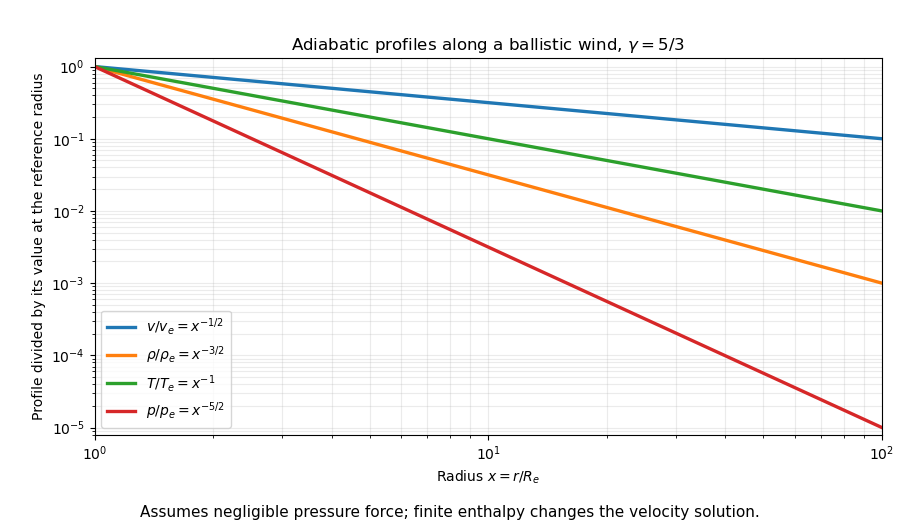
In the stated gravity-dominated approximation, neglect the pressure force in the radial momentum equation. A steady outward stellar wind then obeysAt , the escape velocity is , so . The ballistic marginal-escape stellar wind hasThe outward flow decelerates and approaches zero speed at infinity; it is exactly at the escape threshold in this pressure-negligible model. An initial speed above that threshold gives a nonzero asymptotic speed.
Adiabaticity alone would instead conserve the full Bernoulli equation . If finite pressure is retained and equals the mechanical escape speed, then , not zero. With and conservation of mass, the more general implicit solution isIt needs and in addition to the escape-speed datum. The boxed explicit power law is the leading gravity-dominated result, not an exact solution for an arbitrary warm adiabatic wind.
For a steady spherical wind, conservation of mass givesThusHere denotes the given number density at the escape radius, rather than electron density; the composition is atomic hydrogen. The reference speed is . This boundary flux remains fixed even if pressure changes the subsequent radial velocity profile.
Insert the pressure-negligible velocity law into the steady spherical mass flux. With ,An adiabatic equation of state and the ideal gas law giveFor a monatomic gas with ,The normalization , and hence , was not specified and remains a boundary parameter. If it is large enough for the pressure gradient to affect acceleration, replace the ballistic velocity by the full adiabatic Bernoulli equation solution. The general mass-flux and thermodynamic relations still hold, but these particular radius powers then need not hold.

Articles by others on the same topic
There are currently no matching articles.