Original public paper: Physical PDF pages 351–354. All questions and all optional notes are covered. The spherical accretion estimate and pressure-negligible wind approximation are stated explicitly; neither follows from steadiness or adiabaticity alone.
For a steady, spherically symmetric radial inflow, conservation of mass makes the mass accretion rate independent of radius:Atomic hydrogen gives . The Newtonian free-fall speed from rest at infinity is , obtained by setting the specific mechanical energy to zero. Hence the spherical free-fall accretion rate isUsing the given values gives , , andThe area factor assumes a full spherical inflow with negligible angular momentum. With only a local number density and speed, an arbitrary nonspherical inflow's total rate is not fixed; one instead integrates over the inflow surface. This is a flux estimate, rather than the pressure-selected Bondi accretion solution.
Let all velocity amplitudes refer to the same positive normal direction, from medium 1 into medium 2. For a right-going linear sound wave, its pressure amplitude is with acoustic impedance ; for a left-going wave it is . Continuity of normal velocity and pressure at the interface givesEliminating yields the normal-incidence acoustic velocity reflection coefficientThe common adiabatic index and mean particle mass give , soA negative coefficient reverses the reflected velocity perturbation's phase in this fixed coordinate system. The reflected pressure coefficient has the opposite sign. Pressure balance also gives , so the impedance ratio can equivalently be written . These are normal-incidence, small-amplitude results without a surface mass or tension.
Work in an inertial centre of mass frame and write . Differentiation and Newton's second law giveThe pairwise Newtonian gravitational potential energy isFor each pair, combining the two force contributions gives . Therefore , andFor a stationary configuration, or after a long-time average of a bounded system whose endpoint term vanishes, the virial theorem givesThe brackets may be suppressed when denote equilibrium averages. A collapsing cloud or an eccentric Kepler orbit need not obey instantaneously. Confining surface pressure, magnetic stress or other external forces add their own virial terms; the displayed result concerns an isolated gravitational particle system.
A uniform conducting fluid supports three propagating magnetohydrodynamic wave branches. Ideal magnetohydrodynamics couples fluid velocity to the magnetic field through the induction equation; the Lorentz force then supplies magnetic tension and magnetic pressure restoring forces. Let be the angle between wave vector and background field , and define Alfvén speed and adiabatic sound speed .
The shear Alfvén wave hasIts velocity perturbation is perpendicular to both and . It bends field lines without first-order compression, so magnetic tension is the restoring force. Its group velocity follows the background field; the displayed phase speed along is not the full group speed.
The fast magnetosonic wave and slow magnetosonic wave involve coupled compression and magnetic perturbations, with displacement in the plane of :The plus sign is the fast branch. Parallel propagation gives characteristic speeds ; perpendicular propagation gives fast speed while the other two phase frequencies vanish. Degenerate directions require care in assigning polarizations, rather than claiming three distinct nonzero frequencies everywhere.
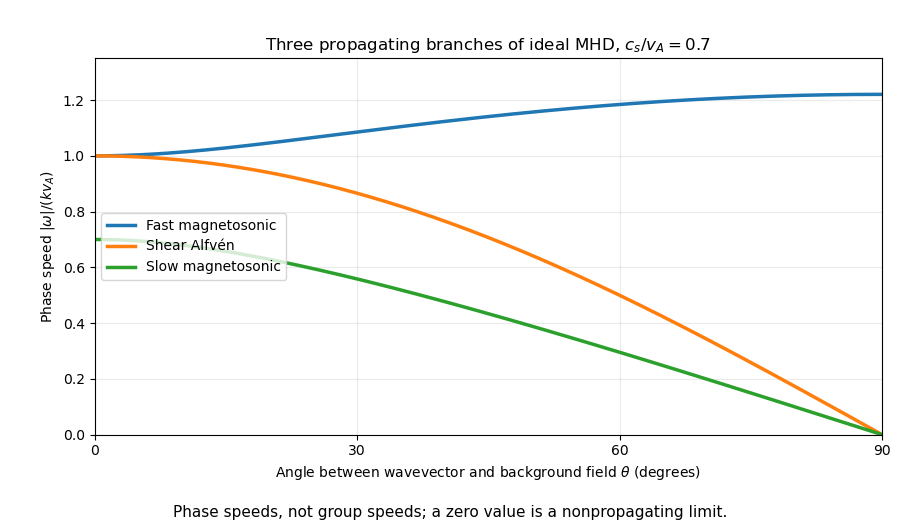
Angular dependence of the three ideal magnetohydrodynamic phase speeds
. Original homogeneous ideal-fluid calculation for sound speed 0.7 times the Alfvén speed. The curves are phase speeds and do not depict group-velocity rays. Details.
These waves transport energy and momentum through magnetized stellar atmospheres and astrophysical plasmas. Their restoring mechanisms distinguish them from ordinary acoustic waves. Resistivity, viscosity, ion-neutral friction and kinetic effects introduce damping or change the model; an ideal undamped dispersion relation alone does not calculate coronal heating.
For steady inviscid motion of a barotropic fluid in a conservative gravitational potential , the Euler equations for an inviscid fluid imply the Bernoulli equationalong each streamline. The barotropic enthalpy function has units of energy per unit mass. For an isentropic ideal gas, gives up to an additive constant. For constant density, the corresponding term is . Pressure work converts between kinetic, enthalpy and gravitational energy.
A converging subsonic nozzle can accelerate a fluid at the expense of its enthalpy; in the incompressible horizontal approximation, higher speed accompanies lower static pressure. Together with conservation of mass, this explains a Venturi effect measurement. Compressible nozzle flow additionally needs its equation of state and sonic conditions. In a stellar wind, the potential term is , so enthalpy or mechanical energy can be spent escaping gravity. A pressure-negligible marginal-escape wind has .
The constant need not be the same on different streamlines. Irrotational barotropic flow in a connected region gives a common value; a general rotational flow does not. A pump, viscosity, a radiating shock, or heat addition changes the relevant energy balance. In particular, adiabaticity alone does not allow one to drop the enthalpy term.
Hydrostatic equilibrium and dimensional scaling give characteristic stellar pressure and mass density . For a fixed-index stellar polytrope with , eliminating density gives the polytropic mass-radius relationThe dimensionless coefficient is determined by the corresponding Lane-Emden equation and boundary conditions. Both the index and must be held fixed to infer this mass dependence.
Nonrelativistic electron degeneracy has , hence for cold fixed-composition white dwarfs: adding mass makes the object smaller. Relativistic electron degeneracy approaches ; the mass scale becomes proportional to independently of the radius, giving the ideal Chandrasekhar limit. The limiting model signals loss of the ordinary stable cold sequence; it does not determine a unique radius at that mass.
For a gas-pressure-supported star, the virial theorem instead gives characteristic temperature . Specifying a common characteristic temperature gives , but stellar temperatures are not generally identical. A main-sequence star also requires nuclear energy generation and radiative or convective transport. Consequently there is no universal mass-radius exponent applicable to every main-sequence mass and composition. An isentropic convective model and a cold degeneracy-supported model can share index while having quite different physical meanings and values of .
The Rankine-Hugoniot conditions for a perfect gas express conservation of mass flux, normal momentum flux, and total energy flux through a steady planar shock wave in its rest frame. With mass flux , momentum flux is and specific transported energy is . The last term is pressure work, so the energy equation contains specific enthalpy rather than only specific internal energy. Neglect gravity across the thin front, magnetic stresses and radiative energy loss for the adiabatic case.
For a calorically perfect ideal gas, and . ThereforePut , so . Momentum conservation givesInsert this and into the energy equation. After multiplying out, its two factors areThe first root is the unchanged flow. The compressive shock branch isIt has for upstream supersonic flow. A strong shock approaches : four for a monatomic gas, or six for a fixed rotationally excited diatomic gas with . The assumed fixed heat capacity ceases to describe the gas when dissociation or ionization becomes important. Adiabatic here means no net heat lost from the shock-plus-flow energy budget; the irreversible front still increases entropy.
For an isothermal shock of unchanged composition, let be the common isothermal sound speed squared. Mass and momentum conservation giveThe compressive branch is thereforeUnlike the adiabatic ratio, it has no fixed upper bound as its upstream Mach number grows. Heat removal prevents the pressure increase that would otherwise resist compression. This approximation describes an efficiently cooled jump between equal-temperature far states, not an adiabatic shock with its energy equation left unchanged. For the same upstream physical temperature and velocity, ; the two sound-speed conventions must not be confused.
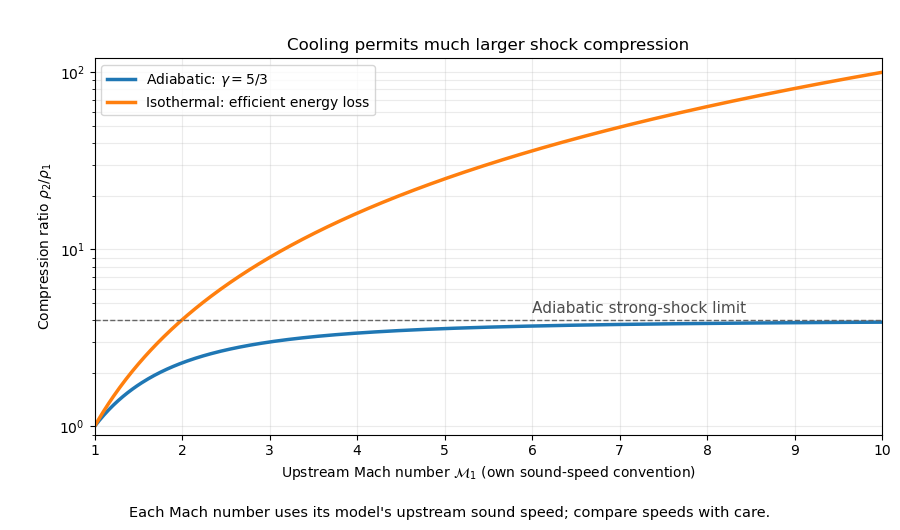
Bounded adiabatic compression and increasing isothermal compression
. Original comparison for fixed composition. The horizontal Mach coordinate uses each model's own upstream sound speed, so equal plotted Mach numbers do not mean identical upstream temperatures and velocities. Details.
Full dissociation changes the equation of state even when the temperature is held constant. With negligible electron and binding-energy mass corrections, upstream molecular hydrogen has and downstream atomic hydrogen has . The conserved quantity is mass flux; particle number flux doubles. ThusEquivalently, the dissociating isothermal shock relation between temperature and the two velocities isWriting givesThe high-compression branch isIts strong-shock limit is , rather than . The pressure per unit mass has doubled, reducing the compression available at a fixed upstream temperature and speed. A real compressive branch in this prescribed fully dissociated, equal-temperature model requires ; the high root has downstream speed no greater than the downstream isothermal sound speed. These mass and momentum conditions do not themselves establish that sufficient energy is available to dissociate every molecule. The chemical energy and any required radiative loss must also be included in a physical energy budget.
For a uniform sphere, and its gravitational potential energy is . The ideal-gas kinetic energy is . Equating these magnitudes using the virial theorem gives . Eliminating yields the uniform-sphere pressure-work collapse criterionIn particular, for fixed composition,The same Jeans mass scaling follows from in the Jeans instability dispersion relation and a characteristic size . Pressure communicates support in a sound-crossing time; sufficiently strong self-gravity wins when the gravitational time is shorter.
The numerical coefficient depends on the equilibrium, boundary and wavelength-to-cloud conventions. A sphere with both exactly uniform density and uniform temperature is not an exact hydrostatic self-gravitating ideal-gas equilibrium without additional stresses. The uniform-sphere argument establishes the characteristic mass scaling; it does not prove an exact stability boundary for that nonexistent equilibrium.
Let be net cooling per unit volume, positive when energy is lost. At thermal equilibrium . For a slow perturbation that maintains pressure balance, the linearized thermal equation isThe heat capacity factor is positive. A positive derivative restores equilibrium: hotter gas cools more strongly, while cooler gas is heated. This is isobaric thermal stability of a heated ideal gas.
For fully ionized hydrogen, both protons and electrons contribute to the ideal gas law, so . Treat the stated constant heat input as a fixed heating rate per unit volume. Substituting into the cooling givesAt equilibrium , its derivative isWith a temperature-independent recombination coefficient, the derivative is : the equilibrium is thermally unstable to isobaric perturbations. More generally, any nonincreasing also gives instability; stability requires its logarithmic slope to exceed one. Heating at fixed volume and pressure-balanced perturbations are distinct assumptions: the density falls as a parcel is heated, reducing the quadratic-density cooling.
No temperature law for is supplied, so the displayed slope criterion states the general result without inventing one. A constant incident ultraviolet flux need not imply constant local volumetric heating in a self-consistent ionization-balance calculation. If the heating instead varies with density, temperature or neutral fraction, its derivative must be included; the conclusion here uses the explicit constant- model.
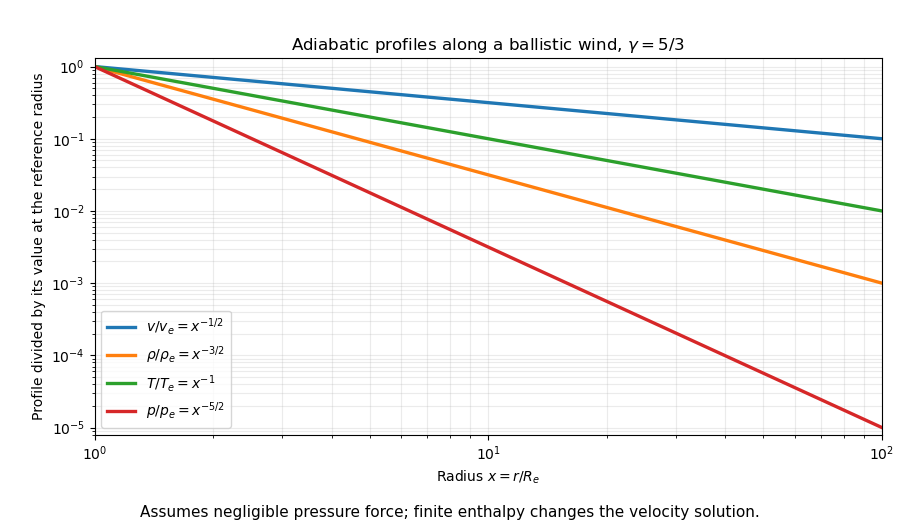
In the stated gravity-dominated approximation, neglect the pressure force in the radial momentum equation. A steady outward stellar wind then obeysAt , the escape velocity is , so . The ballistic marginal-escape stellar wind hasThe outward flow decelerates and approaches zero speed at infinity; it is exactly at the escape threshold in this pressure-negligible model. An initial speed above that threshold gives a nonzero asymptotic speed.
Adiabaticity alone would instead conserve the full Bernoulli equation . If finite pressure is retained and equals the mechanical escape speed, then , not zero. With and conservation of mass, the more general implicit solution isIt needs and in addition to the escape-speed datum. The boxed explicit power law is the leading gravity-dominated result, not an exact solution for an arbitrary warm adiabatic wind.
For a steady spherical wind, conservation of mass givesThusHere denotes the given number density at the escape radius, rather than electron density; the composition is atomic hydrogen. The reference speed is . This boundary flux remains fixed even if pressure changes the subsequent radial velocity profile.
Insert the pressure-negligible velocity law into the steady spherical mass flux. With ,An adiabatic equation of state and the ideal gas law giveFor a monatomic gas with ,The normalization , and hence , was not specified and remains a boundary parameter. If it is large enough for the pressure gradient to affect acceleration, replace the ballistic velocity by the full adiabatic Bernoulli equation solution. The general mass-flux and thermodynamic relations still hold, but these particular radius powers then need not hold.

Articles by others on the same topic
There are currently no matching articles.