The printed magnetic dipole moment uses dimensionless angular momentum operators: their physical counterparts are and . Choose the magnetic field along . Then the Zeeman energy is , whose characteristic size is . In LS coupling, treating this as a time-independent perturbation theory requires it to be much smaller than the relevant fine structure separation, rather than merely smaller than the Coulomb interaction energy.
For a concrete hydrogen atom estimate take the pair. The hydrogen fine-structure correction iswhere is the fine-structure constant, distinguished from the later potential coefficient. ThusConsequently a suitable weak-magnetic field condition for this pair isThere is no single threshold for every hydrogen energy level: the relevant fine structure separations decrease with . The energy level has no same- spin-orbit interaction partner, so it cannot itself define this comparison. This calculation neglects hyperfine structure; resolving that smaller scale requires an additional weak-magnetic field condition.
Within a fixed angular momentum multiplet, the component of along follows from . The corresponding result for follows by interchanging and . For the quantum state ,These are dimensionless expectation values in the convention of part (a). Substituting into the first-order time-independent perturbation theory formula givesFor , the Landé g-factor becomesThe magnetic sublevels must first be diagonalized within a degenerate multiplet; choosing along the magnetic field already does this. For the displayed fraction is undefined, but all vector expectation values vanish and there is no first-order Zeeman splitting. A higher-order shift may remain.
Write and retain the nuclear Coulomb potential. In spherical coordinates, the total potential energy iswhen ; is a Legendre polynomial. Treat the added term using quadratic anisotropic perturbation of hydrogen and degenerate perturbation theory in the hydrogen energy eigenbasis. It preserves parity and , so it cannot mix with , or distinct magnetic sublevels.
For a hydrogen atom, the hydrogen radial second moment givesThe angular expectation values of are for an orbital, for , and for , obtained by integrating the squared spherical harmonics. Therefore the five lowest spatial quantum states, counting statistical weight, have first-order energy levelsEach spatial quantum state has two electron spin states when spin-orbit coupling and the magnetic field are omitted. Thus these are five spatial states but only three distinct first-order energies; five distinct energies would be an incorrect reading. The accidental equality can be lifted at higher order. Quantitatively the added shifts must also be small compared with neighboring principal-shell gaps; is an asymptotic condition, not a guarantee for arbitrary large .
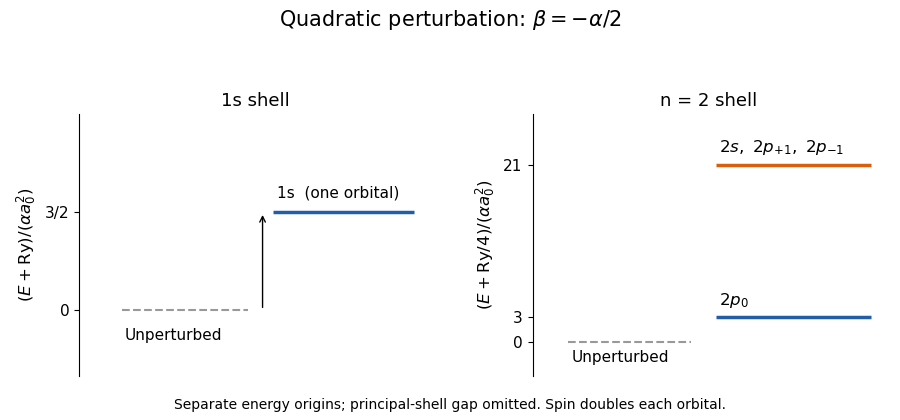
First-order spatial levels of locally perturbed hydrogen; the gap between principal shells is compressed
. Details. 
For general , the expectation value isIt does not cancel every order. At , couples to orbitals. For example its angular matrix element with is , and the radial matrix element is nonzero. The second-order nondegenerate perturbation theory sum has negative denominators, so this is a concrete nonzero higher-order contribution.
There is also a global limitation: for either negative above, . A localized wavepacket translated far along has fixed kinetic energy but arbitrarily negative potential energy, proving there is no true lowest energy level. The results describe local perturbative resonance poles, or a potential completed to a confining form far from the atomic nucleus. No globally exact ground-state cancellation exists for the potential as printed.
Neglect hyperfine structure, spin-orbit coupling and the diamagnetic term, and set , . The Zeeman energy is . The electron spin is free, so every spatial result below is duplicated with an added .
For a magnetic field parallel to , the old magnetic quantum number remains good and the first-order energy levels areThe two orbitals have zero orbital angular momentum, so only their electron spin contributes at this order.
For a magnetic field parallel to , the expectation of in each individual orbital vanishes. One must still check the degenerate subspace: its projected is zero as well. Thus there is no first-order orbital splitting in a sufficiently weak transverse magnetic field. Spin still contributes .
The transverse orbital Zeeman mixing can be seen without assuming its size. Put , , and . In the real orbital basis, is unaffected while have off-diagonal matrix elements of modulus . Diagonalizing this two-dimensional Hamiltonian gives the spatial energy eigenvaluesWhen , their shifts relative to the earlier levels are , with added for electron spin. The displayed square-root expression also handles comparable to , provided coupling to other principal shells stays negligible. The orbital retains zero orbital correction.
These quadratic orbital estimates keep the enhanced contribution from mixing the split levels. Minimal magnetic minimal coupling also produces ; its expectation value is positive and must be added for a full order- calculation. For example it gives for . It is parametrically smaller than the mixing term when .
Articles by others on the same topic
There are currently no matching articles.